
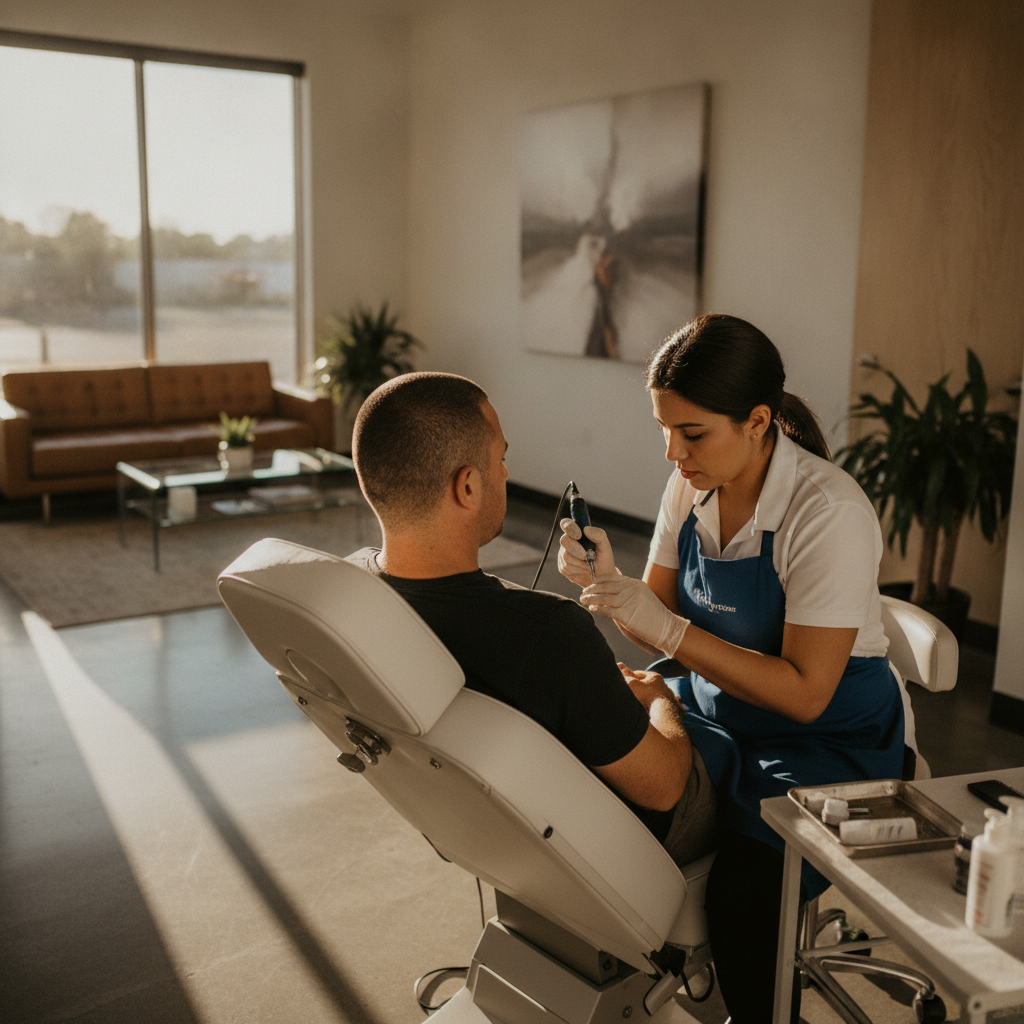

Can You Get SMP If You Have a Shaved Head and Want to Look Like You Have a Full Head of Stubble? What Stockton and Modesto Men Should Know About the Shaved-Head Look
Uncategorized8 min read

Can You Get SMP If You Have a Shaved Head and Want to Look Like You Have a Full Head of Stubble? What Stockton and Modesto Men Should Know About the Shaved-Head Look
Yes — and honestly, this is one of the most popular reasons men in Stockton and across the Central Valley come in for scalp micropigmentation. If you’ve been shaving your head to get ahead of your hair loss, you already know the look works. But you’ve also probably noticed the problem: patches where the skin shows through, an uneven tone across your scalp, or a hairline that’s completely disappeared. SMP fills in what’s missing, creating the appearance of a full, consistent stubble from front to back — so your shaved head looks intentional, dense, and clean rather than like hair loss you’re managing.
Why So Many Men Who Already Shave Still Feel Like Something Is Off
Shaving your head is a confident move. And for a lot of guys, it genuinely works — right up until you notice that the scalp skin in your crown looks noticeably different from your sides, or that your hairline has receded so far that there’s nothing left to frame your face. The shaved look is powerful when the whole picture comes together. When parts of your scalp are visibly bare while others still have stubble growth, the contrast is exactly what draws the eye — and not in the way you want.
That contrast is what scalp micropigmentation is designed to eliminate. SMP deposits tiny, precise pigment impressions into the scalp skin that replicate the look of individual hair follicles at the skin level. When done correctly, every part of your scalp — the crown, the temples, the hairline — reads as consistent, even stubble. The result isn’t a painted-on look. It’s texture. It’s depth. It’s the visual weight of a full head of closely shaved hair.
What Makes Full-Scalp SMP Different from Hairline Restoration
There’s an important distinction worth understanding before you book. If you still have significant hair on top and you’re dealing with a receding front hairline, your SMP session looks very different than if you’re covering a scalp that’s largely bare. Full-scalp SMP — the shaved-head look — is specifically designed for men who have little to no hair coverage across most or all of the scalp.
In a full-scalp treatment, the entire surface of the head is worked across multiple sessions. That includes rebuilding a hairline that makes sense for your face shape and age, blending the temples, covering the crown, and unifying the sides and back so everything reads as one cohesive, close-shaved style. It’s the most comprehensive form of SMP available, and it’s also the approach where results are most dramatic — because you’re not adding to something that’s already there. You’re creating the whole picture from scratch.
How the Session Structure Works for Full-Scalp Coverage
Most full-scalp SMP treatments are completed across two to three sessions, spaced roughly seven to fourteen days apart. The first session establishes the foundation — the base layer of pigment across the scalp and the initial hairline outline. It looks good after session one, but it’s intentionally softer. The second session builds depth and density, refining the hairline and adding dimension. A third session, when needed, is for fine-tuning: adjusting tone, sharpening edges, or addressing any areas that healed lighter than expected.
What surprises most men is how much better the results look as healing progresses between sessions. Pigment that looks slightly bold right after a session will soften and settle into a more natural tone as the skin heals. That’s a feature, not a flaw — it’s how a skilled artist calibrates the work to land exactly right once the healing is done.
What the Shaved-Head SMP Look Actually Requires From You
To maintain the shaved-head SMP look, you do need to keep your existing hair closely cropped — typically with a foil shaver or blade razor at a very low guard. The goal is to match your real hair growth to the pigment impressions, so everything blends seamlessly. If you let your hair grow out, the contrast between your natural hair texture and the flat pigment becomes noticeable. Most clients find this easy to maintain, especially in the Central Valley where the heat makes a close-shaved head genuinely comfortable during the long, hot summers.
Aftercare during the healing window matters here too. The Central Valley sun is no joke — particularly in Stockton, Manteca, and the surrounding area during summer months. Sun exposure too soon after a session can accelerate pigment fading and affect how evenly the work heals. For the first few weeks, keeping your scalp out of direct sun (or covered) goes a long way toward protecting your results long-term.
The Gap Competitors Aren’t Filling: Pigment Tone Matching for the Shaved-Head Look
Here’s something most SMP content — including what you’ll find on competitor websites — skims over almost entirely: the complexity of matching pigment tone to a shaved scalp. When your hair is long, there’s room for error because the natural hair provides visual camouflage. When your head is shaved, the pigment is the entire picture. Every dot needs to match the tone of your stubble, the undertone of your skin, and the way your scalp reads in natural light.
This is especially relevant in a diverse community like Stockton and the broader San Joaquin County, where clients come in with a wide range of skin tones, undertones, and natural hair colors. A pigment that looks right on paper can look ashy, blue, or unnatural if it’s not properly calibrated to your specific complexion. An experienced SMP artist works through a consultation process specifically to dial in that match — and they’ll adjust between sessions based on how your skin absorbs and heals pigment. It’s not a one-size formula. It’s precision work that depends on the artist knowing what they’re looking at.
That level of attention is exactly what separates a result that looks like natural stubble from one that looks like something was drawn on your head. If you’re comparing studios across the region — from Stockton to Modesto to Lodi to Tracy — the consultation process is one of the clearest signals of whether an artist truly understands what the shaved-head look requires.
How Does Cost Compare to Other Hair Loss Options?
Full-scalp SMP typically falls in the range of a few thousand dollars depending on the extent of coverage and number of sessions needed — significantly less than a hair transplant, which can run $10,000 or more and comes with surgical recovery time, scarring risk, and results that can still look uneven years later. It’s also a one-time investment rather than an ongoing expense like hair systems, fiber concealers, or medications you’d need to maintain indefinitely. For men in price-conscious communities across San Joaquin County and Stanislaus County, that permanence is a real advantage. Contact us to talk through what a full-scalp treatment would look like for your specific situation.
Frequently Asked Questions: Shaved-Head SMP in Stockton and the Central Valley
Do I have to shave my head completely before my SMP sessions?
For the shaved-head SMP look, yes — your existing hair should be as short as possible so the artist can accurately see the scalp and design the pigment work to match. Most clients shave down to skin or close to it before their first session.
Will my SMP look different in bright sunlight versus indoor lighting?
It shouldn’t, if the pigment tone is matched correctly. A well-executed shaved-head SMP should look natural in any lighting condition. This is exactly why pigment selection during your consultation matters so much — and why working with an experienced local artist beats rolling the dice on a cheap walk-in.
How often do I need to touch up the shaved-head SMP look?
Most clients return for a refresh every few years, depending on how their skin responds, sun exposure habits, and lifestyle. The Central Valley sun can accelerate fading if you spend a lot of time outdoors without scalp protection. A periodic touch-up keeps the look sharp and consistent.
Can SMP cover the transition between my shaved scalp and my beard or sideburns?
Yes. Part of the full-scalp SMP process includes blending the temples and hairline so the work connects naturally with your facial hair. When done well, it should look like one continuous, seamless stubble from your beard to your scalp.
Is Modesto or Stockton closer for my consultation if I’m in Stanislaus County?
Infusion SMP is based in Stockton and serves clients from across San Joaquin County, Stanislaus County, and the surrounding area — including Modesto, Tracy, Lodi, and Manteca. Many clients in Stanislaus County make the drive up the Highway 99 corridor for their sessions.
Ready to Stop Managing Your Hair Loss and Start Owning the Look?
If you’ve been shaving your head and wondering whether the finished picture could look sharper, fuller, and more intentional — it can. Reach out to Infusion SMP Scalp Micropigmentation in Stockton to book your free consultation. We’ll walk through your scalp, talk through what full-coverage SMP would look like for your specific tone and pattern, and give you a clear picture of what to expect before you ever sit in the chair. No pressure, no guesswork — just a real conversation about whether this is the right move for you.
Results vary. SMP is a cosmetic tattoo procedure, not a medical treatment, and does not regrow hair. Individual results depend on skin, scalp, hair and aftercare.