
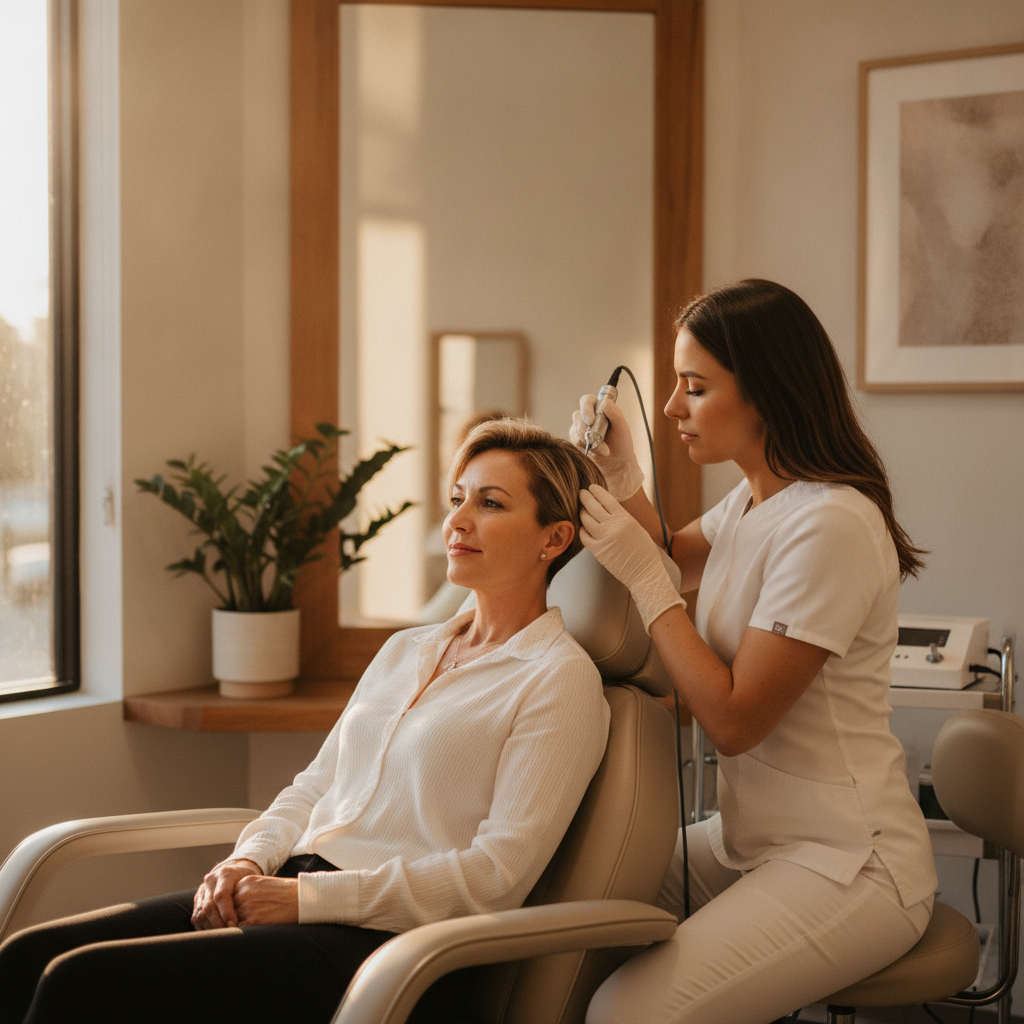

What Should Women Know About SMP for Thinning Hair? What Stockton and Elk Grove Women Should Know About Scalp Micropigmentation
Uncategorized8 min read

What Should Women Know About SMP for Thinning Hair? What Stockton and Elk Grove Women Should Know About Scalp Micropigmentation
If you’re a woman dealing with thinning hair, a widening part, or patches from alopecia, you already know that most of the conversation around hair loss treatments is aimed at men. Walk into almost any SMP studio’s website and you’ll see before-and-after photos of shaved male heads and receding hairlines. The resources for women are sparse, the before-and-afters are rare, and the questions you’re actually asking — “will it look natural with my existing hair?” “can it cover my part line?” “will anyone know?” — often go unanswered.
That gap is real, and it matters. Women in Stockton, Elk Grove, Modesto, and throughout the Central Valley are quietly losing hair every day — and many of them have no idea that scalp micropigmentation is even an option for them. This article is written specifically for you.
Female Hair Loss Is More Common Than You Think — And More Treatable Than You’ve Been Told
Hair loss in women tends to show up differently than it does in men. Rather than a receding hairline or bald crown, women typically experience diffuse thinning — hair that becomes gradually finer and sparser across the top of the scalp. The part line widens. The scalp becomes more visible under certain lighting. Ponytails look thinner. You start styling around it rather than with it.
This kind of thinning can be caused by genetics (female pattern hair loss), hormonal changes, thyroid issues, postpartum shedding, nutritional deficiencies, or autoimmune conditions like alopecia areata. Whatever the cause, the emotional weight is the same: you feel less like yourself, and you’re running out of tricks to hide it.
What SMP can do — when performed by an artist who understands how it works for women specifically — is restore the visual appearance of density. Not by adding real hair, but by adding pigment between your existing strands that mimics the look of hair follicles at the scalp level. Done correctly, it darkens the scalp so the contrast between skin and hair is reduced, making your hair look fuller without altering a single strand.
How SMP for Women Is Different from SMP for Men
This is the section most competitor studios skip entirely, and it’s one of the most important things to understand before you book a consultation anywhere.
SMP for women is not the same as the shaved-head look designed for men with complete baldness. For women, the goal is almost never to replicate a stubble aesthetic — it’s to add density and reduce scalp visibility while working around and beneath existing hair. That requires a different technique, a lighter hand, more precise pigment placement, and a practitioner who has actually worked on women’s scalps before.
Specifically, women’s SMP typically addresses:
- Diffuse thinning across the crown or top of the scalp — placing pigment throughout the thinning zone so the scalp is less visible through the hair
- Widening part lines — filling in the exposed scalp along the part so it looks naturally dense again
- Frontal hairline thinning — softening the appearance of a receding or sparse frontal hairline without creating an artificial edge
- Alopecia areata or totalis — covering patchy or complete hair loss with pigment that replicates the appearance of a close-cropped or natural scalp
- Postpartum or stress-related thinning — adding coverage to areas where hair has not fully grown back
The pigment used is typically lighter and more diffuse than in male SMP, blended to match your natural hair color and scalp tone. SMP for hair density enhancement is designed to work with what you have, not replace it — and in experienced hands, it’s genuinely undetectable.
What the Process Actually Looks Like for Women
Most women’s SMP treatments are completed across two to three sessions, spaced three to four weeks apart. The first session establishes the base layer of pigment across the treatment area. The second session adds depth, refines color, and addresses any areas that healed lighter than expected. A third session — if needed — fine-tunes everything and locks in the final result.
Each session typically runs one to three hours depending on the size of the area being treated. There’s no anesthesia required, though a topical numbing cream is often used to keep you comfortable. Most women describe the sensation as similar to light scratching or a mild sunburn — manageable, not dramatic.
Healing between sessions is straightforward: avoid direct sun exposure on the treated scalp, don’t scratch or pick as the area heals, and keep it moisturized. For women in Stockton and Elk Grove especially, the intense Central Valley heat and sun mean sun protection after treatment is non-negotiable — a wide-brimmed hat or SPF-rated head covering makes a real difference in how well the pigment sets and retains over time.
Results build progressively with each session, and by the final appointment, the difference is usually striking. Your hair looks fuller. Your part looks intentional. The scalp that used to catch you off guard in mirrors or photos is no longer the first thing you see.
Is SMP for Women Worth the Cost?
This is a fair and honest question, especially in a price-conscious market like the Central Valley. Women’s SMP pricing varies based on the size of the treatment area and how many sessions are needed, but it generally falls within the same range as other SMP treatments — typically between $1,500 and $3,500 for most cases. That’s a one-time investment in a result that, with basic care, can last years before a simple touch-up refresh is needed.
Compare that to the ongoing cost of volumizing products, toppers, hairpieces, or Minoxidil — all of which require consistent spending and deliver inconsistent results — and the math starts to shift. SMP doesn’t regrow hair. It won’t stop further loss. But it does give you back something that products rarely can: the ability to wake up in the morning and not think about it.
Women traveling from Sacramento, Tracy, or Modesto to visit Infusion SMP in Stockton often note that the drive is well worth avoiding the premium pricing of Bay Area clinics — and that finding a practitioner who has genuine experience with women’s SMP, rather than treating it as a footnote to their male-focused work, made all the difference. Learn more about what SMP involves and what makes the right practitioner the most important factor in your result.
Frequently Asked Questions: SMP for Women in Stockton and the Central Valley
Will SMP look natural if I still have hair on top?
Yes — when done correctly, that’s the entire point. The pigment is placed beneath and between your existing hair at the scalp level, reducing the visible contrast that makes thinning look so apparent. Your stylist, your partner, and your coworkers won’t know. They’ll just notice your hair looks fuller.
Can SMP cover alopecia patches without shaving my head?
For alopecia areata — patchy hair loss — SMP can be placed within the smooth, hairless patches to mimic the appearance of natural follicles and reduce their visibility significantly. You don’t need to shave surrounding hair for this to work. For more extensive alopecia totalis, the approach shifts and your practitioner will walk you through what’s realistic at your consultation.
How long does women’s SMP last?
Results typically last three to five years before a touch-up is needed, depending on your skin type, sun exposure, and aftercare habits. Women with oily skin or those who spend significant time outdoors — common in Central Valley agriculture and outdoor healthcare settings — may find they need a refresh a bit sooner. Consistent SPF protection extends pigment life considerably.
Is Stockton a good location to get women’s SMP, or should I go to Sacramento?
Stockton is an excellent option, particularly for women in San Joaquin County, Tracy, Elk Grove, and even Sacramento who want to work with a local practitioner rather than commuting into a larger city. What matters far more than location is the artist’s specific experience with female hair loss patterns — ask to see before-and-after photos of women’s work specifically before you commit to anyone.
What if my hair loss is still progressing?
Many women choose SMP even while their hair loss is ongoing, because waiting for stabilization can mean years of unnecessary self-consciousness. SMP can be adjusted and refreshed as your hair changes over time. It’s not a one-and-done decision for life — it’s a living solution that can grow with you.
You Deserve to Feel Like Yourself Again
Hair loss is personal. For women especially, it touches on identity, confidence, and the quiet exhaustion of hiding something that feels shameful when it isn’t. SMP won’t fix what’s happening beneath the surface — but it can restore what you see, and that matters more than most people outside of this experience will ever understand.
If you’re in Stockton, Elk Grove, Sacramento, or anywhere in the Central Valley and you’re ready to have an honest conversation about your options, Infusion SMP Scalp Micropigmentation is here for it. No pressure, no overselling — just a real consultation where you can ask every question you’ve been holding onto.
Reach out today to schedule your free consultation and find out what SMP can realistically do for your hair and your confidence. You’ve been patient long enough.
Results vary. SMP is a cosmetic tattoo procedure, not a medical treatment, and does not regrow hair. Individual results depend on skin, scalp, hair and aftercare.