

Is SMP a Good Option for a Receding Crown or Thinning on Top? What Stockton and Elk Grove Men Should Know
Uncategorized8 min read

Is SMP a Good Option for a Receding Crown or Thinning on Top? What Stockton and Elk Grove Men Should Know
Yes — scalp micropigmentation works exceptionally well for crown thinning and vertex hair loss, and it’s one of the most underappreciated applications of the procedure. If you’re a man in Stockton, Elk Grove, or anywhere across the Central Valley who’s watching the back of your head gradually thin out in photos or catching yourself angling away from overhead lighting, SMP can give you back the appearance of a full, dense scalp without surgery, downtime, or a lifetime of medication. The key is understanding exactly how it works for the crown specifically — because the crown presents unique challenges that not every SMP artist handles well.
Why Crown Thinning Is Different from a Receding Hairline
Most conversations about hair loss focus on the hairline — the front edge that frames your face. And that makes sense, because a receding hairline is what people notice first when they look at you directly. But crown thinning is its own frustrating experience. It often starts subtly — a little more scalp visible in photos, a slightly wider part, a thinning patch that your barber starts working around rather than through. You might not even see it yourself until someone else points it out or you catch a glimpse in a rear-facing camera.
Crown thinning also tends to progress differently than frontal recession. It spreads outward in a circular or diffuse pattern, and for men with pattern baldness (androgenetic alopecia), it often converges with a receding hairline to create that classic horseshoe shape over time. Knowing where you are in that process — and where you’re likely headed — matters when planning your SMP treatment.
How SMP Actually Works for the Crown
Scalp micropigmentation for crown thinning falls into two broad categories, depending on how much hair you still have on top.
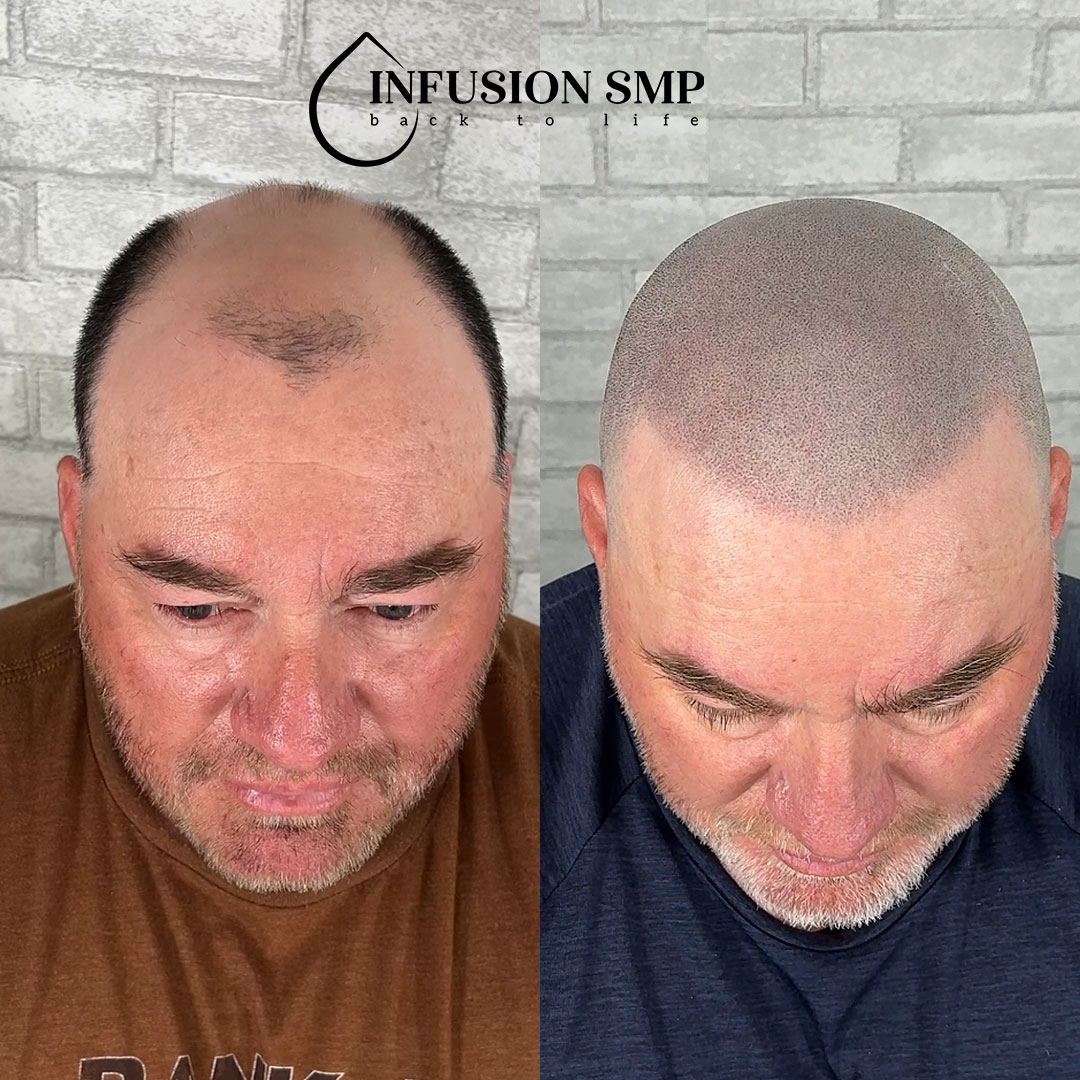
If you’re in the early-to-mid stages of thinning — meaning you still have a good amount of hair but the scalp is becoming visible through it — the goal is density enhancement. The SMP artist places tiny pigment impressions between your existing follicles to reduce the visible contrast between hair and scalp. The result isn’t more hair; it’s less visible scalp. When done correctly, it makes your existing hair look significantly thicker and fuller. You keep your natural hair, and nobody can tell what happened — they just notice your hair looks better. Learn more about how density enhancement works here.
If you’re further along — say, a Norwood 5 or 6 with a large open crown and minimal remaining hair — SMP for the crown typically becomes part of a full-scalp or shaved-head treatment. In this case, the entire crown is treated to replicate the look of a closely shaved head, with consistent dot pattern and tone across the whole scalp. The crown, the top, the sides — everything is blended into a unified, clean look that reads as a deliberate style choice rather than hair loss.
The Crown Thinning Challenge Competitors Rarely Talk About
Here’s something most SMP studios don’t explain clearly: the crown is technically one of the harder areas to treat well, and the reason comes down to light, angle, and the circular growth pattern of hair follicles.
Hair at the crown grows in a spiral or whorl pattern, radiating outward from a central point. This means the angle of pigment placement — how each impression is oriented — has to follow that natural radial pattern to look realistic. If an artist just lays down a uniform grid of dots without accounting for the whorl, the crown can look flat or artificial, particularly under direct overhead lighting. This is the kind of technical detail that separates an experienced SMP artist from someone who learned the basics and stopped there.
It also means your consultation matters a great deal. Any artist worth working with should walk you through how they’ll approach your specific crown pattern, show you examples of crown work specifically (not just hairlines), and explain how the treatment plan accounts for any potential future progression in your hair loss.
What to Expect Across Your Sessions
Crown SMP, like all SMP work, is typically completed across two to three sessions spaced a few weeks apart. The first session lays the foundational layer — lighter, more conservative. By the second session, the artist deepens and refines the tone to match your scalp and hair color. The third session, if needed, is about dialing in final detail and making sure everything looks seamless.
One thing people are often surprised by: the results keep getting better between sessions. As the initial pigment settles and the scalp heals, the impressions soften slightly and start to look more like natural follicles. Most clients say the third-session result looks significantly more natural than what they saw leaving the first appointment — and that’s by design.
For men in Stockton and Tracy who work outdoors or in physically demanding jobs, it’s worth knowing that aftercare during the healing period includes sun avoidance and keeping the scalp clean and moisturized. The Central Valley heat is real, and protecting fresh pigment from direct UV exposure in those first few weeks is genuinely important for long-term color retention. Your artist should walk you through exactly what that looks like for your lifestyle.
How SMP Compares to Other Crown Thinning Treatments
You’ve probably looked into the alternatives. Here’s an honest comparison:
- Hair transplants can restore coverage to the crown, but donor supply is limited, results in the crown area are often less predictable, and the cost typically runs $10,000 or more. Recovery time is weeks, not days.
- Minoxidil and finasteride may slow crown thinning for some men, but they rarely reverse it significantly, require ongoing use, and come with potential side effects that not everyone tolerates.
- Hair fibers and concealers work as a temporary fix but require daily application, come off in water and sweat, and look unconvincing up close — not ideal for active men in the Central Valley heat.
- SMP is permanent (with occasional maintenance touch-ups), looks natural in all lighting, requires no daily upkeep, and costs a fraction of surgical options — typically ranging from around $1,500 to $4,000 depending on the extent of coverage needed.
For men who are tired of working around their hair loss every morning and want a solution they don’t have to think about, SMP is consistently the most low-maintenance path forward. Get a full overview of the SMP process here.
Frequently Asked Questions About SMP for Crown Thinning
Can SMP blend with the hair I still have on top?
Yes. This is actually one of the most common applications. For men with thinning at the crown who still have surrounding hair, SMP is placed within the thinning area to reduce scalp visibility and create the appearance of density. The pigment is matched to your existing hair color, and the impressions are sized and spaced to blend naturally with real follicles.
Will the crown look unnatural if I let my hair grow out a little?
Not if the work is done correctly. A skilled SMP artist will account for how your hair lays and grows around the crown area, and the pigment tone will be matched to your hair color at a natural length. That said, the cleanest, most seamless look is typically at a very short-cropped or shaved length — especially for men with more advanced crown thinning.
Is the crown more painful than other areas during SMP?
Sensitivity varies from person to person, but the crown is generally one of the more comfortable areas to treat. The top and vertex of the scalp tend to have more tissue cushion than the sides or nape. Most clients describe the sensation as mild and manageable throughout.
I’m in Elk Grove — do I have to come all the way to Stockton for treatment?
Infusion SMP is based in Stockton, and it’s an easy drive from Elk Grove, Modesto, or Tracy — typically well under an hour. Many clients from Sacramento County, including Elk Grove, make the trip specifically because they want experienced local work rather than a franchise clinic. The commute is a small trade-off for results you’ll have for years.
What if my crown thinning gets worse after I get SMP?
This is exactly why your consultation matters. A good SMP artist will design the treatment with your likely hair loss progression in mind, so future thinning can be accommodated without the existing work looking out of place. Periodic touch-ups over the years can also keep pace with any changes in coverage needs.
Ready to Stop Hiding Your Crown?
Crown thinning has a way of quietly chipping away at how you feel about yourself — in photos, in meetings, every time you walk past a mirror in bright light. You don’t have to keep working around it. Scalp micropigmentation is a proven, permanent solution that thousands of men have used to reclaim exactly this kind of confidence, and it’s available right here in the Central Valley.
At Infusion SMP Scalp Micropigmentation in Stockton, we work with clients throughout San Joaquin County, Sacramento County, and beyond to create results that look natural, hold up over time, and fit your life — not just your hairline. Reach out today to schedule your free consultation and find out exactly what SMP can do for your crown.
Results vary. SMP is a cosmetic tattoo procedure, not a medical treatment, and does not regrow hair. Individual results depend on skin, scalp, hair and aftercare.