
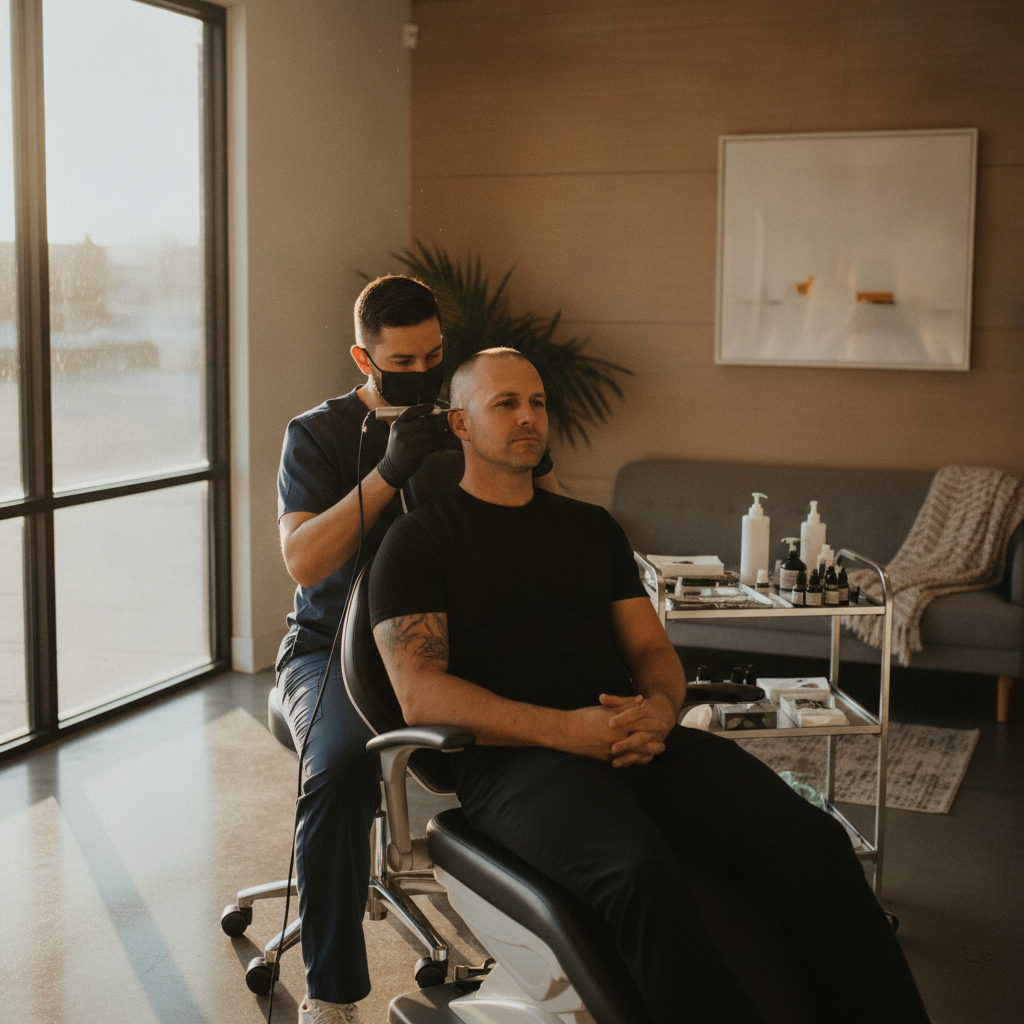

What Should You Know About SMP if You’re a First Responder, Veteran, or Military Member in Stockton?
Uncategorized8 min read

What Should You Know About SMP if You’re a First Responder, Veteran, or Military Member in Stockton?
If you’re a firefighter with the Stockton Fire Department, a San Joaquin County sheriff’s deputy, an Army veteran who came home to the Central Valley, or an active-duty service member stationed nearby — and you’re dealing with hair loss — scalp micropigmentation might be the most practical decision you make this year. Not because it’s trendy. Because it’s built for the kind of life you actually live. No daily products to remember, no hairpiece to maintain, no surgery to recover from. Just a clean, sharp look that holds up shift after shift, deployment after deployment, and through every scorching Central Valley summer in between.
Why Hair Loss Hits Differently When Your Job Is High-Stakes
Hair loss isn’t just a cosmetic issue. For a lot of men and women in high-pressure professions — law enforcement, firefighting, emergency medical services, the military — it carries a specific kind of weight. You’re expected to project confidence and authority every single day. When you look in the mirror and see a hairline that’s receded or a crown that’s thinning, it can quietly chip away at the way you carry yourself, even when you’d never admit it out loud.
Add to that the fact that stress is one of the most underappreciated drivers of accelerated hair loss. High-cortisol careers — the ones that involve irregular sleep, physical strain, adrenaline spikes, and the cumulative emotional toll of service — are genuinely hard on your hair follicles. Many veterans and first responders notice their hair loss progressing faster than their peers who work desk jobs. If that sounds familiar, you’re not imagining it.
Scalp micropigmentation doesn’t stop that underlying process, but it gives you back the appearance of a full, defined head of hair — and it does it in a way that requires almost nothing from you once the sessions are done.
The Low-Maintenance Factor Is Real — And It Matters for Your Lifestyle
This is the angle that competitor studios across Sacramento and the broader Central Valley almost never talk about specifically for first responders and veterans. Most SMP content focuses on how the results look. That matters. But for someone working 24-hour shifts, rotating schedules, or preparing for deployment, what matters just as much is how little you have to think about it afterward.
With SMP, there are no products to apply each morning. No hair fibers that wash out or smear under a helmet. No hairpiece that shifts when you’re physically active. Once your sessions are complete and your scalp has healed, the look is simply there — consistent, durable, and unaffected by the demands of your day.
For firefighters who wear structural helmets for hours at a time, that matters. For law enforcement officers who can’t afford distractions, that matters. For veterans re-entering civilian life and wanting to look sharp without adding complexity to an already demanding transition, that matters enormously.
What the Process Actually Looks Like — And Why the Timing Works Around Your Schedule
SMP is typically completed across two to three sessions, spaced roughly seven to fourteen days apart. Each session runs a few hours depending on the area being treated. The healing between sessions is minimal — some light redness and fading in the first few days, but nothing that sidelines you from work or daily life in a significant way. Most clients from Tracy, Manteca, and Lodi are back to their normal routines within a day or two of each session.
The results build progressively. After the first session, you’ll see the foundation. After the second, the depth and definition come in. By the third session — if one is needed — you’re looking at the finished result. Realistic, natural, and proportioned to your face and head shape. The goal is never to give you a hairline that belongs on a 19-year-old recruit. It’s to give you one that looks right for who you are now.
Central Valley Heat and Scalp Healing: What to Know Before You Book
Living and working in the Central Valley means you’re dealing with heat that Sacramento-based studios don’t always account for when they talk about aftercare. Summers in Stockton and the surrounding San Joaquin County area can push well past 100 degrees, and that has real implications for your healing scalp in the weeks after each session.
Direct sun exposure on a freshly treated scalp can cause pigment to fade prematurely and slow the healing process. If your job puts you outside in that heat — construction, outdoor patrol, agricultural work — timing your sessions during a cooler stretch of the year, or planning a brief stretch of indoor recovery, is worth thinking about. Your artist will walk you through the specific aftercare steps that protect your results, including keeping the scalp moisturized and out of direct sun during healing windows.
This is especially relevant for Modesto-area clients and those commuting along the Highway 99 corridor, where outdoor exposure is a daily reality for a large portion of the workforce.
Scar Coverage for Veterans: A Use Case Competitors Rarely Address
Some veterans come in not just for hair loss coverage, but for scar camouflage — whether that’s from a previous hair transplant that left a linear FUT scar, or from injury. SMP can be applied directly into scar tissue to blend it with the surrounding scalp, making it effectively invisible at normal social distances.
This is delicate, skilled work. Scar tissue holds pigment differently than healthy scalp skin, which is why choosing an experienced artist matters. When done well, the scar disappears into the surrounding texture and no one — not a colleague, not a partner, not anyone — can pick it out from the rest of the scalp.
If you’ve been carrying a scar you’ve been self-conscious about for years, it’s worth having a conversation about whether a consultation makes sense for you.
Frequently Asked Questions
Can I get SMP while I’m still on active duty or working full shifts as a first responder?
Yes. The sessions themselves are a few hours each, and the downtime between them is minimal. Most clients return to work the next day. You’ll want to avoid heavy sweating and direct sun exposure on the treated scalp for a few days after each session, but this is manageable even with a demanding schedule.
Will SMP hold up under a helmet or hat worn daily?
Once fully healed, SMP is not affected by wearing hats, helmets, or headgear. During the initial healing period — roughly the first four or five days after each session — you’ll want to keep the scalp free from friction and covered clothing, but that window is short.
Is SMP a permanent solution, or will I need to keep coming back?
SMP is a long-term solution. Most clients see their results last several years before needing a touch-up session to refresh any areas where pigment has faded. It is not a monthly commitment like hair fibers or a hairpiece. The touch-up timeline varies by skin type, lifestyle, and sun exposure — your artist will give you a realistic picture during your consultation.
I’m a veteran who had a hair transplant that left a scar. Can SMP cover that?
Yes. Scar camouflage is one of the most common reasons veterans and men who’ve had prior hair restoration procedures seek out SMP. Pigment is worked into and around the scar tissue to match the surrounding scalp tone and blend the scar into the overall look. Results vary based on scar type and age, but most scars can be significantly reduced in visibility.
How does SMP compare in cost to other options like a hair transplant or ongoing medication?
Hair transplants typically run $10,000 or more, require significant recovery time, and don’t always deliver the density clients hope for. Ongoing medication requires a monthly commitment with no guaranteed results and potential side effects. SMP is generally completed for a fraction of the cost of a transplant, with no recovery, no ongoing prescriptions, and results you can see clearly after the first session. For more on how pricing works, visit the SMP service page or reach out for a free consultation.
Ready to See What SMP Can Do for You?
At Infusion SMP Scalp Micropigmentation in Stockton, we work with clients from across San Joaquin County — including Tracy, Manteca, Lodi, and Modesto — who are done settling for temporary fixes and want results that fit their actual lives. If you’re a first responder, veteran, or military member who’s been thinking about this for a while and just wants a straight answer from someone who knows what they’re doing, we’d love to talk.
Reach out through our contact page to book a free consultation. No pressure, no sales pitch — just an honest conversation about what SMP can do for you and whether it’s the right fit.
Results vary. SMP is a cosmetic tattoo procedure, not a medical treatment, and does not regrow hair. Individual results depend on skin, scalp, hair and aftercare.