
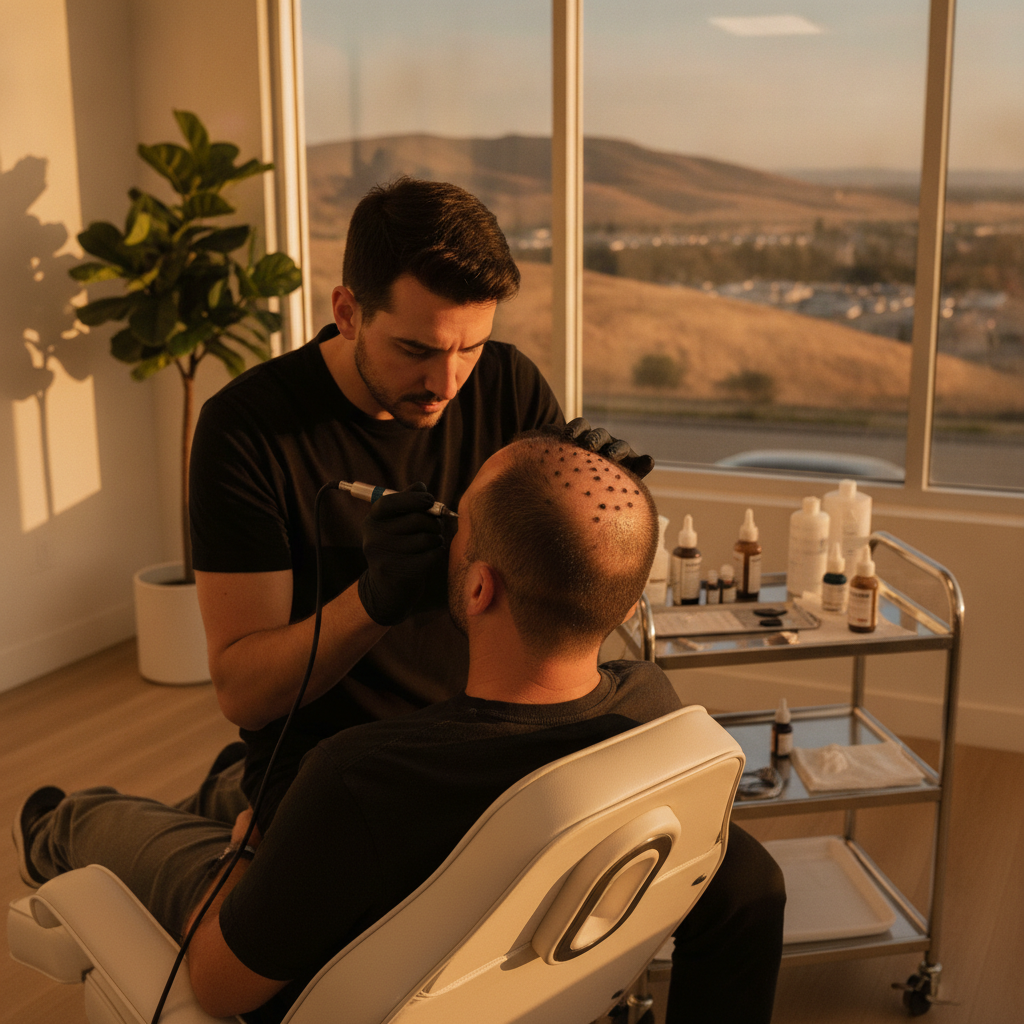

Can SMP Help If You Have a FUE Hair Transplant That Didn’t Give You the Density You Were Hoping For? What Stockton and Sacramento Men Should Know
Uncategorized8 min read

Can SMP Help If You Have a FUE Hair Transplant That Didn’t Give You the Density You Were Hoping For? What Stockton and Sacramento Men Should Know
Yes — and you’re far from alone in asking this question. A hair transplant that falls short of its promised density is one of the most quietly common disappointments in the hair restoration world, and it’s something that men across Stockton, Sacramento, and the broader Central Valley are living with right now. If your FUE procedure left you with results that look thin, patchy, or just not as full as the before-and-after photos you were shown, scalp micropigmentation can be a genuinely effective way to close that gap — without another surgery, without more recovery time, and without draining your savings a second time.
Why FUE Transplants Sometimes Don’t Deliver the Density You Expected
FUE (Follicular Unit Extraction) is real surgery with real limitations, and not every clinic in California is upfront about those limitations before you sign the paperwork. The honest truth is that transplanted follicles don’t all survive. Depending on the surgeon, the technique, your donor density, and your scalp’s response to the procedure, you might end up with 60 to 80 percent of the grafts actually taking — sometimes less. When you do the math, that can mean thousands of dollars spent on a result that still looks noticeably thin under bright light or when your hair is wet.
Add to that the fact that many men who pursue FUE are still losing native hair around and behind the transplanted zone. So even if your grafts took well a few years ago, the hair surrounding them may have continued thinning — leaving the restored hairline sitting in front of a scalp that now looks sparser than ever. It’s a frustrating position to be in, and it doesn’t mean the transplant was a failure. It means hair loss is progressive, and a one-time surgical solution often needs reinforcement over time.
What SMP Actually Does for a Transplant That Underdelivered
Scalp micropigmentation doesn’t grow hair and doesn’t claim to. What it does is deposit precise, layered pigment dots into the scalp that replicate the appearance of hair follicles — the tiny dark impressions of closely cropped stubble. When placed between and around existing transplanted hairs, those pigment dots visually fill in the gaps. Your eye perceives density because the contrast between pale scalp and what looks like stubble disappears.
For men with an FUE result that’s just too thin — where you can clearly see scalp between hair groupings, especially under overhead lighting — SMP bridges that visual gap in a way that no topical product, no fiber spray, and no second surgery can replicate with the same consistency. The result, done well, looks like you have a full, closely shaved or naturally dense head of hair. It doesn’t look tattooed. It doesn’t look like a workaround. It looks like your hair.
This is also where working with a skilled local SMP artist matters enormously. The pigment dots placed around transplanted follicles need to match your existing hair color, your skin tone, and the direction and spacing of your natural growth pattern. That’s not a job for a generic national franchise or someone working off a template. Learn more about how SMP works as a standalone and complementary solution here.
Can SMP Also Cover the Extraction Dots Left Behind by FUE?
This is a question most Sacramento-area competitor sites don’t address clearly — and it’s one worth answering directly. FUE procedures leave small circular extraction scars across the donor area at the back and sides of the scalp. In most cases these are small enough that they’re unnoticeable. But in men with lighter skin, a tightly shaved head, or higher-density extraction, those dots can create a visible pattern of pale circular marks — sometimes called the “polka dot” effect — that contrast against the surrounding scalp.
SMP can address those extraction marks as part of a scar camouflage treatment. Pigment is worked into the scarred areas to blend them with the surrounding scalp tone, reducing the visual contrast and making the extraction zone look consistent with the rest of the head. If your FUE left you with a donor area you’re self-conscious about, that’s something worth talking through during a consultation.
What the Process Looks Like When You Combine SMP with an Existing Transplant
The process for adding SMP on top of an FUE result is similar to a standard SMP treatment, but it requires extra precision. Your SMP artist needs to work carefully around existing grafts — avoiding direct contact with healthy follicles while still placing pigment close enough to create visual density. This takes skill and experience, and it’s exactly the kind of nuanced work you want to vet before booking with any provider.
Typically, this type of treatment happens across two to three sessions spaced a few weeks apart. The first session establishes the base tone and density. The second refines and builds. By the final session, you have a layered result that heals into a natural-looking, consistent appearance. The Central Valley’s warm, dry climate means your scalp will likely need some deliberate aftercare — especially sun protection during the healing weeks — to ensure pigment sets evenly and doesn’t fade faster than expected.
In terms of investment, SMP in this context typically falls in a range well below what you spent on your original transplant. When you’re comparing what another $10,000-plus surgical procedure would cost — with recovery, risk, and no guarantee of better density — a non-surgical SMP treatment starts to look like the clear-headed, practical choice. See how SMP creates the appearance of density for thinning hair of all types.
What to Expect If You’re Coming from Tracy, Lodi, or Modesto
Many of the men we work with at Infusion SMP have already made one expensive trip — sometimes to a clinic in Sacramento, the Bay Area, or even out of state — for a transplant that didn’t give them what they were promised. They drive in from Tracy, Lodi, Modesto, and all across San Joaquin County, and by the time they reach us, they’re done with procedures that require weeks of downtime and uncertain outcomes. SMP, by comparison, is straightforward. You come in, you sit for a session, and you go home looking incrementally better each time — with no stitches, no donor harvesting, and no months of waiting to see whether anything took.
If you’ve already invested in an FUE and want to protect and enhance that investment rather than walk away from it, SMP is worth a serious conversation — not a sales pitch, just an honest look at what’s possible for your specific situation.
Frequently Asked Questions
How long should I wait after an FUE transplant before getting SMP?
Most SMP artists recommend waiting at least 12 months after your transplant before adding SMP. This gives your grafts time to fully mature and your scalp time to stabilize so the artist can accurately assess what density you’re actually working with — not what’s still in a transitional growth phase.
Will the SMP needles damage my transplanted follicles?
When performed by an experienced SMP artist, the needles used are extremely fine and work at a shallow depth — well above the follicle root. The risk of damaging healthy, established grafts is minimal when the artist knows what they’re doing. This is one of many reasons why choosing a skilled, experienced provider matters.
Can SMP make my FUE result look like a full head of hair, or just less thin?
That depends on where you’re starting from. For men with moderate thinning or patchy density, SMP can create a result that genuinely looks like a full, closely cropped head of hair. For more advanced cases, it creates a dramatically improved appearance — denser, more consistent, and far more confident-looking than before. Your artist will give you an honest read during your consultation.
I live in Sacramento County — is it worth driving to Stockton for this?
Clients come to us from Sacramento, Elk Grove, and surrounding Sacramento County regularly, often because they want an artist with specific experience in post-transplant SMP rather than a general provider. The drive down I-5 or Highway 99 is worth it if the artist is the right fit for your situation.
What if my transplant scar from an older FUT procedure is also visible — can that be treated at the same time?
Yes. If you have a linear FUT scar in addition to FUE extraction dots, scar camouflage can be incorporated into your treatment plan. Both types of scarring respond well to SMP when the pigment is matched carefully to your surrounding scalp tone.
Ready to See What’s Actually Possible for Your Scalp?
If your FUE transplant left you underwhelmed — and you’re tired of standing in the right light just to look like it worked — you deserve an honest conversation about what SMP can realistically do for you. At Infusion SMP Scalp Micropigmentation in Stockton, we work with men who’ve been through hair restoration procedures and want real, lasting results they can count on without another round of surgery or recovery. Reach out to us here to schedule your free consultation and let’s talk through your specific situation. No pressure, no sales pitch — just clarity on what comes next.
Results vary. SMP is a cosmetic tattoo procedure, not a medical treatment, and does not regrow hair. Individual results depend on skin, scalp, hair and aftercare.