
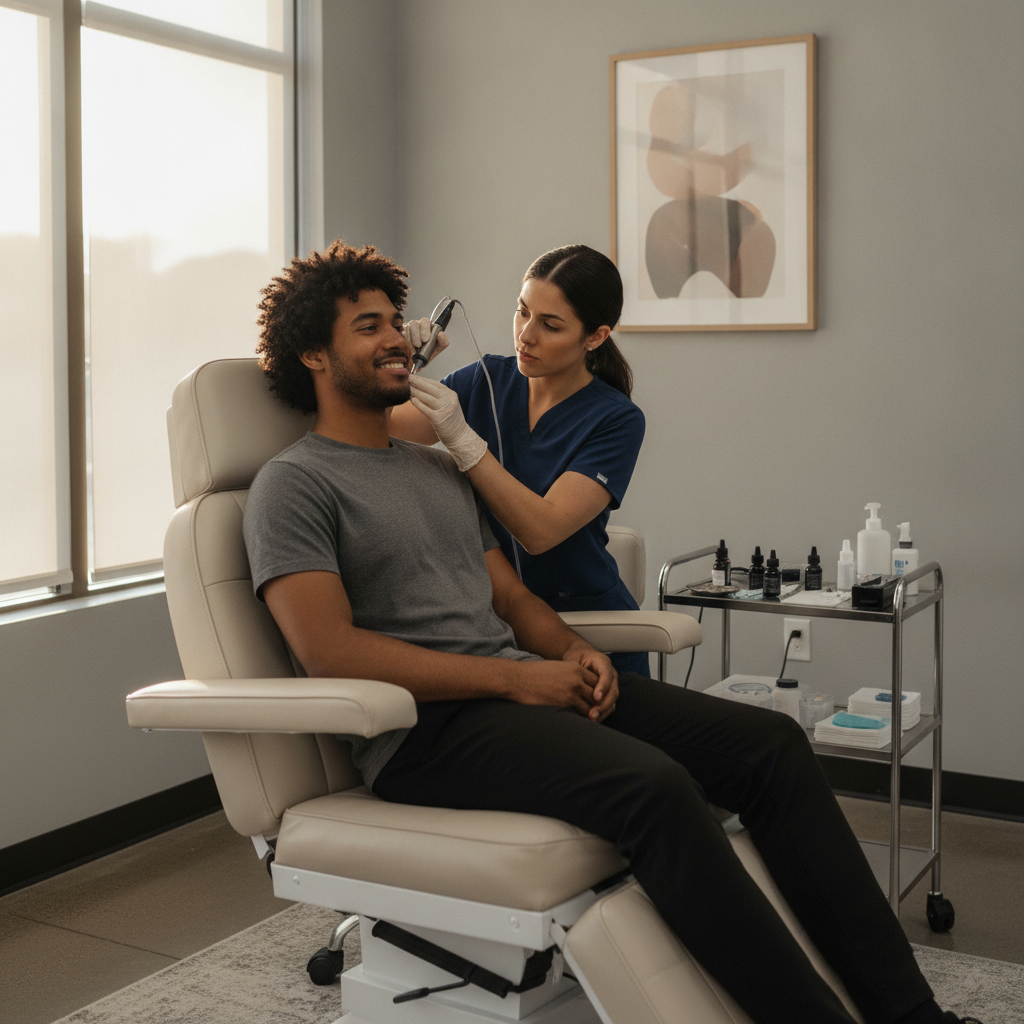
Can You Get SMP If You Have Curly or Textured Hair? What Stockton Clients with Natural Hair Should Know
Yes — scalp micropigmentation absolutely works on curly, coily, and wavy hair. In fact, for many clients with textured hair, SMP can look even more seamless than it does on straight hair, because the natural variation of coily follicle patterns blends beautifully with realistic pigment dots. But here’s the catch: SMP only looks right on textured hair when the artist truly understands how to match the technique to your specific hair type. If you’re in Stockton — or coming in from Manteca, Modesto, or Tracy — and you’ve been wondering whether SMP will actually look natural on you, this article is worth reading before you book anything.
Why Textured Hair Is Actually an Advantage for SMP
Most people assume that SMP is designed for men with short, straight hair who want a clean shaved look. That’s one use case, but it’s far from the only one. For clients with curly or coily hair, the natural texture of each strand creates a follicle opening at the scalp surface that looks distinctly different from a straight-hair follicle. Instead of a simple round dot, the follicle appears slightly irregular, with more visual depth and dimension.
A skilled SMP artist who understands textured hair will replicate that look by varying the pressure, needle angle, and dot shape they use during each impression. The result is a field of pigment deposits that mirrors the way your real follicles actually look — not a stamped grid of uniform dots that looks artificial in any light. That subtle variation is exactly what separates SMP that looks real from SMP that looks like a stencil.
The natural volume and density of curly or wavy hair also works in your favor when the goal is density enhancement rather than the shaved-head look. If you still have some natural hair growth but it’s thinning at the crown, the temples, or along the part line, SMP for hair density adds the impression of fuller coverage that blends almost invisibly into your existing curls. Clients who’ve tried fibers or thickening sprays know how limiting those products are — especially in Central Valley heat, where sweat and humidity can betray those cover-ups within hours. SMP doesn’t wash out. It doesn’t transfer onto your pillow or your collar. It’s there every morning when you wake up.
The Technique Has to Match Your Follicle Shape — Not Just Your Skin Tone
One of the biggest gaps in how competitor studios approach this topic is that they treat SMP for textured hair as purely a pigment-matching issue. They talk about matching darker skin tones, which matters — but that’s only half the equation. The other half is follicle shape replication.
Coily and kinky hair follicles curve beneath the scalp surface, which gives the follicle opening a unique visual signature. When you look closely at a freshly shaved scalp with tight coils, those dots aren’t perfectly round — they have a slight crescent quality, a shadow that curves. An artist who only knows how to place uniform circular impressions will create pigment work that looks subtly off to anyone who knows what to look for. It won’t look bad from across the room, but it won’t look completely real up close either.
At Infusion SMP in Stockton, the consultation process is where this matters most. Before any pigment is placed, you’ll discuss your hair texture, natural density patterns, growth direction, and what outcome you’re actually trying to achieve. That conversation shapes everything — from needle selection to the hairline design to how the crown is treated versus the temples.
What About Hairline Design for Natural Hair?
Hairline design is one of the most important and personal parts of any SMP treatment, and it deserves special attention when your hair is textured. Men and women with coily or wavy hair often have naturally softer, less geometric hairlines than clients with straight hair — and that needs to be reflected in how the SMP hairline is drawn.
A rigid, ruler-straight hairline that might look clean on certain hair types can look completely out of place on someone with natural hair. The SMP hairline should follow the natural arc of your existing recession, frame your face proportionally, and match the visual weight of your hair texture. If you’re coming in for hairline restoration specifically — recapturing a hairline that’s been retreating over the years — the goal isn’t to give you the hairline of a 19-year-old. It’s to give you one that looks credible, age-appropriate, and genuinely yours.
You can learn more about what to expect from the full SMP process on our scalp micropigmentation service page — but the short version is that most clients complete their treatment over two to three sessions, spaced several weeks apart. Each session allows the pigment to settle, and the results tend to look progressively more natural as healing progresses.
SMP for Women with Textured or Natural Hair
This is a topic that almost no competitor in the Sacramento-to-Stockton corridor addresses with any real depth, and it’s worth saying clearly: SMP works for women with textured hair too. Women experiencing diffuse thinning across the scalp, a widening part line, or patchy loss from alopecia areata — these are all situations where SMP can make a meaningful difference without requiring anyone to shave their head.
For women with natural hair who wear their hair in locs, twists, buns, or natural styles that expose the scalp, thinning at the part or crown can feel especially visible and frustrating. SMP fills in those gaps with pigment that matches the surrounding scalp color and mimics the look of denser follicle coverage. When your hair sits on top of it, the overall impression is of fuller, thicker hair — not a scalp that’s fighting a losing battle.
If you’re a woman in Lodi, Tracy, or anywhere in San Joaquin County who’s been dealing with hair loss and feels like your options are limited, a free consultation is the best place to start. There’s no obligation, and it’s the only way to get advice that’s actually based on your specific hair type, loss pattern, and goals.
What to Ask Before You Book with Any SMP Studio
If you’re comparing studios — whether in Stockton or considering a trip to Sacramento or Modesto — there are a few questions worth asking any SMP artist before you commit, especially if your hair is textured:
- Can you show me portfolio work specifically on clients with curly, coily, or natural hair? Not stock photos — real client results, ideally close-up shots in multiple lighting conditions.
- How do you adjust your technique for coily or kinky follicle shapes? An artist who can explain this specifically knows what they’re doing. One who gives you a vague or generic answer may not have the experience your hair type requires.
- How do you approach hairline design for natural hair clients? The answer should include something about facial proportions, existing hairline recession, and texture-appropriate softness — not just “we draw it where you want it.”
- What pigment shades do you work with for deeper skin tones? Pigment selection for Fitzpatrick types IV through VI requires a different approach than lighter skin, and a qualified artist will have a clear answer.
Stanislaus County and San Joaquin County are home to some of the most diverse communities in California. A good SMP artist in this region should have real experience with a wide range of skin tones and hair textures — not just the client types that show up most often in before-and-after galleries from national franchise clinics.
Frequently Asked Questions
Will the pigment match my dark skin tone?
Yes — pigment color-matching for deeper skin tones is a standard part of the SMP consultation process. Your artist should mix or select a shade that closely matches your natural scalp color, and for clients with melanin-rich skin, that often means working with a warmer, darker pigment base that reads as real follicle shadow rather than ink.
Can SMP be done on a scalp with tight curls without shaving?
It depends on the treatment goal. For density work where you’re keeping your existing hair, shaving isn’t required — the SMP adds pigment beneath your existing hair growth. For the full shaved-head look, you would maintain a closely shaved head going forward, which allows the pigment to show as part of a consistent stubble aesthetic.
Does SMP on coily hair require any special aftercare?
The core aftercare is the same regardless of hair texture: keep the scalp out of direct sun during initial healing, avoid heavy sweating for the first few days, don’t scratch or pick at the treated area, and keep the scalp moisturized once healing is complete. In Central Valley summers, sun protection matters year-round — UV exposure is one of the main reasons pigment fades faster than it should, and Stockton’s climate means that’s a real factor to plan around.
I’ve had bad experiences with artists who didn’t understand my hair type. How is this different?
That’s a completely valid concern, and it’s exactly why the consultation matters. Before any pigment is placed, you should feel confident that your artist has worked with clients whose hair texture and skin tone match yours — and that they can show you the results to prove it. If something feels off during the consultation, trust that instinct.
How much does SMP cost for textured or natural hair clients?
The treatment scope — not the hair texture — is what primarily drives cost. A full scalp treatment typically runs differently than targeted hairline or density work. SMP generally ranges from around $1,500 to $4,000 depending on the area being treated and the number of sessions needed. That’s a very different conversation than a hair transplant at $10,000 or more, or the ongoing monthly cost of hair systems that need constant maintenance. For specific pricing based on your situation, reach out for a free consultation — that’s the only way to get a number that’s actually relevant to you.
Ready to See What SMP Can Do for Your Hair?
If you have curly, coily, wavy, or natural hair and you’ve been holding off on exploring SMP because you weren’t sure it would work for you — that hesitation is understandable, but it’s worth setting aside. With the right artist and the right technique, SMP for textured hair can look genuinely undetectable. Not like a tattoo. Not like a stencil. Like your own scalp, only fuller.
Infusion SMP Scalp Micropigmentation is based in Stockton and serves clients throughout the Central Valley — from Lodi and Manteca to Modesto and beyond. If you’re ready to talk through your options with no pressure and no obligation, we’d love to hear from you. Reach out to schedule your free consultation and let’s figure out together whether SMP is the right fit for your hair type, your lifestyle, and your goals.