
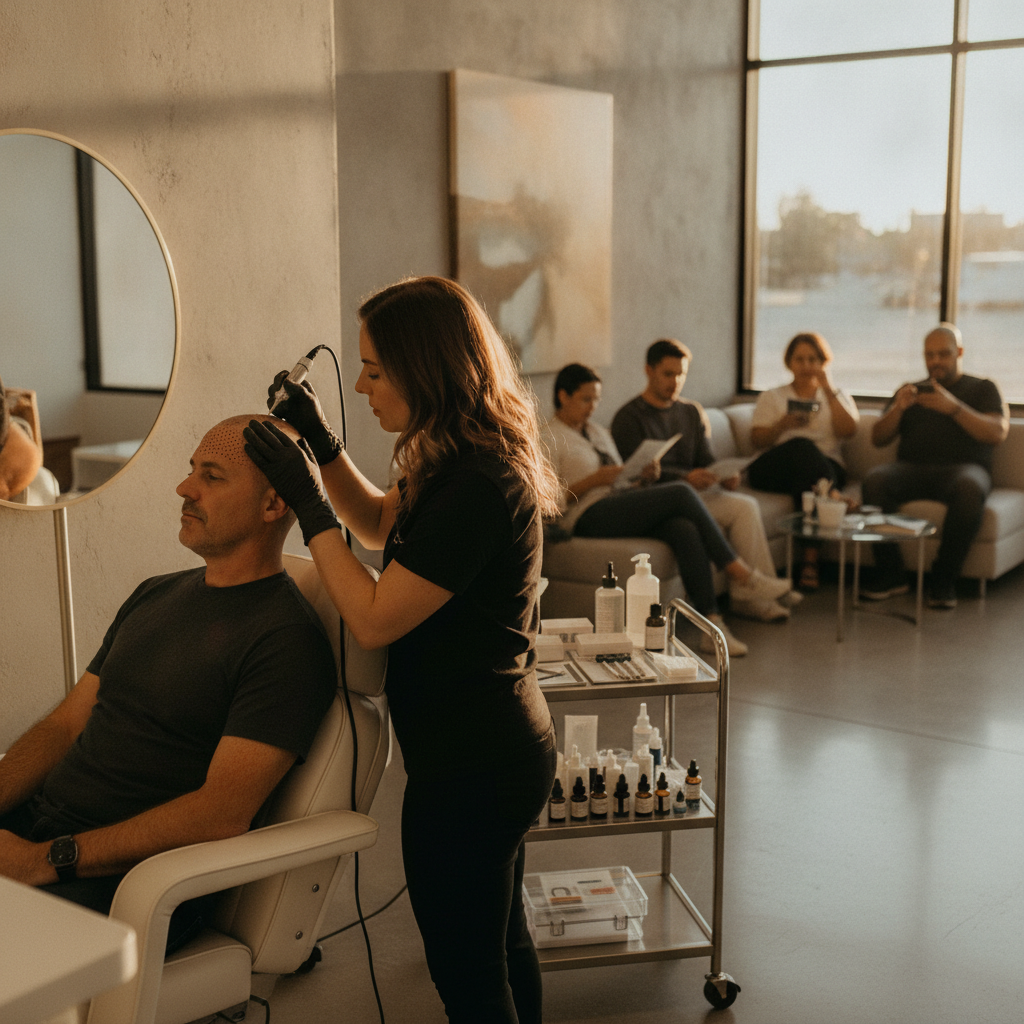
What Is the Difference Between SMP and a Hair Tattoo? What Stockton Clients Should Know Before Booking
It’s one of the most common questions we hear at Infusion SMP in Stockton: “Isn’t SMP just a tattoo on your head?” It’s a fair question — and the honest answer is that while scalp micropigmentation and a conventional tattoo share some surface-level similarities, they are fundamentally different in technique, pigment, needle type, depth, and long-term result. If you’ve been researching hair loss solutions in Stockton or anywhere in the Central Valley and you’re not sure what separates the two, this article is worth reading before you book anything.
Why This Question Comes Up So Often
People in San Joaquin County — and across Tracy, Manteca, and Modesto — are increasingly familiar with SMP as a concept. But because the procedure involves a needle and pigment applied to the scalp, it’s easy to assume it’s just a standard tattoo performed by a tattoo artist with a different subject matter. Some providers out there don’t exactly discourage that assumption, which is part of the problem. A few will market it as a “hair tattoo” precisely because it sounds familiar and less clinical. That casual framing, unfortunately, can set unrealistic expectations and lead to outcomes that don’t look natural.
Understanding the real differences isn’t just academic — it directly affects whether you end up with results that look like genuine hair follicles or results that look like ink blobs on your scalp a few years from now.
The Technical Differences That Actually Matter
Needle Type and Depth
A conventional body tattoo uses needles designed to drive ink deep into the dermis — the layer of skin where the pigment anchors for life. That depth is intentional for body art. On the scalp, however, you do not want pigment sitting that deep. SMP uses ultra-fine needles — typically a single-point or micro-grouping — and deposits pigment at a much shallower depth within the skin. This precision is what allows a trained SMP artist to replicate the crisp, circular impression of a real hair follicle rather than a blurred dot. Go too deep, as many tattoo-based approaches do, and the dot spreads, softens, and within a few years looks more like a smudge than a follicle.
Pigment Formulation
This is where a lot of “hair tattoos” go wrong. Standard tattoo ink is not formulated for the scalp or for simulating hair. Over time — especially with sun exposure — many conventional inks shift in color. Blues turn green. Blacks go blue. Browns fade to orange or red. In the Central Valley, where summers are long, dry, and intensely sunny, this color migration can happen faster than it would in milder climates. SMP-specific pigments are formulated differently: they’re designed to fade more predictably toward a neutral gray rather than shifting into an unnatural hue. This is a meaningful technical distinction, not just marketing language.
Dot Size and Follicle Replication
A real shaved hair follicle at scalp level appears as a small, slightly irregular dark dot — usually between 0.1 and 0.3 millimeters. Recreating that microscopically requires both the right equipment and the right hand technique. SMP artists train specifically to vary dot size, shape, and density across the scalp to match your natural hair pattern, skin tone, and the angle at which your hair would have grown. A tattoo artist working with standard equipment cannot reliably hit those tolerances, no matter how skilled they are at traditional body work. The tools are different, the objectives are different, and the training is different.
What Happens When Someone Goes to a Tattoo Artist Instead of an SMP Specialist
This isn’t a hypothetical concern — it’s a real pattern we see when clients come in asking about scalp micropigmentation correction work. Someone went to a local tattoo shop, got what was marketed as a “scalp tattoo” or “hair tattoo,” and a year or two later the dots have blurred, the color has shifted, and it doesn’t look like hair anymore. It looks like a tattoo. And fixing that work is significantly more involved than starting fresh.
Some of those clients are coming from Sacramento or surrounding areas where SMP-adjacent services are offered under loose terminology. Others found someone cheap online who claimed to do SMP but was using tattoo equipment and standard ink. The result is the same: pigment that sits too deep, dots that spread, and color that doesn’t hold true over time.
What Genuine SMP Should Look Like — and Feel Like to Receive
A proper SMP treatment is typically completed across two to three sessions spaced a few weeks apart. Each session builds on the last — the first establishes the base layer and initial hairline shape, the second adds depth and density, and the third refines everything once your skin has settled. The result after healing is a look that can pass as a naturally close-shaved head or, for clients with thinning hair, a noticeably fuller scalp that doesn’t advertise itself as a cosmetic procedure.
The sessions themselves feel different from a conventional tattoo too. Because the needle isn’t going as deep, most clients describe the sensation as lighter — more of a scratching or tapping feeling than the deeper pressure of traditional tattooing. It’s not painless, but the vast majority of clients find it very tolerable, especially after the first session when you know what to expect.
The Longevity Question: Fading vs. Shifting
One thing that surprises some clients: SMP is designed to fade gradually over time, which is actually a feature, not a flaw. As you age, your natural hair — if you have any — changes. Your skin changes. A result that looked perfect at 35 should be able to be refreshed and adjusted at 50 rather than permanently locked in. Conventional tattoo ink doesn’t cooperate with this; it stays deep in the skin and continues to migrate rather than fading cleanly.
For clients in Stockton and across the Central Valley who spend a lot of time outdoors — whether you’re in agriculture, construction, healthcare, or just living life in the sun — understanding that sun exposure accelerates fading is important for aftercare planning. Quality SMP-specific pigment fades more predictably and in a way that can be refreshed with a touch-up session rather than looking progressively stranger over time.
Learn more about what the density enhancement process looks like for clients with thinning hair at our hair density enhancement page.
So Why Do Some Providers Still Call It a Hair Tattoo?
Partly because the term is search-friendly and familiar. Partly because some providers genuinely are using tattoo equipment and calling it SMP. And partly because there’s no industry-wide licensing standard in California that prevents someone from picking up a tattoo machine and marketing scalp work as micropigmentation. This is exactly why asking about training, pigment type, needle specifications, and portfolio depth matters before you commit to anything — especially for a procedure that goes on your head and is meant to last years.
When you’re comparing providers in Stockton or driving up to Sacramento to consult with a studio, these are the questions worth asking. What pigment formulation do you use? What needle configuration? How many sessions are included? Can you show me healed results — not just fresh-session photos?
Frequently Asked Questions
Can a regular tattoo artist do SMP if they’re experienced?
Not safely without proper SMP-specific training. The technique, needle type, pigment depth, and dot replication requirements are fundamentally different from body tattooing. Experience with traditional tattoo work is not a substitute for SMP training and practice.
Will SMP turn blue or green like some tattoos do?
When performed with proper SMP-specific pigment — not standard tattoo ink — color migration to blue or green is not a typical outcome. Quality SMP pigments are formulated to fade toward a neutral gray over time rather than shifting to unnatural tones. This is one of the key reasons pigment formulation matters so much.
How do I know if a Stockton area provider is using real SMP technique or just tattooing?
Ask directly about their pigment formulation, needle type, and training background. Request healed portfolio photos — at least three to six months post-procedure. Providers doing real SMP should be able to explain their equipment and show you long-term results confidently. If the answers are vague, that’s a signal.
Is SMP more expensive than a scalp tattoo from a regular tattoo shop?
Typically yes, because you’re paying for specialized training, specific materials, and a multi-session process designed for hair simulation. But the cost difference is small compared to the cost of correcting a poor result — or living with one. SMP generally runs in the range of $1,500 to $4,000 depending on the extent of coverage, which is still a fraction of what a hair transplant costs.
Can SMP be corrected if someone already had a bad hair tattoo done elsewhere?
In many cases, yes — though it depends on the depth and color shift of the existing work. Laser lightening may be needed before new pigment can be applied cleanly. This is more involved than starting fresh, which is why getting it right the first time is worth the research.
Ready to See What Proper SMP Looks Like?
If you’re in Stockton, Tracy, Manteca, or anywhere in the Central Valley and you want a real conversation about whether SMP is the right move for you — not a sales pitch, just an honest look at your situation — reach out to Infusion SMP to schedule a free consultation. We’ll walk you through exactly what to expect, show you healed results, and answer any questions you have about technique, pigment, or the process. You deserve to make this decision with full information, not assumptions.