
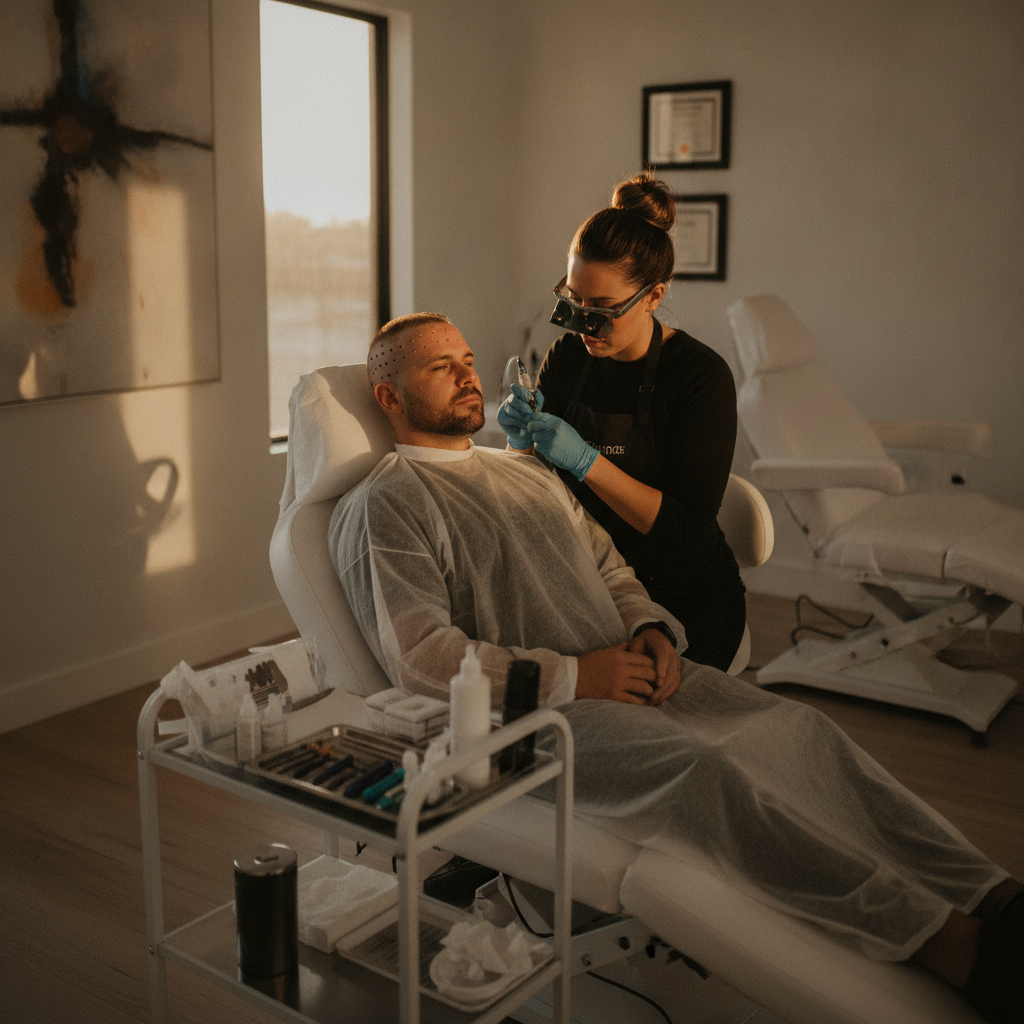
How Do You Know If an SMP Artist Is Actually Qualified? What Stockton Clients Should Ask Before Trusting Anyone with Their Scalp
Here’s the honest answer: in California, almost anyone can legally pick up a machine and call themselves an SMP artist. There’s no single governing body that issues a universal SMP license, no standardized state exam, and no required number of supervised hours before someone starts working on paying clients. That’s not meant to scare you — it’s meant to put you in the driver’s seat. Because if you’re considering scalp micropigmentation in Stockton or anywhere else in the Central Valley, understanding how to evaluate an artist’s actual qualifications is the single most important thing you can do before booking a session.
SMP is a permanent procedure. Done well, it can genuinely restore your confidence and look completely undetectable for years. Done poorly, it can leave you with blown-out dots, the wrong pigment color, or an unnatural hairline that’s far harder to fix than it was to create. Knowing what questions to ask — and what answers should give you pause — protects you from ending up in the second category.
Why This Question Matters More Than Most Artists Will Tell You
The SMP industry has grown fast over the last decade, and that growth hasn’t always been matched by consistent standards. Across the Sacramento-to-Stockton corridor, you’ll find artists who trained rigorously through respected programs and artists who watched a few YouTube videos and bought a kit. From the outside, both might have a clean Instagram page and a handful of five-star reviews.
The difference shows up on your scalp — in the size and spacing of the dots, the way the pigment sits in the skin, how the hairline is designed relative to your face shape and age, and whether the color still looks right six months after your last session. Those details come from real training and real experience. A consultation is your chance to figure out which kind of artist you’re sitting across from.
For clients in Manteca, Tracy, Lodi, and other parts of San Joaquin County who may not have as many local options to compare, this vetting process is especially important. It’s worth the drive to Stockton — or anywhere else — to find someone genuinely qualified rather than settling for whoever is closest.
What Formal SMP Training Actually Looks Like
A serious SMP artist will have completed a structured training program — not just a one-day crash course, but a curriculum that covers needle depth, pigment theory, skin behavior across different tones and textures, hairline design principles, session pacing, and proper healing protocols. The best programs include hands-on practice under supervision, not just observation.
Ask any artist you’re considering: Where did you train? How long was the program? Did it include live model work? A confident, qualified artist will answer these questions without hesitation and often with pride. Vague answers like “I learned from an experienced artist” or “I’ve been doing this for a while” aren’t the same thing as formal instruction.
It’s also worth asking whether they pursue continuing education. SMP technique evolves — pigment formulations improve, needle configurations change, and best practices get refined. An artist who has been doing the same thing the same way for five years without updating their approach may not be delivering the current standard of care. Infusion SMP offers practitioner training precisely because proper instruction matters — and we hold our own work to that same standard.
Portfolio Evaluation: What You’re Actually Looking For
Every SMP artist will show you their best work. Your job is to look past the highlight reel and ask harder questions about what you’re seeing.
When reviewing a portfolio, pay attention to these specifics:
- Dot consistency. Are the individual pigment deposits uniform in size, or do some look blown out and large? Oversized dots are one of the most common signs of improper technique — they look less like natural hair follicles and more like a dotted stamp pattern.
- Hairline design. Does it look like a real, age-appropriate hairline — softly irregular and natural — or does it look like a straight line drawn across the forehead? A natural hairline has variation and a slight irregularity that mirrors what hair actually looks like.
- Color matching. Look for healed results, not just freshly done photos taken immediately after a session. Pigment looks darker and bolder right after application. Ask to see photos taken four to eight weeks after the final session to understand how the work actually settles.
- Diversity of work. Does the artist have experience with different skin tones, different stages of hair loss, and different treatments — not just one specific look? An artist who has only done one type of client may struggle when your needs don’t fit that template.
If an artist doesn’t have healed photos, that’s a red flag. If they can’t show you work on someone with a similar skin tone or hair loss pattern to yours, ask why.
What the Consultation Should Feel Like — and What It Shouldn’t
A qualified SMP artist doesn’t just tell you what you want to hear. They ask about your goals, look at your scalp, discuss your skin type and tone, and give you an honest assessment of what SMP can realistically achieve for you. They should talk about the number of sessions you’ll likely need, what the healing process looks like, and what aftercare will involve — especially relevant in a place like Stockton where the summer heat and sun exposure can affect how your scalp heals and how long pigment retains its crispness.
Be cautious of any artist who rushes through a consultation, pressures you to book the same day, or glosses over the limitations of the procedure. SMP can do a lot, but it’s not right for every situation and it doesn’t work the same way for everyone. An artist who acknowledges that and helps you understand the nuances is one you can trust. The team at Infusion SMP approaches every consultation as a real conversation — no pressure, no overselling.
Red Flags That Should Make You Walk Away
Some warning signs are subtle. Others aren’t. Here’s a list of things that should genuinely give you pause:
- No physical portfolio — only stock photos or graphics on their website
- Inability to explain their training background in specific terms
- Prices dramatically lower than the regional market rate with no clear explanation
- Before-and-after photos that only show results immediately post-session, never healed
- A consultation that lasts less than 15 minutes and skips a scalp assessment
- Promises that sound too absolute — “guaranteed to look perfect,” “zero fading ever”
- No discussion of potential risks, revision options, or what happens if you’re not satisfied
The SMP market in and around Sacramento and Modesto has a range of providers at different quality levels, and some clients from Tracy or Lodi have driven significant distances based on a cheap quote only to end up needing corrective work that costs more than proper treatment would have. Corrective SMP is possible, but it’s more complicated than starting fresh — and it starts with whoever did the work in the first place not being qualified to do it right.
Does Certification From a Specific Organization Matter?
This is a fair question, and the honest answer is: it depends. Some certification bodies in the SMP industry are well-regarded and rigorous. Others are essentially pay-to-play credentials that don’t reflect actual skill. A certificate on the wall isn’t meaningless, but it’s not sufficient on its own either.
What matters more than the name of a certification is the actual evidence of skill — the portfolio, the consultation experience, the artist’s ability to answer technical questions clearly, and the testimonials of real clients with results you can verify. Use credentials as one data point, not as a substitute for doing your homework. Learn more about what professional SMP actually involves so you can ask better questions when you sit down for a consultation.
Frequently Asked Questions
Is SMP regulated in California?
There’s no specific California state license for scalp micropigmentation. Artists typically operate under a cosmetology, esthetics, or tattoo artist license depending on their local jurisdiction. The lack of SMP-specific regulation makes it even more important that you vet an artist’s training and portfolio yourself.
How many sessions of experience should an SMP artist have before I trust them with my scalp?
There’s no magic number, but an artist with fewer than 50 completed treatments is still in the early stages of building real-world experience. Ask directly how many clients they’ve worked on and whether they can connect you with past clients for references if you’re uncertain.
Should I be concerned if an SMP artist is also a tattoo artist?
Not necessarily — many excellent SMP artists come from a tattooing background. What matters is whether they received specific SMP training on top of that. Standard tattooing technique doesn’t translate directly to SMP. The needle depth, pigment behavior, and dot size requirements are different, and an artist who treats SMP like regular tattooing will produce results that look artificial.
What questions should I ask about pigment specifically?
Ask what brand or type of pigment they use, whether it’s formulated specifically for SMP, and how it behaves as it fades over time. Some pigments shift color as they age — turning bluish or greenish — which is a known issue with certain formulations not designed for scalp work. A qualified artist can explain their pigment choice and why it holds color well long-term.
Does Infusion SMP serve clients from Modesto, Tracy, or Manteca?
Yes. Clients travel to our Stockton studio from across San Joaquin County and beyond, including Modesto, Tracy, Manteca, Lodi, and Sacramento. We offer free consultations so you can make an informed decision before committing to anything.
You Deserve to Get This Right the First Time
Choosing an SMP artist isn’t a decision to rush. This is your scalp — and the results will be with you every day. Taking the time to ask hard questions, review real healed portfolios, and sit through a genuine consultation isn’t being difficult. It’s being smart about a permanent procedure.
At Infusion SMP Scalp Micropigmentation in Stockton, we welcome every one of those questions. We’ll show you our work, walk you through our process honestly, and help you figure out whether SMP is the right fit for where you are right now. No pressure, no scripts — just a real conversation about what you’re dealing with and what we can actually do about it.
Ready to start that conversation? Contact us to schedule your free consultation and see for yourself what a qualified SMP artist looks like up close.