
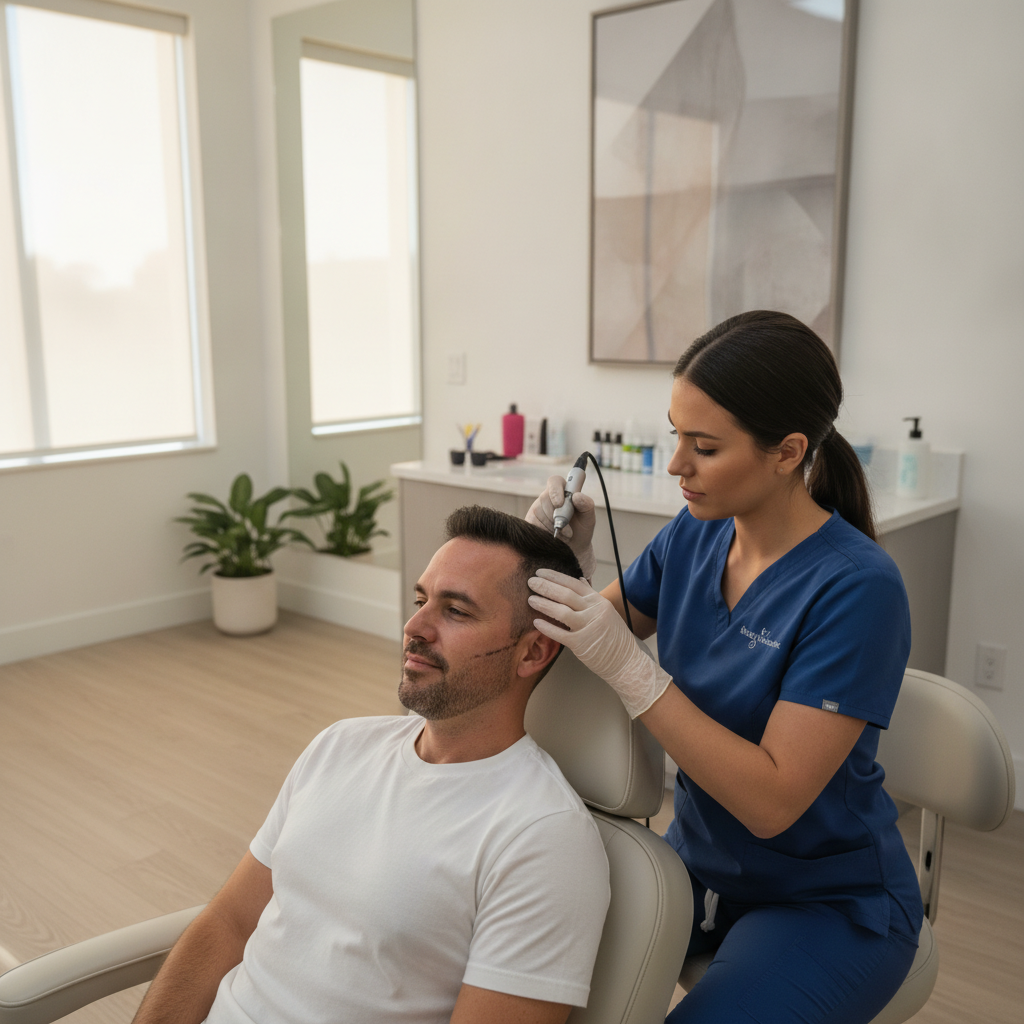
Can SMP Help with Hair Transplant Scars? What Stockton Clients Should Know About Scar Camouflage
Yes — scalp micropigmentation is one of the most effective ways to camouflage hair transplant scars, and for many clients in Stockton and the surrounding Central Valley, it’s the missing piece they didn’t know existed. Whether you have the telltale horizontal strip scar from an older FUT procedure or the scattered dot scarring from a more recent FUE transplant, SMP can blend those marks into the surrounding scalp so precisely that even you’ll stop noticing them.
But scar camouflage is also one of the most technically demanding types of SMP work — and unfortunately, it’s one of the topics that most local studios barely scratch the surface on. If you’ve been searching for answers and coming up empty, you’re not alone. Let’s walk through exactly how it works, what makes scar tissue different to work with, and what you should realistically expect.
Why Hair Transplant Scars Are So Hard to Hide — and Why SMP Works When Nothing Else Does
Most men who go through a hair transplant don’t expect to end up trading one hair loss problem for another. But scars happen. FUT (follicular unit transplantation) surgeries leave a linear scar across the back of the head that can range from a faint line to a wide, raised strip that’s visible whenever the hair is cut short. FUE (follicular unit extraction) procedures are less invasive, but they leave dozens or even hundreds of small circular scars — and at certain hair lengths, those dots can become surprisingly obvious under direct light.
Concealers, fibers, and longer hairstyles can only do so much, and for men who work outdoors in the Central Valley heat or spend time in the water, those temporary fixes are impractical. SMP places tiny deposits of specialized pigment directly into the scar tissue itself, replicating the appearance of hair follicles at skin level. When done well, the treated area matches the surrounding scalp seamlessly — the scar essentially disappears into the background.
What Makes Scar Tissue Different to Work With
This is where the skill of the artist matters enormously. Scar tissue behaves differently than healthy scalp skin. It’s often denser, less porous, and has irregular texture — which means pigment doesn’t deposit or hold the same way it does on a normal scalp. In some cases, scar tissue absorbs pigment unevenly, meaning an inexperienced artist can make the scar more visible, not less.
An experienced SMP artist will approach scar camouflage in stages. Rather than overloading the area in one session, they work gradually — layering pigment carefully across two or three appointments to build up coverage that looks natural rather than patchy or blotchy. The goal isn’t to tattoo over the scar. It’s to make the scar indistinguishable from the rest of the scalp.
This is also why clients from Tracy, Manteca, and Modesto who’ve had bad experiences with inexperienced artists elsewhere sometimes come to us for corrective work. Scar camouflage done wrong is a real problem — and it’s one more reason to be selective about who you trust with this kind of work. Learn more about what sets quality SMP apart from rushed or undertrained work.
FUT Strip Scars vs. FUE Dot Scars: Same Approach?
They share the same underlying technique, but the execution looks different for each scar type.
For a FUT strip scar, the artist works along the linear scar, implanting pigment to match the surrounding stubble texture. The width and depth of the scar affects how many sessions are needed. Wider or raised scars may require more layering to fully neutralize the contrast. The result, once healed, should look like a consistent field of follicles from hairline to nape — no visible line.
For FUE dot scars, the challenge is less about one concentrated area and more about covering a larger zone with many small individual marks. The artist replicates follicle dots across the scarred field so the dots blend in with — rather than stand out from — the surrounding pigmentation. Depending on density, this can actually be completed more efficiently than FUT scar work.
What the Healing Process Looks Like in the Central Valley Climate
Stockton summers are no joke — prolonged sun exposure, dry air, and heat can all affect how your scalp heals after SMP. This applies to scar camouflage just as much as any other SMP treatment. Scar tissue tends to be thinner and more reactive, so protecting the treated area from direct UV exposure during the first few weeks is especially important.
After each session, you’ll want to keep the area moisturized, avoid sweating heavily in the first few days, and stay out of direct sun without a hat or SPF until your artist gives you the go-ahead. Sacramento-area clients driving down the I-5 or Highway 99 corridor for appointments should keep this in mind — even sitting in a car in summer sunlight counts as exposure during early healing.
The full result typically reveals itself after your final session heals — usually around four to six weeks after your last appointment. Scar tissue sometimes requires a third session to get full, even coverage, so patience is part of the process.
Is SMP for Scars Right for You Even If You Still Have Hair?
Many clients asking about scar camouflage still have existing hair — they just want to wear it shorter without the scar showing. SMP for scar coverage doesn’t require you to shave your head completely. The artist matches the pigment to your natural hair color and existing stubble tone so the treated area integrates with what’s already growing.
If your transplant gave you good results in the crown and top but left you self-conscious about the back of your head, scar camouflage can be a standalone treatment — you don’t need to commit to full scalp SMP unless that’s what you want. If you also have thinning areas you’d like to address, density enhancement can be combined with scar work in the same treatment plan.
Frequently Asked Questions About SMP Scar Camouflage in Stockton
How many sessions does SMP scar camouflage typically take?
Most clients need two to three sessions. Scar tissue is unpredictable in how it holds pigment, so the artist builds coverage gradually rather than forcing too much in one appointment. Each session is spaced several weeks apart to allow proper healing.
Will the scar be completely invisible after SMP?
In most cases, the scar becomes effectively undetectable from normal conversational distance and in photographs. Very wide or textured scars may retain some minor surface irregularity under close inspection, but the color contrast — which is what makes scars obvious — is eliminated.
Does SMP work on older scars as well as newer ones?
Yes. Scar tissue needs to be fully healed before SMP can be applied — generally at least 12 months post-surgery — but the age of the scar beyond that point doesn’t significantly affect the outcome. Whether your transplant was two years ago or fifteen, the technique is the same.
How does the cost of SMP scar camouflage compare to other treatments?
SMP scar camouflage is typically more affordable than a revision surgery and far less invasive. Costs vary depending on the size and complexity of the scar, but SMP is generally a fraction of the price of corrective transplant procedures, with no recovery time required. Contact us directly for an accurate quote based on your situation.
Can SMP be done on scars from injuries or surgeries other than hair transplants?
Absolutely. SMP works on a wide range of scalp scars — from injuries, accidents, or other surgical procedures — not just hair transplants. If you have a scar anywhere on the scalp that’s affecting your confidence, it’s worth having a conversation about what’s possible.
Ready to Stop Hiding That Scar?
You went through the transplant process hoping for a solution — you deserve to actually wear your results without the scar getting in the way. At Infusion SMP Scalp Micropigmentation in Stockton, scar camouflage is one of our most rewarding treatments because the transformation is so personal. Clients come in covering the back of their head with their hands, and leave months later running a razor over it without a second thought.
If you’re in the Stockton area — or coming in from Modesto, Tracy, Sacramento, or anywhere in San Joaquin County — we’d love to take a look at what you’re working with and give you an honest assessment of what SMP can do for your specific scar. No pressure, no guesswork. Just a real conversation about your options.
Reach out today to schedule your free consultation and find out what scar camouflage could look like for you.