
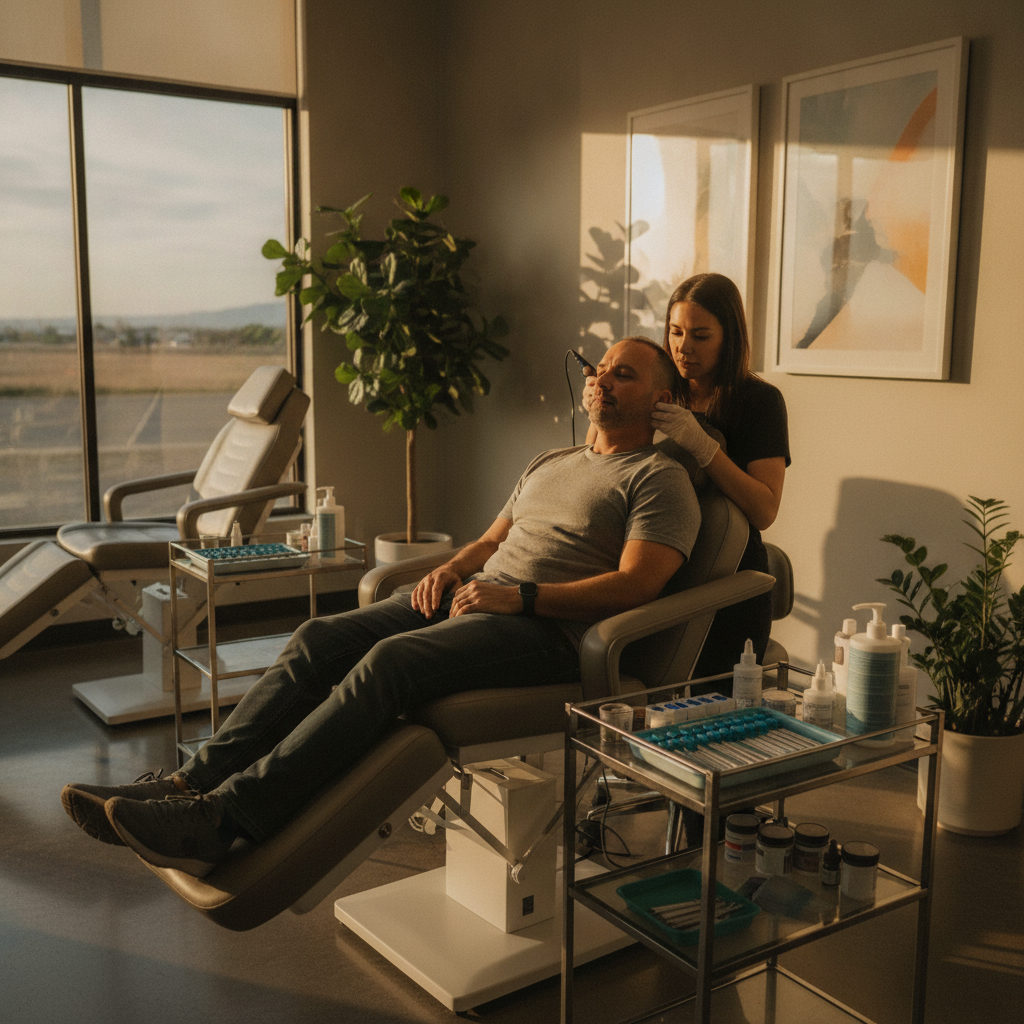
Does SMP Work with Hair Systems or Wigs? What Elk Grove and Stockton Clients Should Know About Combining or Transitioning
Yes — scalp micropigmentation can absolutely work alongside a hair system, and for many people it becomes the path that finally lets them leave the system behind for good. If you’re in Stockton, Elk Grove, or anywhere in the Central Valley and you’ve been managing hair loss with a hairpiece, wig, or bonded hair system, you deserve a straight answer: SMP is not just a backup plan. For a lot of clients, it’s the upgrade they wish they’d known about years earlier.
This is a topic that almost nobody in the Sacramento-area SMP market talks about directly. Most studios focus on clients who are already shaving their heads or have never worn a hair system. But the reality is that a significant number of people seeking SMP consultations are coming from years — sometimes decades — of living in a hair system. They have questions that aren’t being answered anywhere. This article is for them.
Why So Many Hair System Wearers Start Looking at SMP
Hair systems — whether bonded, clipped, or taped — can look incredibly natural when done well. But maintaining one is a full-time commitment. You’re managing adhesives in the heat, scheduling regular reattachments, worrying about whether it moves at the wrong moment, and absorbing ongoing costs that add up fast over the years. In the Central Valley’s summers, where temperatures in Stockton, Manteca, and Modesto routinely climb past 100 degrees, those adhesives and the scalp conditions beneath them become a real source of discomfort.
People start exploring alternatives not because they hate how they look in their system, but because they’re exhausted by what it takes to maintain that look. They want something they can wake up with, swim with, sweat through a shift with — and not think about. That’s where SMP enters the conversation.
Can You Wear a Hair System While Getting SMP?
In most cases, yes — though there are practical considerations. If you’re planning to use SMP as a transitional step, your artist needs to understand how you currently wear your system, where the bonds or clips sit, and what the scalp beneath it looks like. Adhesive residue, skin sensitivity from long-term tape or glue use, and the condition of your scalp all factor into how SMP will take and heal in those areas.
It’s worth having an open conversation during your consultation about your system-wearing history. A skilled SMP artist in Stockton will ask about this — and if they don’t, that’s worth noticing. The scalp skin under a long-worn bonded system can behave differently than untreated scalp skin, and your artist should account for that in how they approach pigment placement and depth.
You’ll also want to remove your system for each SMP session and allow normal healing between visits. Most SMP treatments involve two to three sessions spaced a few weeks apart, so you’ll need to plan around how you’ll manage your appearance during that window if you’re not yet ready to go without the system entirely.
Using SMP to Transition Away from a Hair System
This is where the real conversation gets interesting — and where scalp micropigmentation offers something no other non-surgical option can match: a permanent, zero-maintenance alternative that looks convincing without anything sitting on top of your head.
The transition process usually looks something like this: you come in for an initial consultation, your artist assesses your current hair loss pattern, discusses where your natural hairline sits and what a realistic replacement looks like, and you begin sessions while still wearing your system as needed. By the time the SMP is complete and fully healed, many clients find they simply stop reaching for the system. The need it was filling is gone.
For clients dealing with more advanced hair loss — a fully bald crown, significant temples, or diffuse thinning across the top — SMP creates the appearance of a closely shaved, full head of hair. The pigment replicates individual follicle dots with precision, giving the impression of stubble rather than bare scalp. When done well, it’s genuinely undetectable in normal light, in photos, and in close conversation.
What About the Hairline? That’s Always the Hard Part
The hairline is what makes or breaks both a hair system and an SMP result. Hair system wearers often know this intimately — they’ve spent time managing that front edge, making sure it looks natural, worrying about it lifting. With SMP, the hairline is designed manually by your artist and implanted permanently into your scalp. That means you get one chance to get it right, and the design matters enormously.
A good SMP artist will never just draw a straight line across your forehead. A natural hairline has irregularity — slight variations in depth, micro-recession at the temples, a softness at the front edge that mirrors how real hair actually grows. They’ll also consider your face shape, your age, and where your hair loss is likely to progress, so the result looks appropriate not just today but in the years ahead.
If you’ve been wearing a hair system with a particularly low or aggressive hairline, your artist may recommend a slightly more conservative design for your SMP. This isn’t about settling — it’s about giving you results that look completely natural without anything artificial sitting on top to support the illusion.
The Financial Reality: What You’re Actually Comparing
Hair systems are not cheap when you account for the full picture. A quality system can cost several hundred to over a thousand dollars, needs to be replaced multiple times per year, requires professional reattachment services, and demands ongoing adhesive and maintenance products. Over five years, many hair system wearers have spent well over $10,000 — sometimes significantly more.
SMP, by comparison, is a one-time investment. The cost varies depending on the extent of coverage needed, but the value over time is clear: you pay once, do touch-ups every few years as needed, and you’re done. For clients in San Joaquin County and Sacramento County who are weighing their options against Bay Area pricing or franchise clinic quotes, working with a local Stockton-area artist can also make the numbers significantly more accessible without sacrificing quality.
For clients whose hair loss is primarily about density rather than complete baldness, density enhancement with SMP can restore the appearance of fullness to thinning areas while leaving existing hair untouched — another option worth discussing if you still have considerable hair but have been using a system to compensate for thinning at the crown or temples.
What Competitors in the Area Aren’t Telling You
Most SMP studios in Sacramento, Elk Grove, and the surrounding region write almost exclusively for clients who are already committed to the shaved-head look or who have never worn a hair system. The transition from hairpiece to SMP is a real experience for a real segment of clients — and it deserves direct, honest guidance rather than being ignored.
If you’ve been living in a hair system for years, you already know what it costs emotionally, not just financially. You know the anxiety before a swim, the planning around windy days, the mental load of maintaining something that feels fragile. SMP doesn’t ask any of that of you. Once it’s done, it’s done. You wake up looking the way you want to look, every day, without a checklist.
Frequently Asked Questions
Can I still wear my hair system after getting SMP?
Yes, there’s no rule that says you have to stop immediately. Some clients use their system occasionally during the transition period while they get comfortable with their new look. Over time, most find they simply don’t need it anymore.
Will SMP work if my scalp has been exposed to adhesives for years?
In most cases, yes. Long-term adhesive use can affect scalp skin texture in some areas, and your SMP artist should assess this during consultation. It doesn’t disqualify you from treatment, but it may affect how your artist approaches certain areas.
How do I choose the right hairline if I’ve been wearing one that was designed for me by a hair system specialist?
Your SMP artist will work with you during the consultation to design a hairline that suits your face, age, and natural bone structure. If your current system hairline is particularly low or aggressive, your artist may recommend a slightly adjusted version — one that will look completely believable without the system’s hairline tape helping to sell it.
Can clients from Elk Grove or Lodi come to Stockton for SMP without making multiple day trips?
Absolutely. Elk Grove, Lodi, and Manteca are all within easy driving distance of Stockton along the I-5 and Highway 99 corridors. Sessions are typically spaced three to four weeks apart, so scheduling is manageable even if you’re commuting from a neighboring city or county.
How long before I can go back to wearing my hair system after an SMP session?
Your artist will give you specific aftercare guidance, but generally you’ll want to allow the treated area to heal fully — typically around ten to fourteen days — before applying adhesives or wearing a bonded system over freshly worked scalp. This protects the pigment and gives your skin time to settle.
Ready to Have This Conversation?
If you’ve been wearing a hair system and you’re curious about what life could look like without one — or you just want to understand your options before making any decisions — that’s exactly what a free consultation is for. At Infusion SMP Scalp Micropigmentation in Stockton, you’ll get honest answers, real expectations, and a no-pressure conversation about what SMP can and can’t do for your specific situation.
You don’t have to keep maintaining something that exhausts you. Reach out today to schedule your free consultation and find out what’s actually possible.