
Can You Get SMP If You’re Still Actively Losing Hair? What Lodi and Stockton Clients Should Know About Timing Your Treatment
Yes — you can get scalp micropigmentation while your hair loss is still progressing. But how and when you do it matters enormously, and most of the SMP studios serving the Central Valley don’t spend nearly enough time walking clients through what that actually looks like in practice. If you’re based in Lodi, Stockton, Tracy, or anywhere along the Highway 99 corridor and you’re watching your hair thin faster than you’d like, this article is for you. Understanding the timing question up front can save you from frustration, extra sessions, or a result that looks off three years from now.
Why the “Wait Until It Stops” Advice Is Oversimplified
You may have heard some version of this: “Wait until your hair loss stabilizes before getting SMP.” On the surface, it sounds reasonable. But for most people with androgenetic alopecia — the pattern baldness that affects the vast majority of men and a significant number of women — hair loss doesn’t neatly stop at a predictable age or stage. It slows, pauses, sometimes accelerates, and rarely announces itself with a finish line.
If you’re in your late twenties or thirties, waiting for “stability” could mean waiting a decade or more. That’s a decade of feeling self-conscious at work, at family gatherings, or out in the community. For the healthcare workers, ag professionals, and commuters across San Joaquin County who spend long days on their feet or in client-facing roles, that kind of confidence hit has real daily consequences.
The better question isn’t whether to wait — it’s how to plan your SMP treatment with future hair loss in mind, so your results hold up as your hair continues to change.
How a Skilled SMP Artist Plans for Future Hair Loss
This is where the quality of your artist makes an enormous difference, and it’s a topic that surprisingly few SMP providers address in their publicly available content. A skilled practitioner doesn’t just replicate what your scalp looks like today. They look at where your hair loss is heading and design your treatment accordingly.
Here’s what that looks like in practice:
- Conservative hairline placement: If you’re still in an early stage of loss, your artist should design a hairline that looks natural not just now, but also if your temples recede further over the next several years. An overly low or sharp hairline drawn today can look mismatched if surrounding hair continues to thin.
- Working with your natural hair, not against it: For clients with thinning hair who still have significant coverage, SMP can be used to add the appearance of density — filling in the scalp between existing follicles so the overall look is fuller. This works especially well for clients who aren’t ready to shave down but want to stop the thinning from showing.
- Building in flexibility for touch-ups: Good SMP isn’t a one-and-done decision made in isolation. A practitioner who’s thinking long-term will frame your initial sessions as the foundation of an evolving result — one that can be adjusted as needed over time.
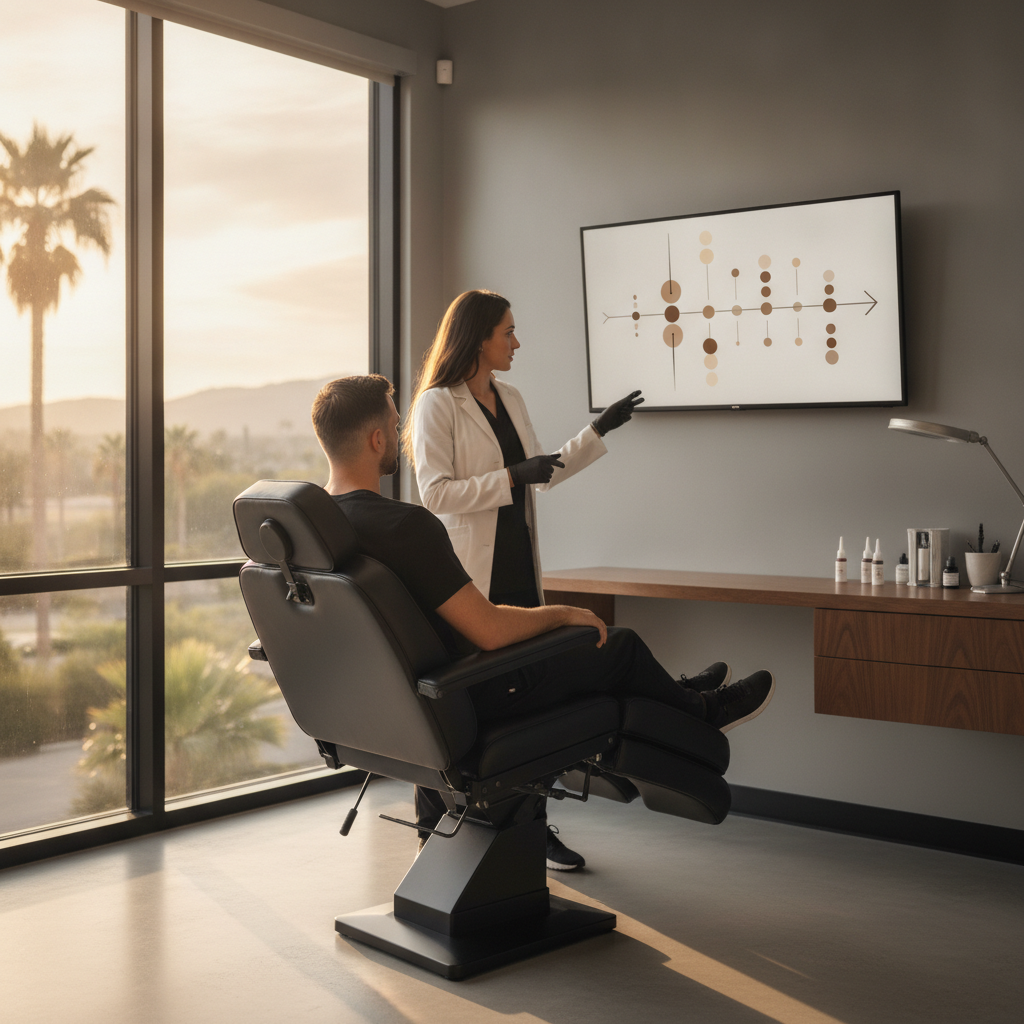
At Infusion SMP Scalp Micropigmentation, this kind of forward-thinking design is part of every consultation. It’s not about selling more sessions — it’s about making sure you’re genuinely happy with your results years from now, not just weeks after your final session.
What Stage of Hair Loss Are You Actually At?
Most practitioners use the Norwood Scale for men or the Ludwig Scale for women to assess the extent and pattern of hair loss. Where you fall on that scale matters when thinking about SMP timing.
If you’re a Norwood 2 or 3 with a mildly receding hairline, SMP can add density and softly reinforce the existing hairline without committing to a dramatically different look. If you’re a Norwood 5 or 6 with significant coverage loss across the crown and vertex, a full scalp approach may make more sense — and the design process is more straightforward because the natural hair isn’t competing with the pigment placement.
The middle stages — Norwood 3 to 4 — are often the trickiest to plan, and they’re the stage where most clients come in asking the timing question. The honest answer: you don’t have to wait, but you do need an artist who will be honest with you about the tradeoffs and design your treatment with the next few years of possible progression built into the plan.
The Lodi and Stockton Client Reality: Time Is Not Always on Your Side
There’s a practical reality that affects a lot of clients across the Central Valley. People here aren’t always in a position to put major decisions on hold indefinitely. Whether you’re working long shifts in healthcare in Modesto, managing a business in Tracy, or raising a family in Lodi while commuting to Stockton — life moves fast, and waiting years for “the right moment” isn’t always realistic or necessary.
The good news is that SMP is one of the more adaptable hair loss solutions available precisely because it isn’t a surgical intervention. Unlike a hair transplant — which requires that your donor supply be relatively stable before surgery — SMP doesn’t require harvesting anything from your scalp. Pigment placement can be adjusted, expanded, or refined at future sessions as your hair loss evolves. That flexibility is one of SMP’s genuine strengths, and it’s one reason why many clients find it preferable to waiting on a transplant or cycling through medications indefinitely.
What About Hair Loss Medications? Do You Need to Be On Them First?
This comes up often, and it’s worth addressing clearly. You don’t need to be on finasteride, minoxidil, or any other hair loss treatment before getting SMP. SMP works independently of whatever medical route you’re on — it’s a cosmetic pigment procedure, not a medical treatment for hair loss.
That said, if you are using medication to slow your progression, that’s worth mentioning during your consultation. It gives your artist context for how your hairline may change over time and can influence how conservatively or aggressively they design your initial treatment. The goal is always a result that ages with you gracefully — and knowing your full picture helps make that happen.
If you’re thinking about using SMP for density enhancement while you still have meaningful hair coverage, that’s a conversation worth having sooner rather than later — especially before additional thinning makes the blending process more complex.
Frequently Asked Questions: SMP and Active Hair Loss
Do I have to shave my head to get SMP while still losing hair?
Not necessarily. For density enhancement on thinning hair, your existing hair can stay in place and SMP is worked in between follicles to create the look of fullness. However, if your loss has progressed significantly or you’re going for a shaved-head look, a close shave gives your artist the cleanest canvas for precise pigment placement.
Will I need more sessions if my hair keeps thinning after I get SMP?
Possibly — but not immediately, and not necessarily dramatically. Many clients go years between touch-ups even with some continued progression. How your artist designs your initial treatment plays a big role in how well the result holds up. A thoughtfully designed hairline with conservative placement typically needs less adjustment over time than one that was positioned without accounting for future change.
Can SMP be added to over time as I lose more hair?
Yes. This is one of the legitimate advantages of SMP over surgical options. Coverage can be extended, density can be added, and the overall design can be adapted in future sessions. It’s a manageable, incremental process — not a dramatic redo every time something changes.
What if I decide I want a hair transplant later? Does SMP get in the way?
Generally, no. SMP and hair transplants aren’t mutually exclusive, and many clients use SMP to camouflage transplant scars or fill in areas the transplant didn’t fully cover. If there’s any chance you’re considering a transplant in the near future, mention that during your consultation so your artist can plan accordingly.
I’m in Lodi — do I have to travel far to get this done?
Infusion SMP Scalp Micropigmentation is located in Stockton, just a short drive from Lodi on I-5. Most clients from the surrounding area — Tracy, Manteca, Modesto — find the trip easy and well worth it given the quality and personalized approach. Most SMP treatment plans involve two to three sessions spaced a few weeks apart, so you’re not committing to constant travel.
Ready to Talk Through Your Timing?
You don’t have to figure this out on your own, and you don’t have to wait until your hair loss reaches some arbitrary endpoint before exploring your options. The right time to have a conversation about SMP is whenever you’re ready — and a good consultation will give you an honest picture of what’s realistic for your specific stage of loss, your goals, and your timeline.
Infusion SMP Scalp Micropigmentation serves clients throughout Stockton, Lodi, Tracy, Modesto, and the broader Central Valley. If you’re curious about whether now is the right time for you, reach out and request a free consultation. There’s no pressure, no guesswork — just a straightforward conversation about your scalp, your goals, and what a smart SMP plan looks like for where you are right now.