

Can SMP Work If You Have a FUT Strip Scar From an Older Hair Transplant? What Stockton and Lodi Men Should Know About Scar Camouflage
Uncategorized8 min read

Can SMP Work If You Have a FUT Strip Scar From an Older Hair Transplant? What Stockton and Lodi Men Should Know About Scar Camouflage
Yes — scalp micropigmentation is one of the most effective ways to camouflage a FUT strip scar, and for many men in Stockton, Lodi, and across San Joaquin County, it’s the solution they wish they’d found years ago. If you had a follicular unit transplantation (FUT) procedure at some point in your life and you’ve been keeping your hair long ever since just to hide a horizontal scar at the back of your head, SMP can change that. The scar doesn’t disappear, but when it’s done right, it becomes virtually invisible at close-cropped or shaved lengths — and you get your freedom back.
Why FUT Scars Are Uniquely Difficult to Hide
The FUT method — sometimes called a strip transplant — involves removing a horizontal section of scalp from the donor area at the back of the head, then stitching or stapling it closed. The result is a linear scar that can range from a thin white line to a wider, raised, or uneven band of tissue, depending on how the wound healed and how many sessions the person had.
For a lot of men, the original transplant delivered decent results on top. The problem is the trade-off at the back. You gained density at the hairline and lost the ability to cut your hair short without exposing the scar. That means constantly managing length, angle, and styling — and always feeling slightly self-conscious in a barber’s chair, at the pool, or in a bright-lit room where someone might notice.
What makes FUT scars particularly tricky is that scar tissue doesn’t hold pigment the same way normal scalp skin does. The texture is different. The color is often lighter or pinker than surrounding skin. And because it’s a long horizontal line rather than a point or patch, it needs to be blended convincingly across its full length — not just darkened in the middle and left lighter at the edges. That requires skill, the right needle configuration, and an artist who actually understands how scar tissue behaves under a machine.
How SMP Blends a Strip Scar Into the Surrounding Scalp
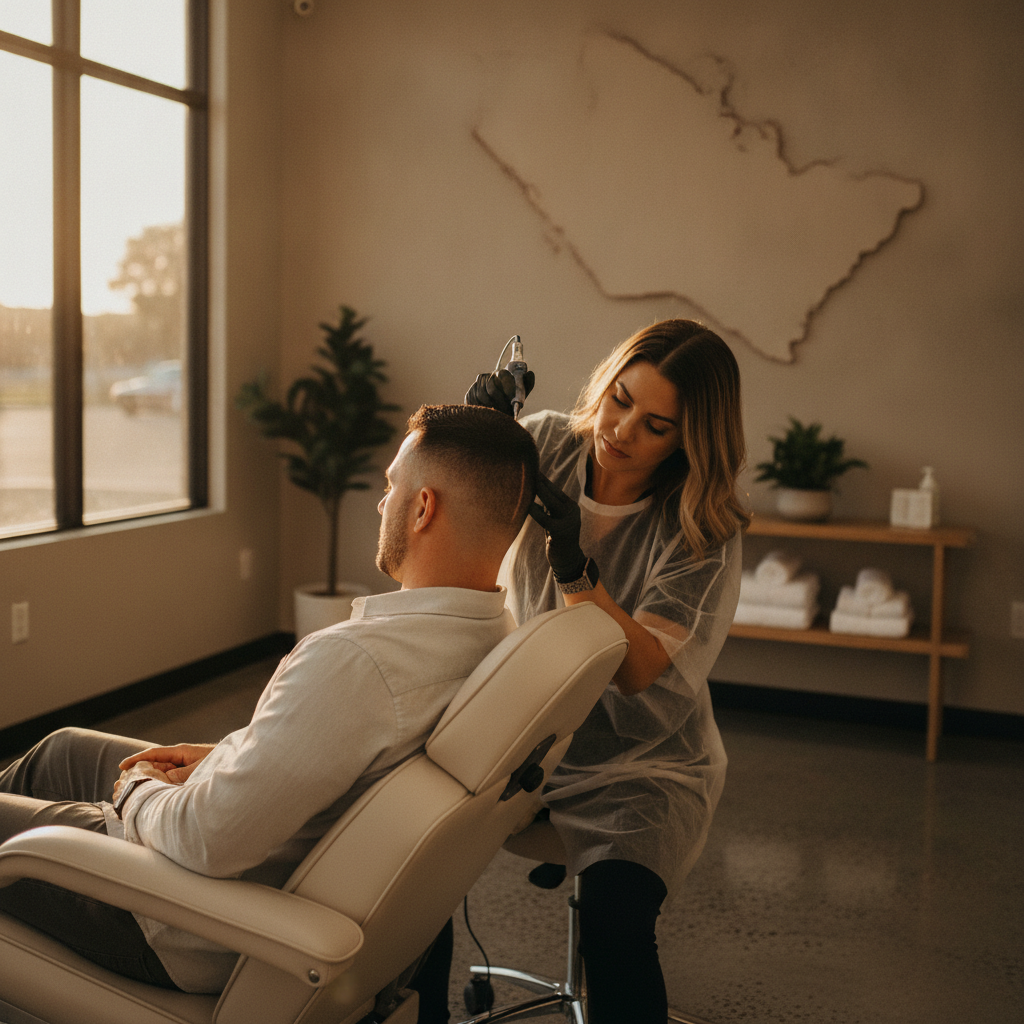
Scar camouflage with SMP works by depositing pigment directly into and around the scar tissue, carefully matching the tone of the surrounding scalp and replicating the look of hair follicle dots so the scar visually disappears into the texture of the rest of the head. When you’re wearing your hair at a short or shaved length, the scar stops reading as a scar and starts reading as just more scalp.
The process usually requires two to three sessions, spaced several weeks apart, to build up pigment gradually. Scar tissue is less predictable than normal skin — it may absorb pigment unevenly at first, fade faster in certain spots, or require slightly different needle pressure and depth. An experienced SMP artist knows to expect this and builds in the refinement sessions to correct it. Rushing the process or using a one-size-fits-all approach is exactly what leads to patchy, inconsistent results that can actually make the scar more noticeable, not less.
If you’ve also experienced some continued hair thinning on top since your original transplant — which is extremely common, since FUT doesn’t stop natural hair loss from progressing — SMP can address that at the same time, adding the appearance of density across the crown and mid-scalp while your scar is being camouflaged. You can read more about that approach on our hair density enhancement page.
What Makes FUT Scar Camouflage Different From Standard SMP
This is an area where a lot of studios in the Sacramento and Central Valley market fall short. Many SMP providers are well-trained for standard hairline work and density fills — but scar tissue is a different medium entirely. When you look at the competitor landscape in Northern California, very few studios provide detailed, honest information about how scar work actually differs from standard scalp work, what results are realistic on different scar types, or how they adapt their technique for tissue that doesn’t behave predictably.
At Infusion SMP in Stockton, scar camouflage is a core part of what we do — not an afterthought or an upsell. We assess your specific scar before committing to a treatment plan: its width, depth, texture, coloring, and how it sits relative to the surrounding scalp. Some scars are thin and uniform and respond beautifully in two sessions. Others are wider, raised, or have uneven edges and require more careful layering. You deserve an honest conversation about what your scar looks like now and what’s realistically achievable — not a sales pitch with stock photos of someone else’s results.
Living in Stockton and the Central Valley With a Strip Scar
If you’re in Stockton, Lodi, Modesto, or Tracy, you know that the Central Valley climate adds an extra layer of complexity to any scalp procedure. Our summers are hot and dry, and sun exposure in the weeks after SMP treatment — including scar work — matters. UV light is one of the main factors that causes SMP pigment to fade faster than it should, and scar tissue, which often has less natural melanin than surrounding skin, can be particularly vulnerable.
That’s not a reason to avoid treatment — it’s just a reason to plan smart. Scheduling your sessions in fall or winter gives you the best healing conditions. When you do go into the sun after treatment, covering the back of your head (a cap, a buff, SPF) makes a real difference in how long your results hold. This is practical guidance that too many studios — especially those with generic websites built for national audiences — simply don’t give you.
We work with clients from across San Joaquin County and beyond who’ve been managing FUT scars for years, sometimes decades, waiting for a solution that actually fit their lifestyle. Scalp micropigmentation offers them exactly that — a permanent camouflage that doesn’t require constant maintenance, doesn’t come off in the pool, and lets them walk into a barbershop and finally say “take it short.”
Frequently Asked Questions
How many SMP sessions will it take to cover my FUT scar?
Most FUT scar camouflage treatments are completed across two to three sessions, spaced four to six weeks apart. The first session deposits initial pigment, and subsequent sessions refine color, fill in areas that absorbed unevenly, and blend the scar seamlessly into the surrounding scalp. Your artist will give you a more specific estimate after seeing your scar in person.
Will the SMP look natural on a wide or raised scar?
Wider or raised scars require more careful technique and realistic expectations going in. SMP won’t make a raised scar flat, but skilled pigment work can dramatically reduce its visual contrast, especially at the cropped lengths most men prefer after treatment. Your artist should be honest with you about what’s achievable on your specific scar before you commit.
Can I get SMP on my strip scar if I still have hair on top?
Absolutely. Scar camouflage at the back of the head is completely independent of what’s happening on top. Many clients in Stockton and Lodi get their FUT scar treated while keeping their existing hair on top at whatever length they prefer. The two don’t conflict at all.
Is SMP for a FUT scar more expensive than standard SMP?
Scar work is often priced slightly differently than a full scalp or hairline treatment because of the additional technique and session time involved. The scope and severity of your scar will influence the cost. The best way to get an accurate picture is through a free consultation, where your artist can assess your scar and give you a real quote — not a rough number pulled from a website.
I had my FUT transplant 15 or 20 years ago. Is it too late for SMP to help?
Not at all. Older, fully healed scars are actually in many ways easier to work with than fresh ones. Mature scar tissue is more stable, and the healing process has long since completed. Men in their 40s, 50s, and 60s across the Central Valley regularly get excellent results on strip scars that have been there for decades. The scar’s age is not the limiting factor — the technique and the skill of the artist are.
Ready to Stop Hiding That Scar?
If you’ve spent years keeping your hair longer than you’d like just to cover a FUT strip scar, you don’t have to keep doing that. Scalp micropigmentation can give you the freedom to cut your hair short, go without a hat, and stop thinking about the back of your head every time you leave the house.
Infusion SMP Scalp Micropigmentation is based in Stockton and serves men and women across the Central Valley — from Lodi and Tracy to Modesto and Sacramento. We specialize in scar camouflage, hairline restoration, and density work, and we take the time to actually understand your specific situation before recommending anything.
Schedule your free consultation today. There’s no commitment, no pressure — just a real conversation about what your scar looks like, what SMP can do for it, and what you can expect from the process. You deserve to feel comfortable in your own skin, and we’re here to help make that happen.
Results vary. SMP is a cosmetic tattoo procedure, not a medical treatment, and does not regrow hair. Individual results depend on skin, scalp, hair and aftercare.