
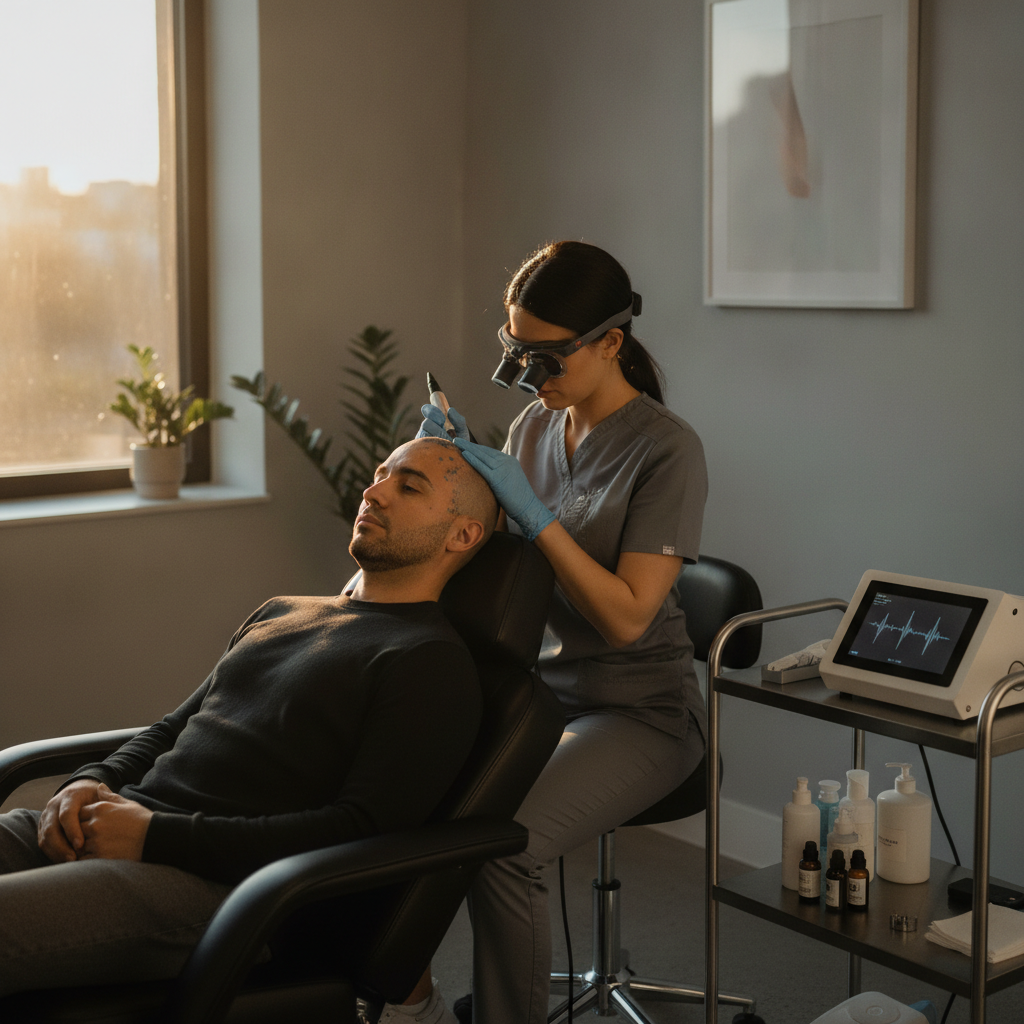

Can You Get SMP If You Have a Scalp Micropigmentation from Another Artist That Looks Wrong? What Stockton and Sacramento Men Should Know About SMP Correction
Uncategorized10 min read

Can You Get SMP Correction If Your Previous Work Looks Wrong? What Stockton and Sacramento Men Should Know
Yes — if you’ve had scalp micropigmentation done by another artist and the results don’t look right, correction is possible in most cases. Whether the pigment has turned blue or green, the hairline looks unnatural, the dots are too large and blurry, or the density is uneven, you are not stuck with it forever. Men across Stockton, Sacramento, and the broader Central Valley come to Infusion SMP after getting work done elsewhere — sometimes locally, sometimes at a franchise clinic, sometimes even overseas — and discovering that what they paid for doesn’t match what they were promised. Here’s what you actually need to know about SMP correction: what can be fixed, how the process works, and what honest expectations look like.
Why SMP Correction Cases Are More Common Than People Realize
SMP has grown fast as a service, and that growth hasn’t always been matched by practitioner quality. As more barbers, tattoo artists, and estheticians add SMP to their menu without proper training, the number of clients ending up with disappointing results has increased alongside it. The Central Valley market isn’t immune — with Sacramento-area clinics, national franchise operations, and the occasional practitioner working out of a home studio all competing for clients, it can be difficult to know who actually has the depth of skill this procedure demands.
The most common complaints we hear from correction clients fall into a few consistent categories:
- Pigment that has shifted blue, green, or purple — This happens when the wrong type of ink is used (often standard tattoo ink rather than SMP-specific pigment), or when the ink is implanted too deeply into the skin.
- Dots that are too large, blurry, or smeared — Oversized impressions that bleed into the surrounding skin, creating an unnatural, painted look rather than the crisp follicle simulation that good SMP produces.
- A hairline that looks harsh, artificial, or mismatched to the face — Straight-line hairlines, unnatural symmetry, or a shape that doesn’t suit the client’s age or facial structure.
- Uneven density or patchiness — Areas where the pigment didn’t take, faded dramatically, or was applied inconsistently, leaving some zones looking sparse or splotchy.
- Color that’s too dark or too saturated — Pigment matched to the client’s natural hair color at the time of the procedure rather than to their shaved-head stubble tone, leaving the scalp looking unnaturally dense or ink-heavy.
None of these outcomes are what SMP is supposed to look like. Done well, scalp micropigmentation should be nearly undetectable — a clean, natural-looking replication of shaved follicles that holds up in direct light, up close, and in photographs. If yours doesn’t, there are options.
What SMP Correction Actually Involves
Correction work is more complex than a fresh SMP application, and it’s important to be honest about that going in. An experienced SMP artist can do a great deal, but the starting point matters — the type of pigment used, how deep it was implanted, how long ago it was done, and how your skin has responded to it all affect what’s possible.
Color Correction for Blue or Green Pigment
If your pigment has shifted to an obviously blue or green tone, the most common approach is a combination of pigment correction and, in some cases, laser treatment to lighten or break down the existing color before reworking the area. Laser treatment (usually a series of sessions with a nd:YAG laser, the same type used for tattoo lightening) can soften the discoloration significantly, making it much easier for a skilled artist to work over the top with correctly matched SMP pigment. In cases where the shift is mild, an experienced artist may be able to neutralize the tone using corrective pigment without laser assistance.
This is worth raising directly because it’s a topic that competitor studios in the Sacramento and Roseville area rarely address openly. Most competitor websites that discuss SMP correction stop at vague reassurances. The reality is that blue or green pigment correction requires specific knowledge and, often, a coordinated approach with a laser provider. It’s not simply a matter of applying more SMP over the top.
Dot Size and Texture Correction
Oversized, blurry impressions are one of the hardest correction scenarios. If the dots are significantly larger than a natural follicle, working over them with smaller, sharper impressions can improve the appearance considerably — but it cannot shrink what’s already there. The goal in these cases is usually to blend the existing work into a more cohesive, natural-looking texture. Again, laser lightening may be recommended first to give the corrective work the best possible foundation.
Hairline Shape Correction
A poorly designed hairline is one of the most emotionally difficult outcomes of a bad SMP experience. The good news is that hairline shape can often be softened, blended, or partially redesigned, particularly at the edges where definition matters most. An artist can blur a harsh straight edge, create more natural irregularity, or extend and reshape a line that sits too high or too low. What cannot be undone without laser treatment is a hairline that extends too far forward onto the forehead — in those cases, selective lightening before correction is usually the right path.
What to Expect from the Correction Process
SMP correction typically involves a consultation first, where the existing work is assessed honestly and a plan is outlined. Depending on what’s needed, you may be looking at one to three corrective sessions — or a combination of laser lightening sessions followed by fresh SMP work. Healing between sessions is just as important during correction as it is for a first-time procedure, so the timeline may stretch over several weeks or months.
The Central Valley climate is worth factoring in here. Stockton’s hot, dry summers mean that scalp skin is often more stressed and sun-exposed than in coastal areas. If you’re going through a correction process during warmer months, diligent sun protection between sessions isn’t optional — it directly affects how the pigment settles and how predictably the skin heals. Your artist should walk you through aftercare specific to the correction work, not just generic instructions.
It’s also worth acknowledging the emotional weight of this situation. Coming in for correction work after a disappointing experience with another provider takes courage. You’ve already spent money, possibly a significant amount, and you’re placing trust in someone new. That’s not something to brush past. At Infusion SMP, correction consultations are treated with the same care and honesty as first-time client consultations — you’ll get a realistic picture of what’s achievable before any work begins.
How to Avoid Needing Correction in the First Place
If you haven’t had SMP yet and found this article while researching providers, the best way to protect yourself is to vet thoroughly before committing. Ask to see healed results — not just fresh-session photos. Ask specifically about the pigments the artist uses and why. Ask what training they’ve completed and how many correction cases they’ve handled. For men in Tracy, Elk Grove, Modesto, and surrounding areas who are comparing studios across a wide radius, the temptation to book the cheapest or closest option is understandable — but SMP is a semi-permanent procedure, and the cost of correction can exceed the cost of doing it right the first time.
If you’re evaluating Infusion SMP as a potential provider, our about page gives you a clear picture of our background, training, and approach — including how we approach correction cases differently from first-time applications.
Frequently Asked Questions About SMP Correction in Stockton and Sacramento
Can all bad SMP be corrected without laser treatment?
Not always. Minor unevenness, light patchiness, or mild color inconsistency can often be corrected with skilled SMP work alone. But significant color shifting (blue or green pigment), oversized dots, or hairlines that need to be moved back typically benefit from laser lightening sessions before corrective SMP work begins. During your consultation, an honest assessment of what’s needed will be part of the conversation.
How do I know if my SMP artist used the wrong type of ink?
The clearest sign is color shift — if your pigment has taken on a blue, green, or purple hue over time, it’s very likely that standard tattoo ink was used rather than SMP-specific pigment. Tattoo ink molecules are larger and behave differently in the scalp than pigments formulated for micropigmentation. The depth at which the ink was placed also matters: too deep, and color migration and spreading become much more pronounced.
How much does SMP correction cost compared to a fresh procedure?
Correction work is typically priced differently from first-time SMP because it involves additional complexity and may require more sessions. If laser lightening is part of the plan, that’s a separate cost as well. The best way to get an accurate picture is through a consultation — a reputable artist won’t give you a correction quote without seeing the existing work in person. What we can say is that addressing poor-quality SMP early, before it becomes more entrenched, is generally less costly and less complicated than waiting years.
Can I get SMP correction if my work was done at a national franchise clinic?
Yes. We see clients from franchise clinics in Sacramento County and the Bay Area who weren’t satisfied with their results. Franchise operations are not automatically low quality, but inconsistency between locations and artist skill levels does occur. Regardless of where your original work was done, what matters for correction is the current state of your scalp — which is what we assess during the consultation.
How long do I need to wait after my original SMP before getting correction work?
In most cases, waiting until the original work has fully healed — typically six to eight weeks after your last session — is advisable before beginning correction. If laser lightening is part of the plan, your laser provider will outline the timeline for those sessions before SMP correction work can begin. Rushing the process rarely produces better outcomes, and your artist should be upfront about why patience at this stage matters.
You Deserve Results You Can Actually Be Proud Of
Living with SMP you hate — especially when you’re wearing it every single day — is genuinely demoralizing. If you’ve been hiding under a hat or avoiding mirrors because your previous procedure didn’t turn out the way you hoped, know that you have options and that correction is achievable in most cases. The first step is an honest conversation about where you’re starting from and what’s realistically possible.
Infusion SMP Scalp Micropigmentation serves clients throughout Stockton, Sacramento, Modesto, Tracy, Elk Grove, Roseville, and across San Joaquin and Sacramento Counties. If you’re dealing with the aftermath of work done by another provider and want a clear-eyed assessment of what can be done, we’re here to help — no pressure, no upselling, just an honest look at your situation and a plan that makes sense for you.
Reach out to schedule a free consultation and let’s talk about what correction could look like for you.
Results vary. SMP is a cosmetic tattoo procedure, not a medical treatment, and does not regrow hair. Individual results depend on skin, scalp, hair and aftercare.