
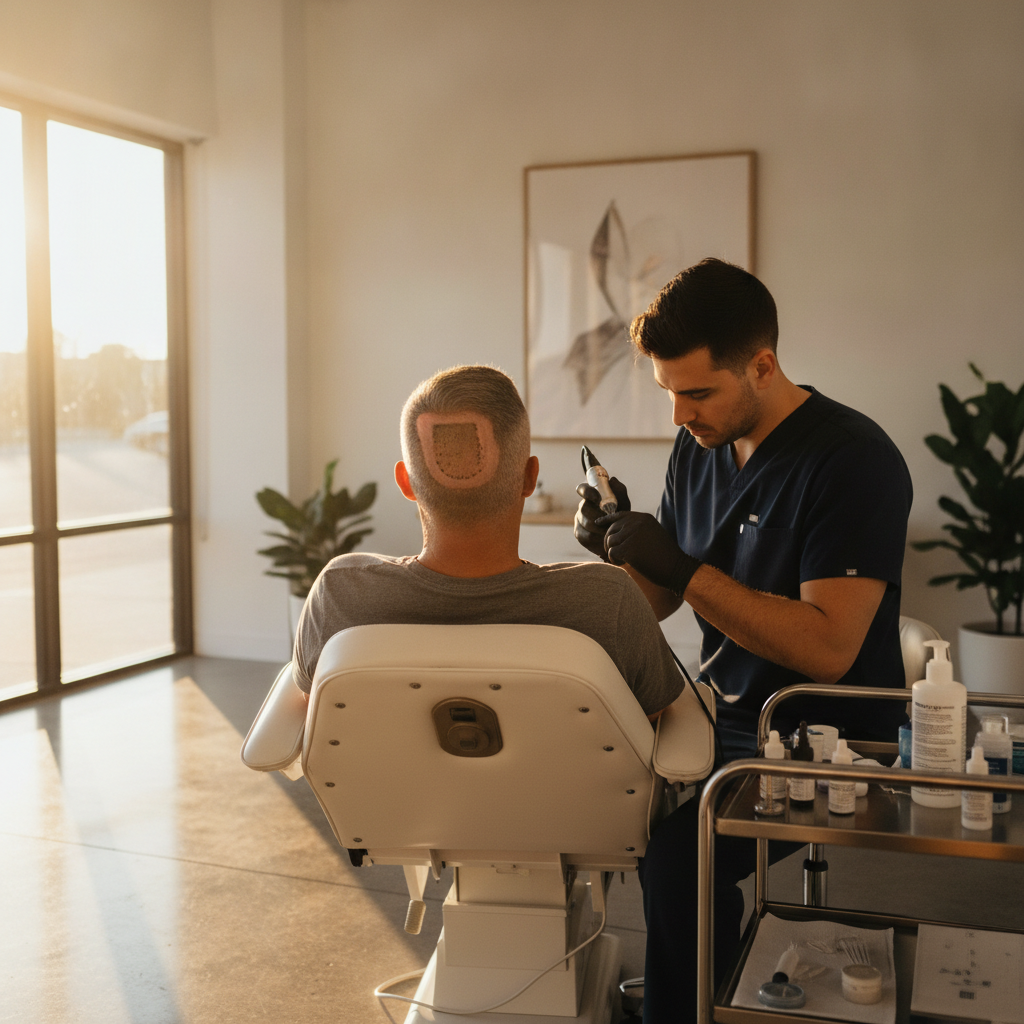

Can SMP Cover a Scalp Reduction or Flap Surgery Scar? What Stockton and Modesto Men Should Know About Older Hair Restoration Scars
Uncategorized9 min read

Can SMP Cover a Scalp Reduction or Flap Surgery Scar? What Stockton and Modesto Men Should Know About Older Hair Restoration Scars
Yes — scalp micropigmentation can significantly camouflage the scarring left behind by scalp reduction and flap surgery procedures. It’s not always simple work, and not every provider will tell you that upfront, but in experienced hands, SMP is one of the most effective tools available for blending these older, often complex scars back into the surrounding scalp. If you’re carrying a scar from a procedure you had years — or even decades — ago and you’ve quietly accepted that it’s just part of your life now, it doesn’t have to be. Here’s what you should know before you reach out to a studio in Stockton or anywhere else in the Central Valley.
What Are Scalp Reduction and Flap Surgery Scars — and Why Are They Different?
Scalp reduction was a popular hair restoration technique from roughly the 1970s through the 1990s. The procedure involved surgically removing bald sections of scalp and pulling the hair-bearing skin together to close the gap. Flap surgery — sometimes called a scalp flap or rotation flap — went a step further, repositioning sections of scalp with their own blood supply to cover balding areas. Both techniques were considered advanced at the time and were performed on tens of thousands of men.
The problem is that both procedures often left behind significant scarring — wide, irregular, sometimes raised or sunken seams that sit directly on the top or back of the scalp. Unlike the linear strip scar from a traditional FUT hair transplant, these scars can run in curved, zigzag, or even radial patterns. They may cause visible tension lines where the scalp was pulled tight, or leave behind areas of altered texture that catch light differently than the surrounding skin. Some men also experienced what’s called a “slot deformity” — a groove or indentation along the scar line that becomes more visible as surrounding hair continues to thin with age.
These aren’t subtle scars. And for many men who had these procedures done in their 30s or 40s, the scar is now fully exposed because the hair that once covered it has continued to recede. That’s a painful irony — a procedure meant to restore confidence ends up creating a new, more visible problem years later.
How SMP Approaches These Types of Scars
The goal of scalp micropigmentation in scar camouflage is not to erase the scar — it’s to neutralize its visibility by matching the pigment tone of the surrounding scalp and stubble. For standard hair transplant scars, this is a relatively straightforward process. For scalp reduction and flap surgery scars, the work is more nuanced, and here’s why:
- Irregular scar shapes require precise mapping. A curved or zigzag scar line doesn’t follow predictable geometry. An experienced SMP artist has to map the scar carefully, understanding where the skin texture changes and how pigment will settle differently in scar tissue versus healthy scalp.
- Scar tissue absorbs pigment differently. Dense, fibrous scar tissue tends to hold pigment less predictably than normal skin. It may require adjusted needle depth, pigment concentration, and additional sessions to achieve even coverage. This is why working with someone who has real scar camouflage experience — not just general SMP experience — matters enormously.
- Surrounding hair density affects strategy. If you still have some hair in the area, the SMP needs to blend seamlessly with that existing hair. If the scalp is fully exposed, the artist is working to replicate a consistent stubble tone across both the scar and the surrounding scalp.
- Tension lines and slot deformities need careful handling. Indented or raised areas may require a slightly different approach to avoid emphasizing the texture difference. An honest consultation will tell you what’s achievable and what isn’t.
What Results Actually Look Like — Managing Expectations Honestly
This is an area where you deserve a straight answer, not a sales pitch. SMP can dramatically reduce the visibility of scalp reduction and flap surgery scars in most cases. When done well, the scar blends into the surrounding scalp so that it reads as normal stubble or scalp tone at conversational distances — and even up close, it no longer draws the eye the way an uncovered scar does.
What SMP cannot do is fully restore the appearance of natural hair growth in a scarred area, or eliminate textural differences that are visible under very close inspection in strong raking light. If a scar has significant raised ridging or deep depression, the texture will still exist — the pigment simply reduces the color contrast that makes it stand out. For most men, that reduction in visual contrast is transformative. The scar stops being the first thing they — and everyone else — notice.
Results typically develop across two to three sessions, spaced several weeks apart. The first session establishes the base pigment layer. Subsequent sessions refine tone, fill in any areas where pigment didn’t settle evenly in the scar tissue, and dial in the final match. This is especially important with scar tissue, where you simply can’t rush the process.
Why This Topic Is Largely Ignored by Other Studios
If you’ve been searching for information about SMP for scalp reduction or flap surgery scars, you’ve probably noticed that almost no studio — including competitors across Sacramento and the broader Central Valley — addresses this topic directly. Most SMP content focuses on FUE and FUT hair transplant scars, which are far more common today. But scalp reduction and flap surgery patients are a real and underserved group, many of them now in their 50s, 60s, and 70s, who had these procedures done decades ago and have never found a satisfying answer for what the surgery left behind.
At Infusion SMP in Stockton, these clients deserve the same quality of care and the same honest conversation as anyone else sitting down for a consultation. If you’re coming from Modesto, Tracy, Manteca, or even making the drive down from Sacramento, we’ll look at your specific scar, talk through what SMP can realistically achieve, and give you a clear picture of the process — before you commit to anything.
It’s also worth knowing that the Central Valley’s intense summer sun adds a layer of consideration for anyone healing SMP work over scar tissue. Scar tissue can be more reactive to UV exposure during the healing window, so scheduling sessions during cooler months or committing to strict sun protection during recovery is especially important here. We’ll walk you through all of that during your consultation.
What to Ask at Your Consultation
Not every SMP studio has worked with scalp reduction or flap surgery scars specifically. Before you book anywhere, ask these questions:
- Have you worked on scalp reduction or flap surgery scars before — and can you show me examples?
- How do you adjust your technique for older, dense, or irregular scar tissue?
- How many sessions should I expect, and what does the healing process look like for this type of scar?
- What results are realistic for my specific scar — and what won’t SMP be able to fix?
An artist who gives you honest, specific answers to these questions is one you can trust. An artist who glosses over the complexity or guarantees results that sound too good is one to avoid.
If you’re wondering whether density work around the scar might also help blend the transition zone — especially if you still have thinning hair surrounding the scar area — that’s absolutely worth discussing as part of your overall plan.
Frequently Asked Questions
Can SMP cover a scalp reduction scar that’s been there for 20 or 30 years?
Yes. The age of the scar actually works in your favor in some ways — older, fully healed scar tissue tends to be more stable than fresh scarring. The pigment still needs careful placement, but a mature scar is typically easier to work with than one that’s still settling.
Will the SMP look different on scar tissue than on the rest of my scalp?
Pigment can settle slightly differently in scar tissue, which is why multiple sessions are important. After the full session process, the goal is a consistent, blended appearance — not a perfect match under a magnifying glass, but natural and undetectable in everyday life.
I live in Modesto — is it worth driving to Stockton for this type of specialized work?
For scar camouflage on a complex, older scar like a scalp reduction, finding an artist with the right experience matters far more than finding the nearest studio. The drive from Modesto on Highway 99 is straightforward, and many of our clients from Stanislaus County make that trip specifically because they want experienced, careful work — not the closest option.
How long does SMP last on scar tissue?
SMP on scar tissue generally lasts as long as standard SMP — typically several years before a refresher session may be needed to maintain vibrancy. Sun exposure is the main factor that accelerates fading, so consistent SPF use on the scalp after healing is especially important in San Joaquin County’s hot climate.
Is SMP the only option for covering a scalp reduction scar, or should I consider something else?
For most men, SMP is the most practical and lowest-risk option. Surgical scar revision is possible in some cases but carries its own risks and recovery, and further hair transplantation into scarred tissue can be unpredictable. SMP is non-surgical, requires no downtime that disrupts work or daily life, and produces results that most clients find genuinely satisfying.
Ready to Find Out What’s Possible for Your Scar?
You don’t have to keep working around a scar that’s been following you for decades. Whether you’re in Stockton, Modesto, Tracy, Manteca, or anywhere else in San Joaquin or Stanislaus County, Infusion SMP is here to have an honest conversation about what SMP can do for your specific situation — without pressure and without overpromising.
Reach out to us at infusionsmp.com/contact-us to request your free consultation. We’ll look at your scar, talk through realistic outcomes, and help you decide whether SMP is the right next step. You’ve waited long enough.
Results vary. SMP is a cosmetic tattoo procedure, not a medical treatment, and does not regrow hair. Individual results depend on skin, scalp, hair and aftercare.