

Can You Get SMP If You Have a Norwood 6 or 7 Pattern — Full-Scale Baldness? What Stockton and Modesto Men Should Know
Uncategorized10 min read
Can You Get SMP If You Have a Norwood 6 or 7 Pattern — Full-Scale Baldness? What Stockton and Modesto Men Should Know
If you’re at the point where most of the hair on top is gone and even the sides and back are thinning, you might feel like you’ve run out of options. Hair transplants require donor hair you may no longer have enough of. Hairpieces feel like a full-time job. Medications don’t grow back what’s already gone. But scalp micropigmentation — particularly a full scalp treatment — was practically built for men at the Norwood 6 and 7 stage. For men across Stockton, Modesto, Manteca, and the rest of the Central Valley dealing with advanced or complete baldness, SMP can deliver a result that looks purposeful, clean, and completely natural.
What Is a Norwood 6 or 7 Pattern, and Why Does It Matter for SMP?
The Norwood Scale is the standard way dermatologists and hair specialists classify male pattern baldness from Type 1 (barely any loss) to Type 7 (the most advanced stage). At Type 6 and 7, the familiar horseshoe fringe is either significantly thinned or nearly gone. There’s minimal separation between the thinning top and the receding sides, and in some cases very little donor-safe hair remains anywhere on the scalp.
For hair transplant surgeons, a Norwood 6 or 7 is a significant challenge — there may simply not be enough healthy donor hair to create meaningful coverage. That’s why many men in this category are either told to manage expectations drastically or turned away entirely. With SMP, however, there’s no donor hair requirement. The artist is working with pigment, not follicles — which means advanced baldness doesn’t limit the procedure the way it limits surgery.
What Full Scalp SMP Actually Involves at This Stage
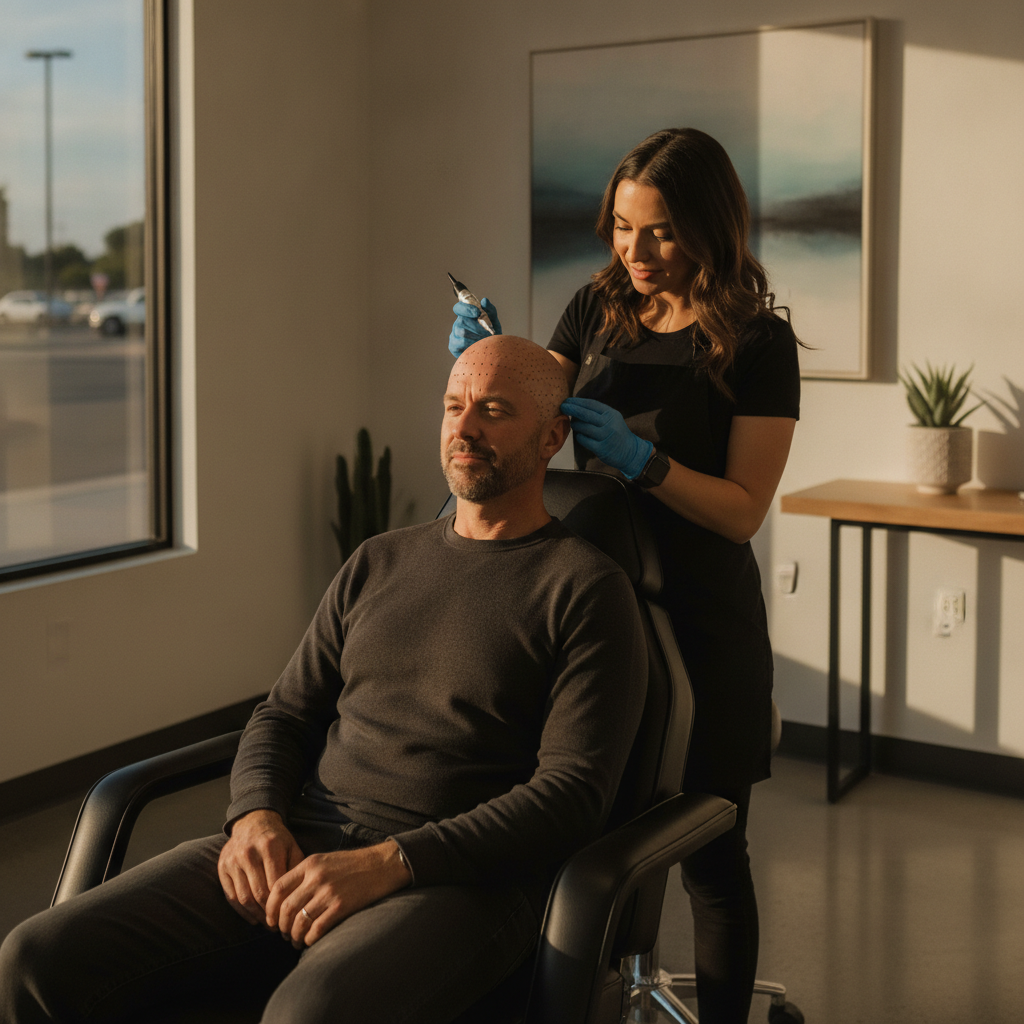
At the Norwood 6 or 7 level, the most common approach is a full scalp SMP treatment designed to replicate the look of a closely shaved head — a clean, intentional buzz-cut or blade-shaved aesthetic. This isn’t about trying to fake a full head of hair. It’s about creating the impression that you chose to shave your head, and that the shape and definition of your scalp look deliberate and polished.
Here’s what that typically involves:
- Hairline design: Even on a completely bald scalp, your artist will map out a hairline that fits your face shape, head size, and age. The goal is something that looks like it belongs to you — not too low, not too sharp, not one-size-fits-all. A good SMP artist in Stockton will spend real time on this step before a single drop of pigment touches your scalp.
- Full scalp coverage: Pigment is applied across the entire top of the scalp to replicate the appearance of hair follicle stubble. At this stage, that often includes the crown, mid-scalp, and front hairline area — the full canvas.
- Blending into the sides and back: For men at Norwood 6 or 7, the sides and back may be thinning too. Your artist will blend the pigment seamlessly into any remaining natural hair, so there’s no visible line between the treated and untreated areas.
- Shade matching: Pigment color is custom-matched to your natural hair color and skin tone. This is one of the most underrated steps — getting the shade slightly wrong on a full scalp treatment is much more noticeable than on a smaller area, which is why experience really counts here.
The full process usually spans two to three sessions, spaced several weeks apart. Each session builds on the last, and the results look progressively more refined and natural as the pigment settles and the scalp heals. Learn more about how the SMP process works from start to finish.
The Part Most Competitor Studios Skip Over: What Makes Full Scalp SMP Different from Partial Coverage
Here’s something that rarely gets addressed in detail — and it’s one of the most important things men with advanced baldness need to understand before choosing a provider. A full scalp SMP treatment at the Norwood 6 or 7 stage is fundamentally more complex than treating a receding hairline or adding density to thinning hair. It requires a higher level of skill for several reasons:
- The hairline is being created from nothing, not refined or restored. That means the design judgment has to be right before any pigment goes in.
- The artist has to maintain consistent dot size, depth, and spacing across a much larger surface area — inconsistency becomes much more visible on a full scalp.
- The transition from treated scalp to any remaining natural hair has to be seamless. A blunt or uneven edge looks artificial immediately.
- Pigment must be applied at a depth that retains well in Central Valley conditions — the hot, dry summers in the San Joaquin Valley accelerate skin cell turnover, which can affect how pigment fades over time if the technique isn’t precise.
When you’re evaluating providers — whether in Stockton, Tracy, or even Sacramento — ask specifically about their experience with full scalp treatments at advanced Norwood stages. Ask to see examples. A portfolio of partial hairline treatments tells you something, but not nearly enough if you’re at Norwood 6 or 7.
What About Men Who Still Have Some Hair on the Sides?
Most men at Norwood 6 or 7 still have some hair on the sides and back, even if it’s thin. In these cases, SMP is designed to work alongside your existing hair — not replace it or require you to shave everything off (though many men do prefer a clean shave once they see how sharp the result looks).
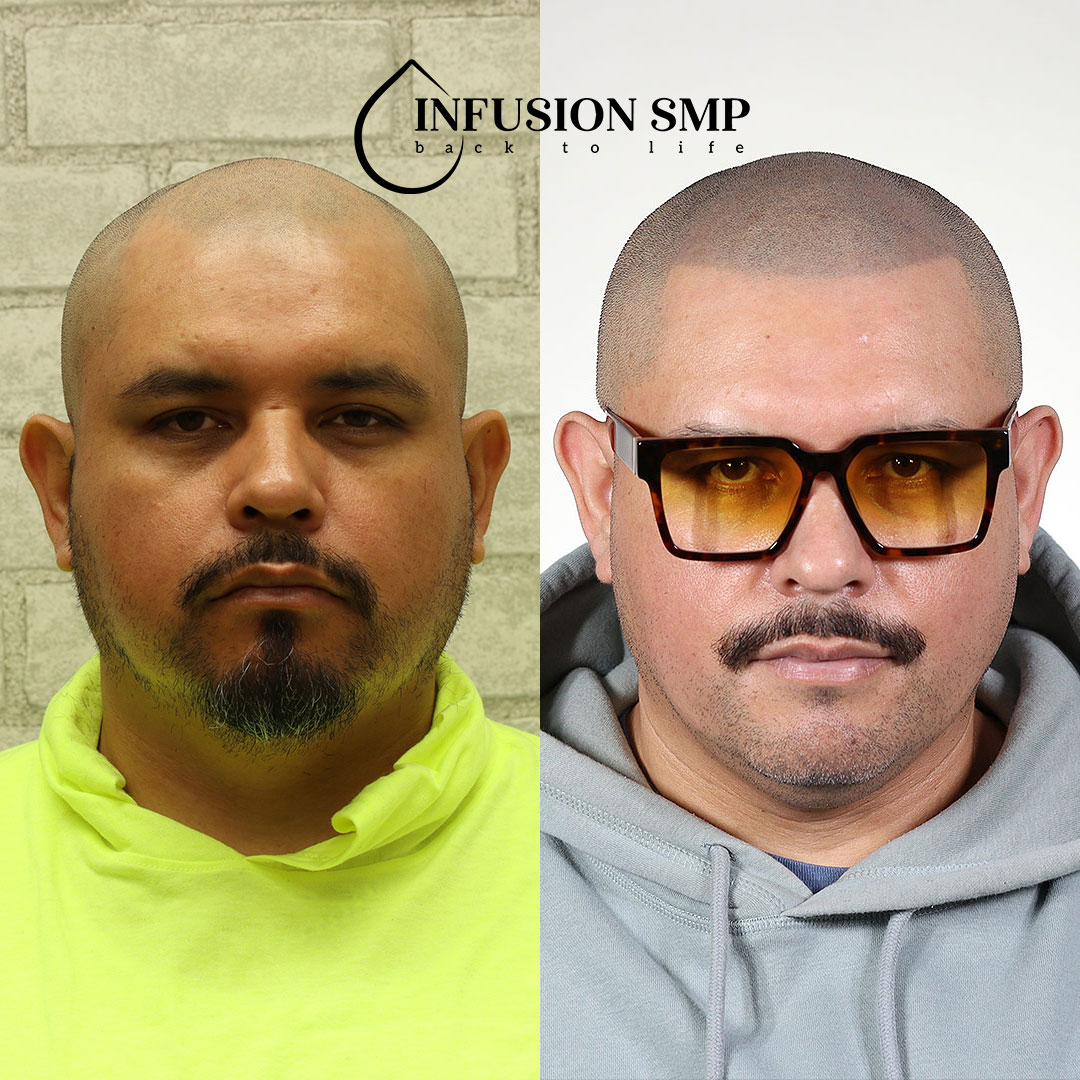
Your SMP artist will blend the pigment into the fringe hair so the transition looks natural. If you keep a short buzz, the treated scalp matches the texture of the closely cut sides. If you shave completely, the treated area looks like a full, even stubble across your entire head — no ghost patches, no visible scalp, no awkward contrast.
Many men in the Modesto and Manteca area come in unsure about whether to shave fully or keep what’s left. That’s exactly the kind of conversation worth having during your consultation — a good artist will walk you through both approaches and show you what each result tends to look like.
Aftercare Matters More at This Scale
Covering a full scalp means more surface area to protect during healing. In Central Valley summers — where temperatures in Stockton regularly push past 100°F — sun exposure is one of the biggest threats to pigment retention in the first weeks after your session. UV rays can break down pigment and cause premature fading if you’re not protecting the scalp consistently.
For full scalp SMP clients, aftercare generally means:
- Keeping the scalp out of direct sun for at least 28 days post-session, or using SPF 50+ if outdoor exposure is unavoidable
- Avoiding swimming, heavy sweating, and steam rooms during the initial healing window
- Moisturizing the scalp daily once healing is complete to keep the skin supple and pigment looking fresh
- Not picking or scratching any flaking or dry patches — this is especially tempting with a larger treated area
If you work outdoors — in agriculture, construction, or any trade that keeps you in direct sun across San Joaquin or Stanislaus County — talk with your artist about scheduling sessions around your work calendar so you have adequate healing time built in.
How Does the Cost Compare to Other Options at This Stage?
For men at Norwood 6 or 7, the alternative options are limited and expensive. A hair transplant — if you even have sufficient donor coverage — can run $10,000 or more and still may not deliver satisfying density at this stage. Hair systems require ongoing adhesive, adjustment, and replacement costs that add up significantly year over year. SMP for a full scalp treatment is typically in the range of $2,500 to $4,000 depending on the scope of coverage, the number of sessions needed, and the provider’s experience level. It’s a one-time investment, not a recurring expense.
That said — don’t choose a provider based on price alone. At this scale, the result covers your entire head. There is no hiding a poorly executed full scalp treatment. The cost difference between an experienced local SMP artist and someone undercutting on price is not worth the risk.
See how Infusion SMP serves Stockton and the surrounding Central Valley area.
Frequently Asked Questions: Full Scalp SMP for Advanced Baldness
Do I have to shave my head completely to get full scalp SMP?
Not necessarily, but most men at the Norwood 6 or 7 stage get the cleanest result with a closely shaved or blade-shaved head. Your artist can work with whatever length you prefer, but the shorter the remaining hair, the more seamless the blend between natural hair and treated scalp.
Will the hairline look fake if I have no natural hairline left as a reference?
Only if the artist designs it poorly. An experienced SMP practitioner draws on your face shape, bone structure, skin tone, and age to create a hairline that looks like it was always yours. It shouldn’t look sharp or tattooed — it should look like a freshly shaved head with natural edge variation.
How long does a full scalp SMP treatment take across all sessions?
Plan for two to three sessions spaced three to four weeks apart. Each session typically runs two to four hours depending on the coverage area. The full process from first session to final result usually spans about six to ten weeks.
Does SMP on a fully bald scalp require more touch-ups over time?
Full scalp treatments may need a touch-up every three to five years, similar to any other SMP work. In hot, sunny climates like the Central Valley, sun exposure is the main factor that accelerates fading — diligent SPF use significantly extends how long your result stays sharp between touch-ups.
I’ve seen full scalp SMP that looked obviously artificial. How do I avoid that?
This almost always comes down to pigment color selection, dot placement technique, and hairline design. Artificial-looking results happen when pigment is too dark, dots are too large or uniform, or the hairline edge is too perfectly straight. Ask any provider you’re considering to show you healed full scalp results — not photos taken immediately after treatment — so you can see how the work settles over time.
Ready to See What Full Scalp SMP Could Look Like for You?
If you’re at the Norwood 6 or 7 stage and you’re tired of working around something that isn’t working, scalp micropigmentation deserves a serious look. At Infusion SMP Scalp Micropigmentation in Stockton, we work with men across the Central Valley — from Lodi to Tracy to Modesto — who are done with workarounds and ready for a result that actually fits their life. The consultation is free, there’s no pressure, and it’s the right place to start asking the questions that matter. Reach out today and schedule your free consultation.
Results vary. SMP is a cosmetic tattoo procedure, not a medical treatment, and does not regrow hair. Individual results depend on skin, scalp, hair and aftercare.