
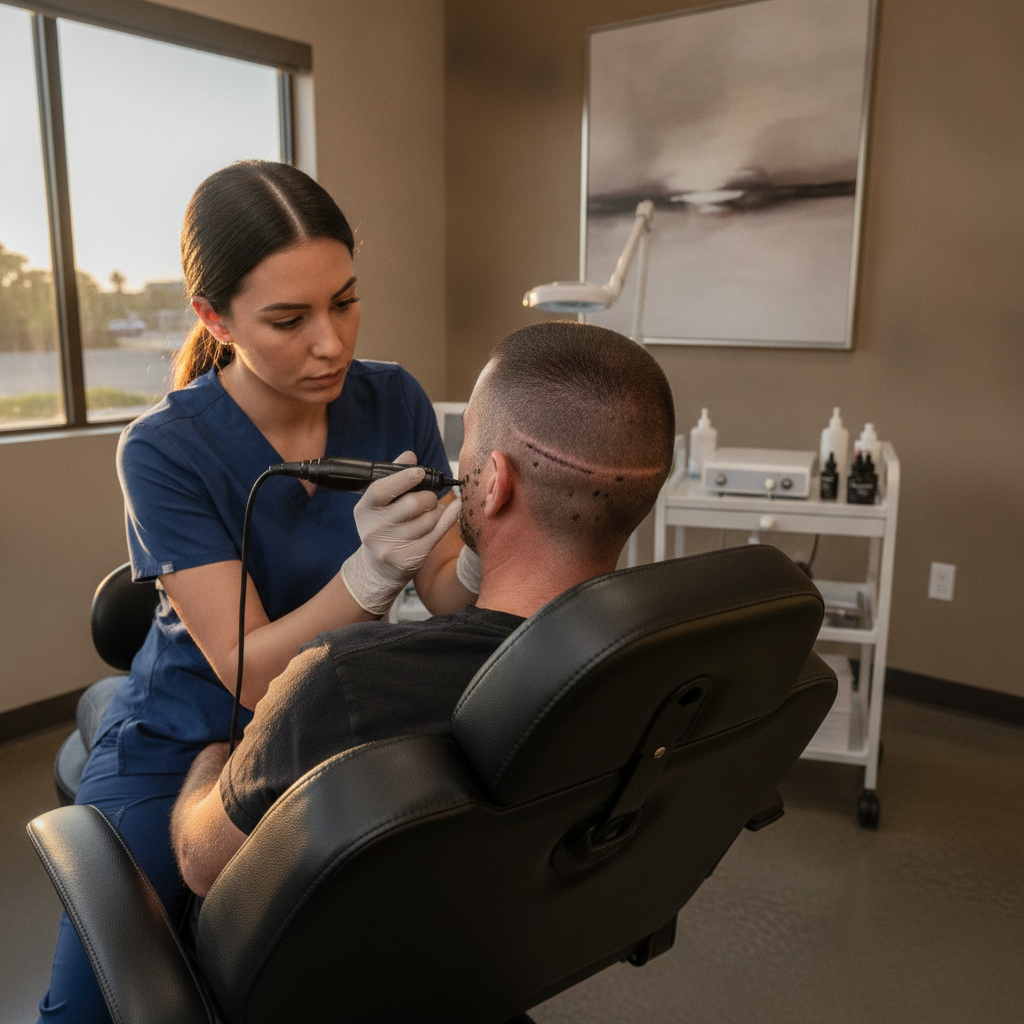

How Do You Cover a Hair Transplant Scar with SMP? What Stockton and Sacramento Men Should Know About FUE and FUT Scar Camouflage
Uncategorized9 min read

How Do You Cover a Hair Transplant Scar with SMP? What Stockton and Sacramento Men Should Know About FUE and FUT Scar Camouflage
Yes — scalp micropigmentation can cover hair transplant scars, and in many cases, it’s the most effective non-surgical option available. Whether you’re dealing with a long linear strip scar from a FUT procedure or a field of tiny circular scars from FUE extraction, SMP can deposit pigment directly into and around the scar tissue to match the surrounding scalp and stubble. For men in Stockton, Sacramento, and across the Central Valley who had a hair transplant years ago and are now left with a visible scar they can’t hide, SMP scar camouflage offers a path to finally feeling comfortable with a short, clean look.
Why Hair Transplant Scars Are More Common — and More Visible — Than People Expect
Hair transplants have become increasingly popular, and many men in the region made that investment hoping to restore what they’d lost. For a lot of them, the transplant worked reasonably well — but the scarring left behind became a different problem entirely. With a FUT (follicular unit transplantation) procedure, a strip of scalp is removed from the donor zone at the back of the head, leaving a horizontal linear scar that can range from nearly invisible to quite wide depending on healing, tension, and the surgeon’s technique. With FUE (follicular unit extraction), the donor area is punctured hundreds or thousands of times to harvest individual follicles, leaving a pattern of small round scars that, when the hair is cut short, can look like a constellation of white dots against the scalp.
Neither type of scar goes away on its own. And both become increasingly visible the shorter you cut your hair. If you’ve been keeping your hair longer just to hide what’s on the back of your head, you already know the frustration — and the feeling that your haircut choices are being made for you.
How SMP Scar Camouflage Actually Works
Scar tissue is different from normal scalp skin. It’s often smoother, less porous, and lighter in color — which is exactly why it stands out. SMP scar camouflage involves using specialized pigments and needle techniques to deposit color into and around the scar so that it visually blends with the surrounding scalp and the appearance of hair follicles.
For a FUT strip scar, the goal is to fill in the light band with pigment that matches the tone and texture of your shaved scalp, effectively making the scar disappear into the surrounding stubble pattern. For FUE dot scars, the process involves matching each extraction point with a pigmented dot that mimics a natural follicle, so the scattered white marks blend seamlessly into the rest of the donor area.
The technique requires a skilled hand. Scar tissue doesn’t always accept pigment the same way healthy scalp skin does — it can be more resistant, patchy, or unpredictable in how it heals. This is why scar camouflage is genuinely one of the more technically demanding applications of SMP, and why the artist’s experience matters so much. Learn more about what scalp micropigmentation can address across different hair loss types.
What Results Look Like — and What’s Realistic to Expect
Done well, SMP scar camouflage can make a FUT scar nearly undetectable even when the hair is cut to a short buzz or shaved close. The scar doesn’t disappear in the literal sense — the tissue is still there — but the visual contrast between the scar and the surrounding scalp is reduced dramatically. Most clients find they can finally cut their hair the way they want without positioning every strand to cover the back of their head.
FUE scar coverage tends to be even more seamless, because the individual dot scars are small and already scattered in a pattern that mirrors what SMP naturally produces. In many cases, even people who know what to look for struggle to distinguish treated FUE extraction areas from a healthy donor zone.
That said, results depend on several variables: how wide or raised the FUT scar is, how your scar tissue absorbs pigment, your skin tone, and how well you follow aftercare. Some scars require an additional session to fully saturate the tissue. A skilled artist will be honest with you during your consultation about what level of coverage is realistic for your specific scar.
The Gap Most Competitors Don’t Address: What If Your Transplant Worked But Left You Worse Off?
Here’s something you won’t find clearly explained on most SMP studio websites: a significant portion of scar camouflage clients aren’t just hiding a scar — they had a transplant that didn’t deliver the results they hoped for, and now they’re dealing with two problems. The hair didn’t grow in as densely as expected, and the scarring from the procedure is now visible when they cut their hair short. In that situation, SMP can actually address both issues at once.
For the donor zone, SMP camouflages the scar. For the recipient area — where transplanted hair grew in thin or patchy — SMP can add the appearance of density between existing hairs, filling in the gaps and making the overall result look fuller and more intentional. This density work is one of the most underappreciated applications of SMP for men who still have some hair but want more coverage.
If you’re in Stockton, Lodi, Elk Grove, Modesto, or anywhere in San Joaquin County and Sacramento County and you feel like your transplant left you with more questions than answers, this combined approach may be exactly what you’ve been looking for.
Sessions, Healing, and What Happens in Central Valley Heat
Scar camouflage typically requires two to three sessions, spaced several weeks apart, to allow the skin to heal and the pigment to settle before adding additional density or coverage. The first session lays the foundation. By the second session, your artist can assess how the scar tissue responded and refine accordingly. Most clients achieve their final result by session three.
If you’re coming in during the summer months — and Central Valley summers are no joke — you’ll want to be diligent about sun protection during healing. The back of your head is particularly exposed when you’re working outdoors, commuting on Highway 99 with the sun coming through the back window, or just spending time outside. UV exposure during healing can cause pigment to fade unevenly, which matters even more in scar tissue that’s already less predictable. Your artist will walk you through exactly what to avoid and for how long.
Frequently Asked Questions About SMP for Hair Transplant Scars
How long do I need to wait after a hair transplant before getting SMP on the scar?
Most artists recommend waiting at least 12 months after your transplant surgery before pursuing SMP on the scar. The tissue needs time to fully mature and stabilize. Treating an immature scar can lead to unpredictable pigment retention and potentially compromise the final result. If you’re unsure whether your scar is ready, bring photos and discuss your timeline during your consultation.
Will SMP make my FUT scar completely invisible?
Not completely invisible in every case — but dramatically less noticeable. The goal is to reduce visual contrast so the scar blends with the surrounding scalp at normal viewing distances. Wide or raised scars may not achieve 100% coverage in a single area, but even significant improvement can allow you to wear your hair much shorter than before without anxiety about what people see.
Does it hurt more to get SMP on scar tissue than on a normal scalp?
Sensation varies. Some clients report that scar tissue is actually less sensitive because nerve endings may have been disrupted during healing. Others find certain areas of a scar more sensitive than expected. Either way, the experience is manageable, and your artist can adjust pace and technique to keep you comfortable throughout each session.
Can SMP fix FUE scars even if they’re spread across a large donor area?
Yes. FUE extraction scars distributed across the donor zone are actually one of the cleaner applications of scar camouflage, because the pattern of dots naturally mirrors what SMP creates anyway. A skilled artist can blend your extraction points into the treated area so that the entire donor zone looks consistent and uniform — no patchiness, no giveaway dots.
Do Sacramento-area studios handle this differently than Stockton providers?
The technique itself is consistent across skilled practitioners, but working with someone local to Stockton means you’re not driving to Sacramento for every session and every follow-up. Given that scar camouflage requires multiple appointments and at least one post-healing check, choosing a studio close to home — or close to your work in San Joaquin County — makes the process significantly less disruptive to your schedule.
You Invested in Your Hair. You Deserve Results You Can Actually Live With.
A hair transplant is a serious investment — financially and emotionally. If the scar it left behind has been controlling how you cut your hair or making you self-conscious every time someone stands behind you, that’s not the outcome you signed up for. SMP scar camouflage won’t undo the surgery, but it can close the chapter on the scar and give you the freedom to wear your hair the way you actually want to.
At Infusion SMP Scalp Micropigmentation, we work with clients from across Stockton, Sacramento, Modesto, Lodi, Elk Grove, and throughout the Central Valley who are ready to stop managing their scar and start moving past it. Every scar is different, and we’ll be straightforward with you about what’s achievable for yours.
Ready to find out what your scar camouflage results could look like? Reach out to schedule your free consultation — no pressure, no commitment, just an honest conversation about your options.
Results vary. SMP is a cosmetic tattoo procedure, not a medical treatment, and does not regrow hair. Individual results depend on skin, scalp, hair and aftercare.