

Can You Get SMP If You Have a Keloid Scar or Raised Scarring on Your Scalp? What Stockton and Sacramento Clients Should Know
Uncategorized9 min read

Can You Get SMP If You Have a Keloid Scar or Raised Scarring on Your Scalp? What Stockton and Sacramento Clients Should Know
If you have a keloid or raised scar on your scalp and you’ve been searching for answers about whether SMP can help, you’ve probably found a lot of silence. Most studios — including several that serve clients from Sacramento down through the Central Valley — don’t address this topic in any real depth. They’ll mention scar camouflage in passing, maybe show a before-and-after of a flat FUT strip scar, and leave it at that. But keloid and hypertrophic scars are a different situation entirely, and you deserve a straight answer.
The short version: SMP can work on raised scarring in many cases, but it requires a more careful approach, a realistic conversation about expectations, and an artist who has actually worked on scar tissue before — not just on healthy scalp skin. Here’s what you need to understand before you sit down anywhere.
What Is a Keloid Scar, and Why Does It Behave Differently on the Scalp?
A keloid is a type of raised scar that grows beyond the boundary of the original wound. Unlike a flat surgical scar or a faded injury mark, keloids are firm, often shiny, and can be tender or itchy. They form when the body overproduces collagen during healing — and certain skin types are significantly more prone to them, including people with darker skin tones who make up a large portion of the population we serve throughout San Joaquin County and the broader Central Valley.
Hypertrophic scars are related but distinct — they’re also raised and firm, but they stay within the original wound margins rather than spreading outward. Both types behave differently under a needle than flat skin does. The texture is denser, pigment absorption can be inconsistent, and there’s a real risk that additional trauma to the area could trigger further keloid growth in susceptible individuals.
This is the part most SMP studios in the region gloss over. And it’s exactly why you should be asking hard questions during any consultation.
What’s Actually Possible with SMP on Raised Scar Tissue?
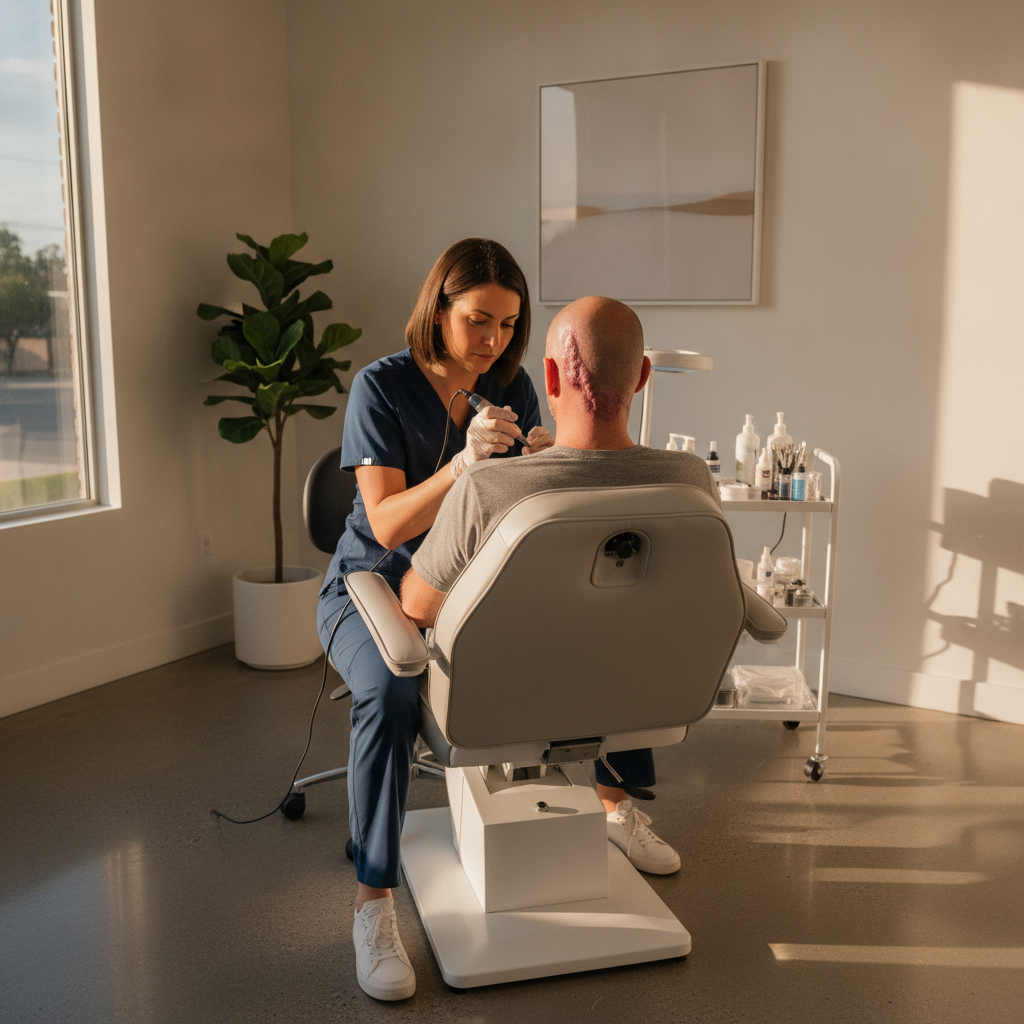
The goal of scalp micropigmentation on a scar — whether it’s flat or raised — is camouflage. You’re not erasing the scar. You’re depositing pigment into and around it so that the color contrast between the scar tissue and the surrounding scalp is reduced. When done well, the scar blends into the surrounding stubble pattern and becomes far less visible, even under close inspection.
For keloid and hypertrophic scars, what’s achievable depends on a few factors:
- The size and location of the scar. A smaller, stable raised scar in a less sensitive area of the scalp generally responds better than a large, active keloid near the hairline or crown.
- Whether the scar is fully healed and stable. Active or still-forming keloids are not appropriate for SMP. The scar needs to have stopped growing and be fully mature — typically at least 12 to 18 months post-injury — before any pigment work should happen.
- Your history of keloid formation. If you’ve developed keloids elsewhere on your body from minor injuries, tattooing, or surgical procedures, you and your artist need to have an honest discussion about whether introducing a new needle wound to the scalp is advisable. In some cases, a small test patch in an inconspicuous area is the right move before committing to a full session.
- Pigment retention in scar tissue. Scar tissue tends to be less receptive to pigment than normal skin. The results may require more sessions, more passes, and more patience to build up to a believable density. This isn’t a reason to avoid it — it’s just a reason to go in with realistic expectations.
The Risk That Most Studios Don’t Mention Openly
Here’s what you won’t read on most SMP studio websites, including several of the larger ones pulling clients from Tracy, Modesto, and Sacramento: introducing needle trauma to a keloid-prone scalp carries a real risk of triggering new keloid growth at the treatment site.
This is not a reason to panic, and it doesn’t mean SMP is off the table for you. It means you need an artist who will take your full skin and health history seriously, who will talk through the risks honestly, and who will not just take your deposit and hope for the best. If an artist dismisses this concern or tells you there’s nothing to worry about without asking any questions about your scar history, that’s a sign to walk away.
A qualified SMP artist will discuss your scar’s history, whether you’ve had other keloids, how the original scar formed, and what your skin has done in the years since. They may recommend you consult with a dermatologist before proceeding. That kind of thoroughness is what separates a genuinely skilled practitioner from someone who is simply looking to fill a session slot.
What a Good SMP Session on Raised Scarring Actually Looks Like
If you and your artist decide to move forward, the approach to a raised scar is typically more conservative than a standard SMP session. Your artist will likely work at a lighter pressure, use a finer needle configuration, and build pigment gradually over multiple sessions rather than attempting to saturate the area in one go. This reduces trauma to the tissue and allows you both to assess how your skin is responding before committing to more coverage.
The surrounding scalp area will also be treated to blend outward from the scar, creating a gradual transition that draws the eye away from the raised texture. Even if the scar itself isn’t perfectly concealed, the overall visual impression — especially at a normal conversational distance — can be dramatically improved.
For clients who also have thinning hair in the surrounding area, combining scar camouflage with density enhancement work can make the entire scalp look more uniform and full, not just the scar area itself.
Aftercare Is Even More Important for Scar Clients
Aftercare matters for every SMP client, but it matters more when scar tissue is involved. In the Central Valley, the dry heat and intense sun that define summers in Stockton, Tracy, and Modesto can stress healing skin in ways that more temperate climates don’t. Keeping the treated area moisturized, avoiding direct sun exposure during the healing window, and not picking or scratching at any scabs that form is critical — especially on scar tissue, which is already more fragile and reactive than normal skin.
Your artist should give you specific aftercare guidance tailored to your skin type and the nature of your scar. Generic aftercare sheets are fine for standard clients. For keloid-prone skin, the instructions need to be more specific and the follow-up communication should be ongoing.
Frequently Asked Questions: SMP and Keloid or Raised Scars
Will SMP make my keloid scar worse or bigger?
It’s possible in individuals who are prone to keloid formation, because SMP does introduce needle trauma to the skin. This risk is manageable with proper screening, a conservative technique, and sometimes a test patch — but it should be discussed openly before any work begins.
How do I know if my scar is ready for SMP?
Your scar should be fully healed, stable, and not actively growing for at least 12 to 18 months before SMP is considered. If the scar is still red, tender, or changing in size, it is not ready. A dermatologist can help confirm this if you’re unsure.
How many sessions will I need for scar camouflage on raised scarring?
Most standard SMP treatments involve two to three sessions. Raised or keloid scars may require additional sessions depending on how the tissue absorbs pigment. Your artist should set expectations around this during your consultation — not after you’ve already paid.
I have a scar from an injury years ago, not a hair transplant. Can SMP still help?
Yes. SMP scar camouflage isn’t limited to surgical or transplant scars. Injury scars, burn scars, and scars from accidents can all potentially be treated, depending on the texture, size, and location of the scar and your skin’s history.
Is there an SMP studio near Stockton or Sacramento that has experience with keloid-prone skin?
That’s exactly the right question to ask, and the answer should come with examples or a direct conversation about their approach — not just a vague yes. At Infusion SMP in Stockton, we take the time to understand your specific scar history before recommending any course of treatment.
You Deserve a Practitioner Who Takes Your Skin Seriously
Keloid and raised scars are not a reason to give up on looking and feeling like yourself again. They are a reason to be more careful about who you trust to work on your scalp. If you’re in Stockton, Modesto, Tracy, Sacramento, or anywhere else in the Central Valley, and you have a scar you’ve been quietly hoping someone could help with — we’d like to have that conversation with you.
At Infusion SMP Scalp Micropigmentation, we work with clients whose cases don’t fit the standard mold. We ask the questions other studios skip. And we will never promise you something we can’t deliver just to get you through the door.
If you’re ready to talk about what’s possible for your specific situation, reach out and book a free consultation through our contact page. No pressure, no sales pitch — just an honest conversation about your scalp, your scar, and what SMP can realistically do for you.
Results vary. SMP is a cosmetic tattoo procedure, not a medical treatment, and does not regrow hair. Individual results depend on skin, scalp, hair and aftercare.