
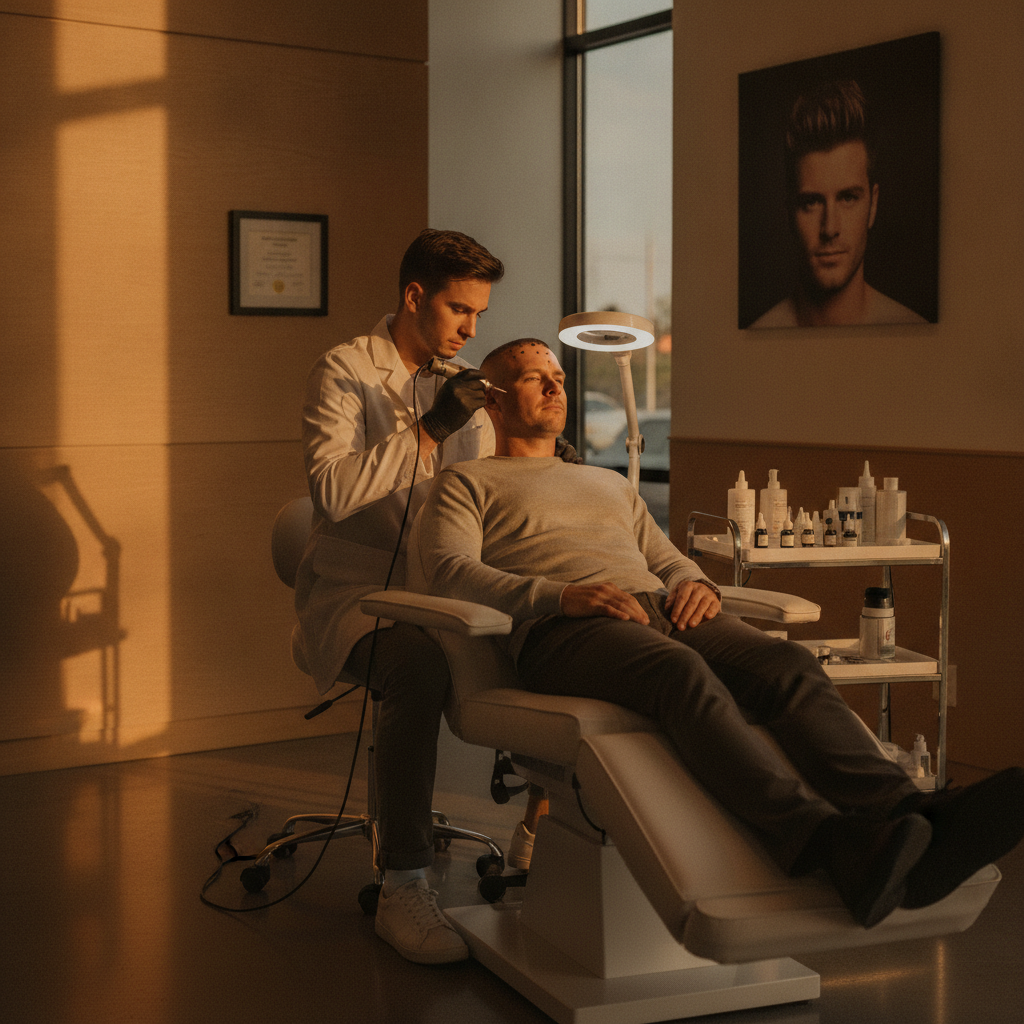

What’s the Difference Between SMP and a Hair Tattoo? What Stockton and Sacramento Men Should Know Before Choosing
Uncategorized8 min read

What’s the Difference Between SMP and a Hair Tattoo? What Stockton and Sacramento Men Should Know Before Choosing
Scalp micropigmentation and a traditional hair tattoo are not the same thing — and if someone at a local tattoo shop told you otherwise, that’s worth pausing on. The two procedures share a basic concept: pigment is deposited into the scalp. But that’s roughly where the similarity ends. For men in Stockton, Tracy, Lodi, and the surrounding areas who are weighing their options for hair loss, understanding exactly what separates SMP from a standard cosmetic tattoo can save you from a result that looks nothing like what you imagined.
Why the Confusion Exists in the First Place
It’s easy to understand why people use the terms interchangeably. Both involve needles and pigment on the scalp. Some tattoo artists even advertise that they offer “hair tattoos” or “scalp tattoos” for hair loss — and in a price-sensitive market like the Central Valley, a lower price from a local tattoo shop can be tempting. But what sounds similar on paper can produce dramatically different results on your head, and those results tend to become more obvious over time, not less.
The confusion also comes from the fact that SMP is a relatively newer field. Not everyone in San Joaquin County has heard of it, and not every practitioner calling themselves an SMP artist has been properly trained. That gap in awareness is exactly why it’s worth slowing down and understanding what you’re actually comparing.
The Key Differences Between SMP and a Traditional Hair Tattoo
Needle Size and Technique
Traditional tattoo needles — even the smallest ones used in fine-line work — are designed to deposit ink into a relatively wide area of skin. SMP uses specialized micro-needles with much finer tips, specifically calibrated to create impressions that replicate the size and shape of a real hair follicle. The goal is to produce a tiny dot, not a line, not a smudge, not a filled-in shape. When done correctly, those individual dots blend together to create the visual effect of a closely cropped stubble or a denser scalp — something a standard tattoo needle simply cannot replicate with the same precision.
Pigment Composition
This is probably the most important difference that most people never think to ask about. Traditional tattoo ink is formulated to stay vivid and sharp over decades. That sounds like a good thing — until you realize that on a scalp, that permanence becomes a problem. Black tattoo ink tends to spread beneath the skin over time, turning what were once crisp dots into blurry blobs. It also tends to shift in color, often fading toward blue, green, or gray tones. These color shifts are especially visible against a light skin tone under direct sunlight — something you deal with constantly in the Central Valley heat.
SMP pigments are specifically formulated to remain stable in color over time without shifting to unnatural tones. They’re designed to fade gradually and evenly, in a way that can be maintained with periodic touch-up sessions rather than turning into something you’d need to explain away. Scalp micropigmentation as a dedicated procedure accounts for this biology from the start.
Depth of Pigment Placement
Where the pigment is placed in the skin matters enormously. SMP is deposited into the upper dermis — a shallower layer than where traditional tattoo ink is placed. This shallower depth is part of what helps SMP maintain its dot-like appearance and prevents spreading. It also means the healing process is different, typically milder, with less redness and recovery time. For guys in Elk Grove, Modesto, or Tracy who can’t afford to look rough at work for a week, that matters.
Artist Training and Specialization
A skilled tattoo artist is talented at what they do — but tattooing and scalp micropigmentation require different training, different hand pressure, different equipment settings, and a completely different understanding of scalp anatomy and hair follicle simulation. An SMP artist who has completed proper training and worked exclusively on scalps develops an eye for follicle pattern replication that a general tattoo artist simply doesn’t have. The goal isn’t just to place pigment — it’s to understand how hair grows, how hairlines naturally recede with age, and how to design a result that looks like it belongs on your specific head.
What Happens When Someone Uses a Regular Tattoo for Hair Loss
It’s not hard to find cautionary examples online. Men who went to tattoo shops for scalp work and ended up with results that faded unevenly, shifted to blue or green, or spread into indistinct patches rather than clean follicle impressions. Correcting a bad scalp tattoo is possible, but it adds cost, time, and complexity to what should have been a straightforward process from the start.
If you’re already considering SMP as a solution for a receding hairline, thinning crown, or full hair loss, you deserve to have it done with tools and technique designed specifically for that purpose. That’s not a luxury — it’s what makes the difference between a result you’re proud of and one you’re hoping nobody looks too closely at.
What a Real SMP Result Actually Looks Like
Properly executed SMP produces results that are genuinely difficult to distinguish from a natural shaved head or a denser scalp. The dots are consistent in size, naturally varied in placement (because real hair doesn’t grow in uniform rows), and matched precisely to your skin tone and natural hair color. When someone stands next to you at work, across a table at a restaurant in downtown Stockton, or out in the sun at a weekend event in Lodi — they should not be able to tell. That’s the standard. Anything that falls short of that standard isn’t really SMP, regardless of what it’s called.
The session structure also reflects this precision. Most clients complete two to three sessions spaced a few weeks apart, allowing the pigment to settle and the artist to refine the result progressively. It’s not a one-and-done appointment — it’s a process that builds toward a result that holds up over time. For men dealing with thinning hair rather than full baldness, the same precision is applied to blending density into areas where hair still exists, making the difference even harder to detect.
Frequently Asked Questions
Can a tattoo artist do SMP if they’ve taken a short course?
Some tattoo artists do pursue proper SMP training and develop genuine skill in the procedure. The key is asking specifically about their SMP training, how many scalp micropigmentation procedures they’ve completed, and whether you can see a portfolio of healed results — not just fresh work. Fresh SMP always looks sharp; what matters is how it looks after six months.
Will SMP turn blue or green over time the way some tattoos do?
Not when it’s done with SMP-specific pigments by a trained artist. The color-shifting issue is associated with standard tattoo inks, which contain different compounds than SMP pigments. That’s one of the most important reasons the distinction between SMP and a hair tattoo actually matters.
Is SMP more expensive than getting a scalp tattoo at a regular shop?
Often yes — but the comparison isn’t really apples to apples. SMP typically ranges from roughly $1,500 to $4,000 depending on the extent of coverage, and that includes multiple sessions with a specialist. A scalp tattoo from a regular shop may cost less upfront, but if the result needs correction or removal later, you’ll spend significantly more overall.
Do SMP studios in the Stockton area use different equipment than tattoo shops?
Yes. Dedicated SMP studios use specialized machines and needle configurations designed specifically for scalp work. The settings, depth, speed, and needle type are all calibrated differently than what a standard tattoo machine uses. This isn’t a minor technical detail — it’s central to why the results differ.
How do I know if someone offering SMP in Sacramento or Stockton is actually trained?
Ask directly about their SMP-specific training and certification, how long they’ve been practicing scalp micropigmentation as a dedicated service, and request a portfolio of healed client results. A confident, experienced SMP artist will have no hesitation answering those questions.
Ready to See What Real SMP Looks Like?
If you’ve been putting off taking action on your hair loss because you weren’t sure what your options actually were — or because you’d heard mixed things about SMP versus other approaches — you now have a clearer picture. The difference between scalp micropigmentation and a hair tattoo isn’t just technical. It shows up in the mirror every morning.
At Infusion SMP Scalp Micropigmentation in Stockton, we work with clients from across San Joaquin County and the greater Central Valley who want results that hold up under real-world scrutiny. If you’re ready to have an honest conversation about what SMP can do for you, reach out and schedule your free consultation. There’s no pressure — just a straightforward look at your situation and what’s actually possible.
Results vary. SMP is a cosmetic tattoo procedure, not a medical treatment, and does not regrow hair. Individual results depend on skin, scalp, hair and aftercare.