What Is SMP Training and Is It Worth It? What Aspiring Artists in Stockton and the Central Valley Should Know
If you’re a barber, tattoo artist, esthetician, or someone considering a full career pivot in Stockton or anywhere along the Central Valley, scalp micropigmentation training might be on your radar — and for good reason. The demand for skilled SMP practitioners in this region is real, it’s growing, and it isn’t being met. But not all training programs are created equal, and the difference between a course that genuinely prepares you to work on real clients and one that just hands you a certificate after a weekend of theory is enormous. Here’s what you actually need to know before you spend a dollar on any SMP course.
Why SMP Is a Skill Worth Learning Right Now — Especially in the Central Valley
Hair loss affects roughly half of all men by their fifties and a significant number of women as well. Across San Joaquin County and Stanislaus County, that’s tens of thousands of people quietly dealing with thinning hair, receding hairlines, alopecia, or transplant scars — and most of them have no idea that a skilled local SMP artist could help them. Many are still driving up to Sacramento or paying premium prices at national franchise clinics because qualified practitioners closer to home are scarce.
That’s an opportunity. A trained SMP artist working in Stockton, Tracy, or Modesto isn’t competing in a saturated market the way you might in Los Angeles or the Bay Area. You’re entering a region where word-of-mouth travels fast and where clients genuinely want a trusted local provider they can come back to for touch-ups without a long drive. If you already have a client base as a barber or work in an environment where hair and grooming come up daily, adding SMP to your services isn’t a stretch — it’s a natural extension of what you already do.
What Real SMP Training Actually Covers
This is where a lot of programs fall short, and it’s the gap that most competitor training pages in the Sacramento area gloss over completely. A genuine SMP course isn’t just about learning to operate a machine. It covers a range of skills that take time, hands-on repetition, and proper mentorship to develop well.
Here’s what a quality training program should include:
- Skin anatomy and scalp biology — Understanding how different skin types, tones, and textures absorb pigment differently. This matters especially in a diverse region like the Central Valley, where clients come from a wide range of ethnic backgrounds.
- Pigment science and color theory — Matching pigment to hair color, skin undertone, and how pigment changes as it heals. A dot that looks perfect fresh may look blue or gray in two weeks if you don’t understand oxidation and fading.
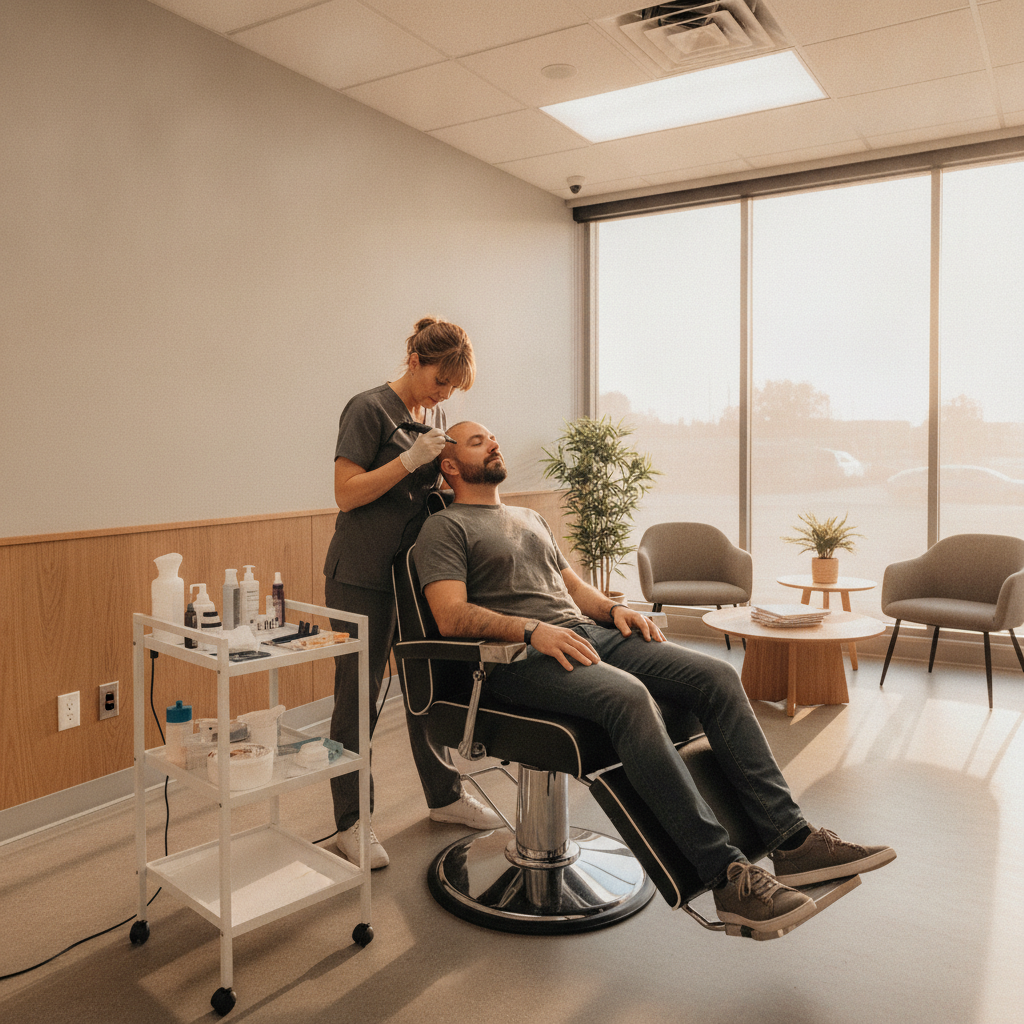
- Needle technique and machine calibration — SMP uses a different technique than traditional tattooing. The needles, depth, pressure, and speed are all calibrated differently to replicate the look of a hair follicle rather than lay ink into skin the way body art does.
- Hairline design principles — Designing a hairline that looks natural and age-appropriate for the individual client is one of the most artistically demanding parts of SMP. A poorly placed hairline is immediately noticeable.
- Density work for thinning hair — This is a different skill set than full scalp work. Blending pigment into existing hair to create the illusion of thickness without creating a harsh contrast requires a careful, layered approach. You can learn more about what this looks like from a client’s perspective on our hair density enhancement page.
- Scar camouflage technique — FUE and FUT transplant scars, injury scars, and alopecia patches all behave differently under pigment. Scar tissue has irregular texture and absorption, requiring specialized handling.
- Client consultation and communication — Managing expectations, having honest conversations about realistic outcomes, and knowing when to refer a client elsewhere are all critical professional skills that separates good artists from great ones.
- Aftercare guidance and follow-up protocol — Knowing how to guide your client through healing — especially in a hot, dry climate like the Central Valley where summer sun and dry air can affect pigment retention — is part of your job as a practitioner.
The Problem with Generic Online-Only Courses
A quick search will turn up dozens of online SMP certification programs, some priced well under a thousand dollars, that promise to make you a certified practitioner in a matter of days. Some of these have value as introductory foundations, but none of them can replace supervised, hands-on practice on real skin. SMP is a tactile skill. You cannot learn needle depth, pressure feedback, or how skin responds to pigment by watching videos.
The same caution applies to training programs offered overseas or by instructors with no verifiable portfolio of real client work. When you’re learning a skill that will be permanently placed on someone’s head, the quality of the hands teaching you matters enormously. Ask any prospective trainer to show you healed results — not fresh-session photos — from clients they have personally treated. Ask about their experience with diverse skin tones, with scar tissue, and with density work on clients who still have existing hair. If they can’t answer those questions with confidence, keep looking.
Who Is SMP Training Right For?
The most natural candidates for SMP training are barbers and tattoo artists, because they already have relevant foundational skills — client communication, an understanding of skin, and comfort working around the head and scalp. If you’re a barber in Stockton who sees clients daily who are quietly self-conscious about their thinning crowns or receding edges, you are sitting on an untapped referral pipeline.
That said, SMP training is also a genuine option for career changers with no prior industry experience. The learning curve is steeper without a tattooing or barbering background, but it’s absolutely achievable with the right program and enough dedicated practice. Motivation and attention to detail matter more than prior credentials.
Estheticians and cosmetologists sometimes explore SMP as well, though licensing considerations in California may affect how and where you can practice. It’s worth understanding the regulatory landscape in your county before you invest in training. A good training provider will walk you through this.
What to Look for in an SMP Training Program
Before committing to any course, ask these specific questions:
- How much of the training is hands-on versus classroom or video instruction?
- Will I practice on synthetic scalp models, live models, or both?
- What ongoing mentorship or support is available after the course ends?
- Can I see healed results — not just fresh work — from the instructor’s own clients?
- Does the curriculum cover density work for thinning hair and scar camouflage, not just the shaved-head look?
- What equipment and pigments are included, and are they professional-grade?
At Infusion SMP Scalp Micropigmentation in Stockton, our SMP training course is built around exactly these principles — real technique, real mentorship, and preparation for the full range of clients you’ll actually encounter in a market like the Central Valley.
Is the Investment Worth It?
That depends on how seriously you pursue the skill after training. SMP services typically range from around $1,500 to $4,000 per client depending on the scope of work — and most clients return for periodic touch-up sessions. An artist who builds a steady local clientele in a market like Stockton or Modesto can realistically recover their training investment within the first few months of working. The overhead is low compared to many service businesses, the demand is consistent, and there is no ongoing product cost the way there is in, say, retail or product-based services.
The artists who succeed are the ones who take the craft seriously — who continue practicing after training, study healed results obsessively, and treat every consultation as an opportunity to genuinely help someone. Hair loss is personal. Clients who trust you with their scalp are trusting you with something that affects their confidence, their self-image, and how they show up in the world every day. That responsibility is real, and the artists who honor it build careers that last.
Frequently Asked Questions About SMP Training in the Central Valley
Do I need a tattoo license in California to perform SMP?
California does not have a specific SMP license, but performing skin procedures for compensation may fall under regulations that vary by county. Many SMP practitioners in California operate under a body art practitioner framework. It’s worth consulting with your local county health department before you begin practicing commercially. A reputable training program will help you understand the compliance landscape.
How long does SMP training typically take?
Quality hands-on SMP training programs typically run between two and five days of intensive in-person instruction, often supplemented by pre-course study materials and post-course mentorship. Be skeptical of programs that claim to fully prepare you in a single day, and equally skeptical of programs that stretch into weeks of theory with minimal hands-on time.
Can I add SMP to my existing barbershop or salon services in Stockton?
Many barbers in the Central Valley are exploring exactly this. SMP pairs well with a barbering clientele because the shaved-head and hairline restoration results are most visible right after a fresh fade. Having SMP available in your existing space can be a natural upsell for clients who are already talking to you about their thinning hair. Check local zoning and county regulations for performing skin procedures in a licensed barbershop environment.
Will I be ready to take on paying clients right after training?
Honestly, most artists benefit from additional practice on volunteer models before charging full rates. A good training program sets you up with the foundational skills, but confidence and precision come from repetition. Plan to spend some time building your portfolio on friends, family, or discounted introductory clients before you open a full-price bookings calendar.
Is there demand for SMP artists specifically in Stockton and the surrounding area?
Yes — and it’s currently underserved. The Sacramento market has more established SMP studios competing for clients from across Northern California, but clients in Stockton, Tracy, and Modesto often prefer a local option they can easily return to for touch-ups. A skilled, trustworthy artist based locally in San Joaquin County has a genuine competitive advantage over studios that require a long drive up I-5 or Highway 99.
Ready to Learn More About SMP Training?
Whether you’re a barber ready to expand what you offer, a tattoo artist curious about making a specialty pivot, or someone starting fresh in a field that genuinely helps people feel better about themselves — scalp micropigmentation training is worth a serious look. The Central Valley needs skilled, locally rooted SMP practitioners, and that gap isn’t going to fill itself.
Infusion SMP Scalp Micropigmentation is based right here in Stockton and serves clients and aspiring artists across the region. If you want to talk through whether SMP training is the right fit for where you are in your career, we’re happy to have that conversation. Reach out to us today — no pressure, no sales pitch, just a real conversation about what’s possible.