
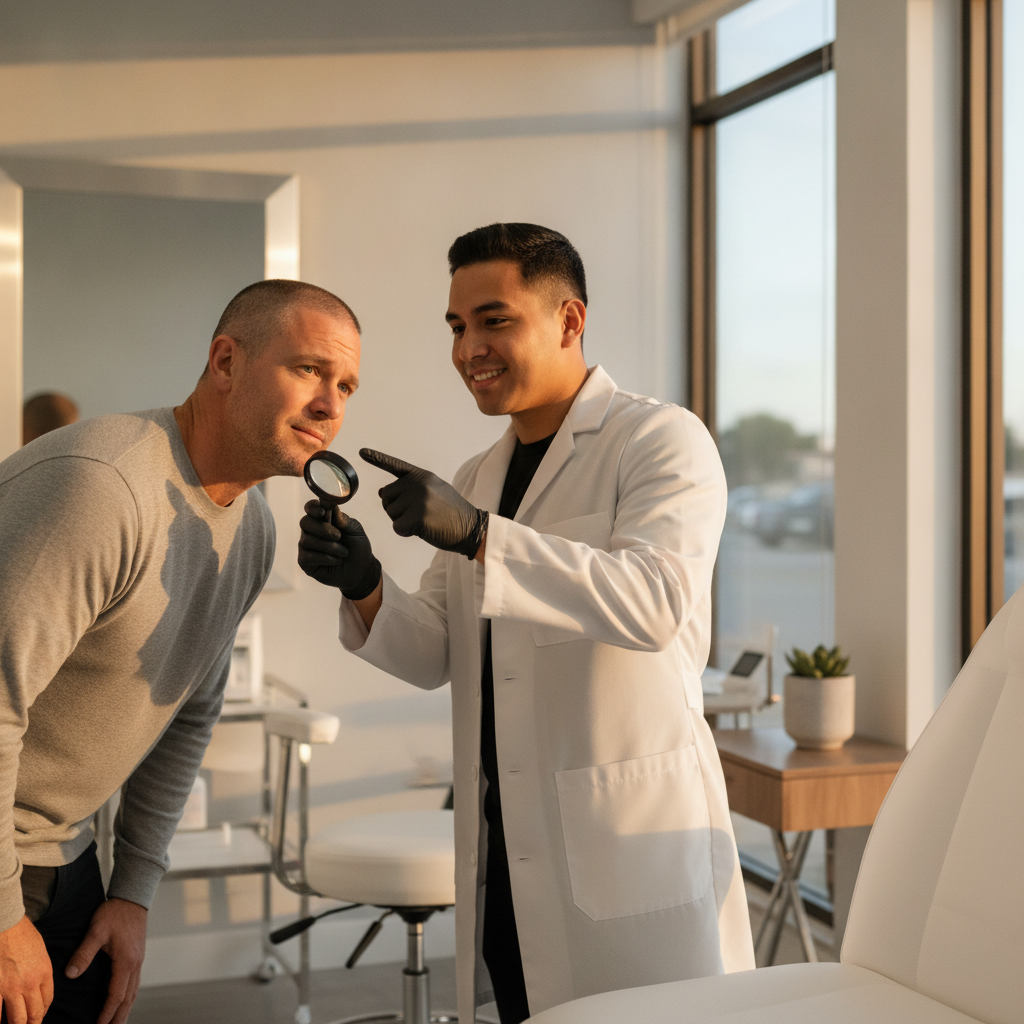

How Does SMP Look Up Close — Will People Be Able to Tell It’s Not Real Hair? What Stockton and Modesto Men Should Know About Undetectable Results
Uncategorized9 min read

How Does SMP Look Up Close — Will People Be Able to Tell It’s Not Real Hair? What Stockton and Modesto Men Should Know About Undetectable Results
When done right, scalp micropigmentation is genuinely undetectable — even at conversational distance. That’s not marketing language; it’s the technical reality of what a skilled SMP artist is building on your scalp. But the fear is completely valid. You’ve probably seen photos of bad hair tattoos that look like someone drew dots on a balloon with a Sharpie, and the last thing you want is to trade one source of self-consciousness for another. If you’re in Stockton, Modesto, or anywhere across the Central Valley and you’re trying to understand what separates natural-looking SMP from the kind that makes people stare — this is the article you need to read first.
Why Some SMP Results Look Obviously Fake — And Others Look Like a Real Shaved Head
The difference between SMP that turns heads for the right reason and SMP that makes people uncomfortable isn’t magic — it comes down to a handful of very specific technical decisions that a qualified artist makes before the needle ever touches your scalp.
The most common reason SMP looks artificial up close is the use of pigment dots that are too large, too uniform, or placed too close together. Real hair follicles aren’t the same size, the same depth, or arranged in a perfect grid. They vary slightly. They cluster naturally. They follow the direction of your hair growth pattern. When an inexperienced artist uses a technique built for traditional tattooing — a larger needle grouping, a heavier hand, or ink designed for skin rather than the scalp — the result is exactly what you’re afraid of: a flat, painted look that becomes obvious the moment anyone gets within a few feet.
Qualified SMP practitioners work with a single-point needle and pigments specifically formulated for the scalp. The dots are intentionally tiny — close to the actual diameter of a hair follicle cross-section. They’re placed at irregular intervals, with varying depth and pressure, to replicate the organic randomness of a naturally shaved head. When the light hits your scalp from different angles, it should behave the way real stubble behaves — not like a tattoo.
The Hairline Is Where Realism Is Won or Lost
Even if the body of the scalp work is technically sound, an unnatural hairline immediately reads as artificial to anyone who looks at your head. This is the detail that separates experienced SMP artists from technicians who learned the basics and stopped there.
A realistic hairline is not a hard, straight line. It doesn’t sit at the same height across your entire forehead. It has what’s called a soft or feathered edge — meaning the density of pigment gradually decreases as you approach the perimeter of the hairline, so there’s no sharp contrast between skin and pigment. Your natural hair, even at its fullest, didn’t start with a crisp geometric edge. Neither should your SMP.
At Infusion SMP Scalp Micropigmentation, hairline design is treated as one of the most important conversations of the entire process. Your hairline needs to match your age, your facial structure, and the look you’re trying to achieve — whether that’s a youthful hairline or something more conservative and age-appropriate. Men in their 40s or 50s who get a hairline designed for a 22-year-old often end up with results that look off, even if the pigment itself is perfect. That design conversation matters enormously.
What Happens to SMP Under Different Lighting Conditions?
This is a question most competitor sites completely ignore, and it’s one of the most common things men think about when they’re considering SMP but haven’t committed yet. You might look great in a bathroom mirror — but what about bright office lighting? Sunlight? A barbershop under fluorescent bulbs?
The honest answer is that quality SMP holds up well under all of these conditions when it’s executed correctly. The key variables are pigment color, saturation, and dot placement. If the pigment is too dark relative to your natural hair color and skin tone, it may look saturated and heavy in direct sunlight or bright overhead lighting. If the dots are too close together, they can appear to merge into a solid block of color — especially under harsh lighting — rather than reading as individual follicles.
This is also why the multi-session structure of SMP matters so much. Most clients complete their treatment across two to three sessions, spaced several weeks apart. This allows the artist to build density gradually, assess how the pigment heals and settles in your specific skin, and adjust tone and saturation based on what the results actually look like — not just what they look like on day one. Trying to achieve everything in a single session dramatically increases the risk of over-saturation and the kind of look that becomes obvious up close.
It’s also worth noting that the Central Valley’s intense sun — especially during Stockton and Modesto summers — accelerates pigment fading over time. That’s actually a feature for realism, not just a maintenance consideration. As pigment softens slightly with sun exposure and time, results often look even more natural. The tradeoff is that periodic touch-ups keep everything looking fresh, typically every few years depending on your skin type and sun exposure habits.
How Close Is Too Close? What Real Clients Experience
Men who’ve had SMP done well routinely report that friends, coworkers, and even barbers assume they simply shaved their head — and nothing else. That includes people who see them under office lighting, hug them, or sit next to them on a commute. Men who work in healthcare settings across San Joaquin County, in Manteca warehouses, or in professional environments in Tracy have come through our studio specifically because they need a result that holds up at close range, every day, without any maintenance ritual or concealment product.
The instances where people report their SMP was noticed are almost always tied to one of two things: a hairline that was designed too aggressively, or work done by an undertrained artist using the wrong technique and pigment. That’s not a risk inherent to SMP — it’s a risk inherent to choosing the wrong provider.
If you want to understand more about what makes density work look natural for men who still have some hair on top, this overview of density enhancement with SMP explains how pigment is blended through existing hair so the two work together seamlessly.
What to Ask an SMP Artist Before You Commit
Before you book anywhere — whether it’s a studio in Sacramento, a franchise clinic pulling clients from across the Central Valley, or a local provider right here in Stockton — ask to see photos taken under different lighting conditions. Photos taken in dim studio lighting with a ring light behind the camera are easy to make look good. Ask for natural daylight photos. Ask for photos of healed results, not just fresh sessions. And ask the artist to walk you through how they design the hairline and how they determine pigment tone for your skin.
An experienced artist will have specific, confident answers to all of those questions. If the conversation quickly shifts to price or vague assurances, that’s information too.
Frequently Asked Questions
Will my barber be able to tell I have SMP when they cut my hair?
Not if the work is done correctly. A skilled SMP artist designs the pigment to blend seamlessly with your natural hair at the edges. Many barbers either don’t notice or simply assume their client shaves their own head. The blend between existing hair and SMP pigment is part of what makes well-executed work genuinely undetectable.
Does SMP look different in sunlight versus indoor lighting?
High-quality SMP is designed to look natural in both. The key is pigment tone selection and dot density — if either is off, results can appear flatter or heavier under bright light. This is one reason working with an experienced artist who understands pigment behavior in different conditions is so important.
Can someone tell just by looking at the top of my head from above?
At the top of the scalp — which is exactly where pattern baldness tends to progress — SMP replicates the look of a close-shaved or clipper-shaved scalp. Someone looking straight down at the crown of your head sees what they’d see on any man who shaves his head. There’s no visible seam or transition when the work is done well.
How do I know if an SMP artist in Stockton or Sacramento is actually skilled enough?
Ask for healed results — not fresh-session photos. Fresh SMP always looks bold and defined. How it looks after healing, fading, and settling is what determines whether the result is truly natural. Any artist confident in their work should have a portfolio of healed results available to show you.
Is there a point in the healing process where SMP looks fake before it looks natural?
Yes — in the days immediately after each session, the pigment appears darker and more defined than the final result. This is completely normal and resolves as the skin heals. By the time the full treatment is complete and healed, the results are significantly softer, more realistic, and closer to the natural variation of real stubble. This is why patience between sessions matters.
Ready to See What Natural Actually Looks Like?
The best way to understand whether SMP will look real on you isn’t to read more articles — it’s to have a conversation with an artist who can look at your scalp, your skin tone, your hair pattern, and your goals, and show you examples of work that’s similar to what you’re considering. At Infusion SMP Scalp Micropigmentation in Stockton, that consultation is free and comes with no pressure and no obligation. If you’re coming from Modesto, Tracy, Manteca, or anywhere else along the Highway 99 corridor, you’re close enough to make the drive worth it. Reach out here to schedule your free consultation and see for yourself what truly undetectable SMP looks like.
Results vary. SMP is a cosmetic tattoo procedure, not a medical treatment, and does not regrow hair. Individual results depend on skin, scalp, hair and aftercare.