
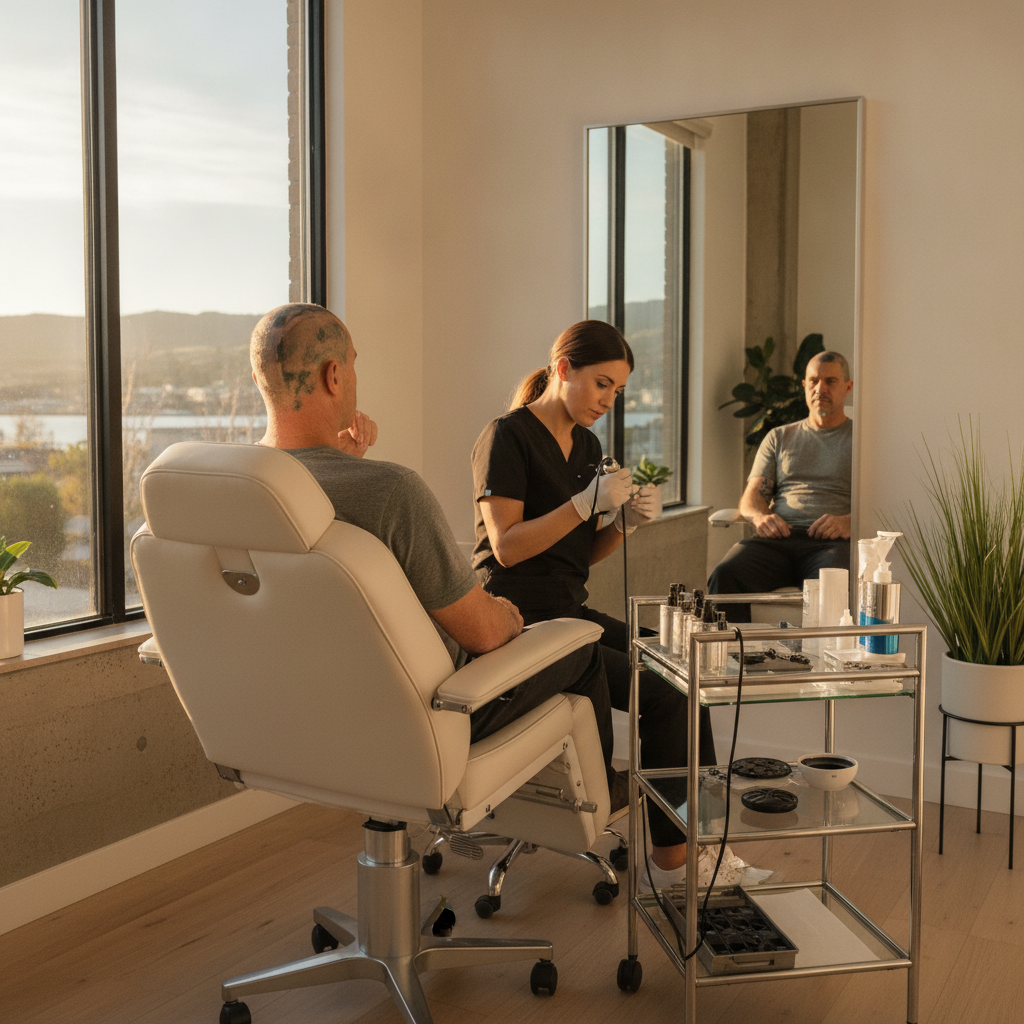

Can You Get SMP If You’ve Had a Bad Tattoo or Previous Ink on Your Scalp? What Stockton and Sacramento Men Should Know
Uncategorized9 min read

Can You Get SMP If You’ve Had a Bad Tattoo or Previous Ink on Your Scalp? What Stockton and Sacramento Men Should Know
Yes — in most cases, scalp micropigmentation can absolutely be performed over existing ink on the scalp, whether that’s an old decorative tattoo, a poorly done SMP treatment from another provider, or pigment that has faded, spread, or turned the wrong color over time. But it’s not a one-size-fits-all situation, and getting it right requires a practitioner who actually understands how existing pigment behaves under the skin — not just someone following a script. If you’re in Stockton or the greater Sacramento area and you’ve been sitting on this question, here’s what you need to know before you book anything.
Why This Question Comes Up More Than You’d Think
More men are walking into consultations with existing scalp ink than ever before. Some got SMP years ago at a studio that’s since closed. Some tried a bargain-priced provider and walked away with dots that are too large, too dark, or scattered in the wrong pattern. Others got a decorative tattoo on the back or side of their head — tribal work, lettering, or geometric designs — and now want to add SMP to cover hair loss without the two things clashing visually.
This is actually one of the topics that most SMP studios in the Sacramento and San Joaquin Valley region barely touch on their websites. You’ll find general information about the SMP process, but almost nothing about what happens when there’s pre-existing ink in the way. That silence leaves a lot of clients guessing — and sometimes assuming they’re not a candidate when they actually are.
The Two Most Common Scenarios
1. You Have a Decorative Tattoo on Your Scalp
Let’s say you’ve had a tattoo on the back of your head for years — something you got when you had a full head of hair or shortly after you started shaving it. Now you want SMP to fill in a receding hairline or add density across the top, but you’re worried about how the existing tattoo interacts with the new work.
The honest answer is that it depends on several factors: how old the tattoo is, how much it has spread or faded, what colors were used, and where it sits in relation to the area you want treated. A faded, older black tattoo in a contained area is very different from a large piece with colored ink that bleeds into where your hairline design would go. A skilled SMP artist can assess this during a consultation and tell you exactly what’s workable — including whether the existing tattoo needs to be lightened or partially removed before SMP is applied on top.
2. You’ve Had SMP Before and It Didn’t Go Well
This is probably the more emotionally charged situation. You took the leap, paid real money, and sat through multiple sessions — and the result just isn’t right. Maybe the dots are too large and look like full circles rather than hair follicles. Maybe the color has shifted to blue or green over time. Maybe the hairline design is too low, too sharp, or just doesn’t fit your face. Whatever happened, you’re living with results you’re not happy with, and you want to know if it’s fixable.
The good news is that correction work is very much possible, and it’s something experienced SMP artists are equipped to handle. Scalp micropigmentation corrections typically involve one or more of the following approaches: working color-matching pigment over faded or discolored dots, breaking up patterns that are too uniform or geometric to look natural, adjusting a hairline that sits in the wrong position, or in some cases recommending a round of laser lightening before new pigment is applied over the top.
What Makes Correction Work Different from a Standard SMP Session
Correction work takes more planning than a standard first-time treatment. The artist needs to assess how the existing pigment has settled in the skin — whether it’s spread, faded, or changed hue — and then map a strategy that layers new work over or around it without making things worse. This isn’t a situation where you want to rush in and just add more ink. Done carelessly, correction work can compound the problem instead of solving it.
The key things a qualified artist will look at during a correction consultation:
- Pigment color shift: Older SMP pigments, especially low-quality ones, often turn blue, green, or purple over time. This changes how new pigment layers on top of them and requires careful color calibration.
- Dot size and spread: If previous dots have spread into blotchy patches, new fine-point work needs to be planned around that rather than on top of it without preparation.
- Hairline placement: If the old hairline is in the wrong spot, it’s not as simple as adding a new one. The approach depends on whether the existing line can be softened, blended into a new design, or whether laser lightening is the better first step.
- Skin condition: Repeated sessions from a previous provider may have created texture changes in the scalp. These need to be assessed before any new work begins.
Does the Central Valley Climate Affect Correction Work?
It does — and this is something Central Valley clients don’t hear enough about. The hot, dry summers across the Stockton and Modesto corridor accelerate how quickly scalp skin cycles, and that affects pigment retention differently than it would in a cooler coastal climate. Clients who had SMP done elsewhere and then spent several summers in the San Joaquin Valley heat without protecting their scalp may find that their original pigment has faded faster or shifted more than expected.
That’s not necessarily a disaster — faded pigment is often easier to work with than dark, dense pigment that’s hardened into the skin. But it does mean that the condition of your existing work is directly tied to your aftercare history, including sun exposure. A good local artist who understands this climate will factor it into the correction plan. At Infusion SMP, this regional context is part of every consultation — not an afterthought.
When Laser Lightening Is Recommended First
Some correction cases benefit from a round or two of laser lightening before new SMP is applied. This is common when the existing pigment is too dark or too blotchy to blend over effectively, or when the original hairline needs to be moved significantly. Laser sessions are typically spaced 6–8 weeks apart to allow the skin to recover, which does add time to the overall process.
Clients coming in from Tracy, Elk Grove, Lodi, or even Sacramento for correction work should plan for the possibility of a longer timeline than a first-time treatment. The results are worth it — but going in with realistic expectations about the process makes the experience much smoother.
If you’re curious about how density work can be incorporated alongside correction treatment for thinning areas, the hair density enhancement page covers what that process looks like in more detail.
Frequently Asked Questions
Can SMP be done over a colored tattoo on my scalp?
Possibly, but it depends on the colors involved and where the tattoo sits. Darker pigments are easier to work with. Brightly colored or heavily saturated tattoos may need partial laser removal first. A consultation will give you a clear picture of what’s possible in your specific case.
How do I know if my old SMP is fixable without laser treatment?
During a consultation, an experienced artist will assess the dot size, pigment depth, color shift, and placement of your existing work. Many corrections can be done without laser prep — but if the existing pigment is particularly dark or the hairline needs significant repositioning, laser lightening may be the better path.
Will correction work cost the same as a new SMP treatment?
Correction work is priced based on complexity, not a flat rate. A minor color refresh is very different from a full correction involving hairline repositioning and multiple session rounds. Expect the conversation to be specific to your situation — a reputable artist won’t give you a number without seeing the existing work first.
I got bad SMP at a studio that’s closed. Can Infusion SMP still help?
Yes. This is actually one of the more common situations we see from clients across Stockton, Sacramento County, and surrounding areas. Even if you don’t know what pigments were used or exactly how many sessions you had, a visual assessment during a consultation gives us what we need to plan the correction properly.
Is there any situation where SMP over existing ink simply won’t work?
Very dense, dark decorative tattoos that cover a large portion of the scalp — particularly with heavy linework or shading — can be difficult to blend SMP into naturally. In those cases, partial laser removal is usually the starting point. But even complex cases are rarely a flat no. The right consultation gives you real answers, not guesswork.
You Deserve a Result You’re Not Hiding
Whether you’re dealing with old decorative ink, a previous SMP treatment that went sideways, or a mix of both — you don’t have to keep wearing hats or avoiding mirrors. Correction work is real, it’s possible, and when it’s done by someone who actually knows what they’re doing, the outcome can be genuinely transformative.
If you’re in Stockton, Tracy, Lodi, Sacramento, or anywhere across San Joaquin County, the first step is a conversation. Reach out to Infusion SMP Scalp Micropigmentation to book your free consultation and get an honest assessment of what your correction or combination treatment would actually look like — no pressure, no guessing, just a clear plan.
Results vary. SMP is a cosmetic tattoo procedure, not a medical treatment, and does not regrow hair. Individual results depend on skin, scalp, hair and aftercare.