
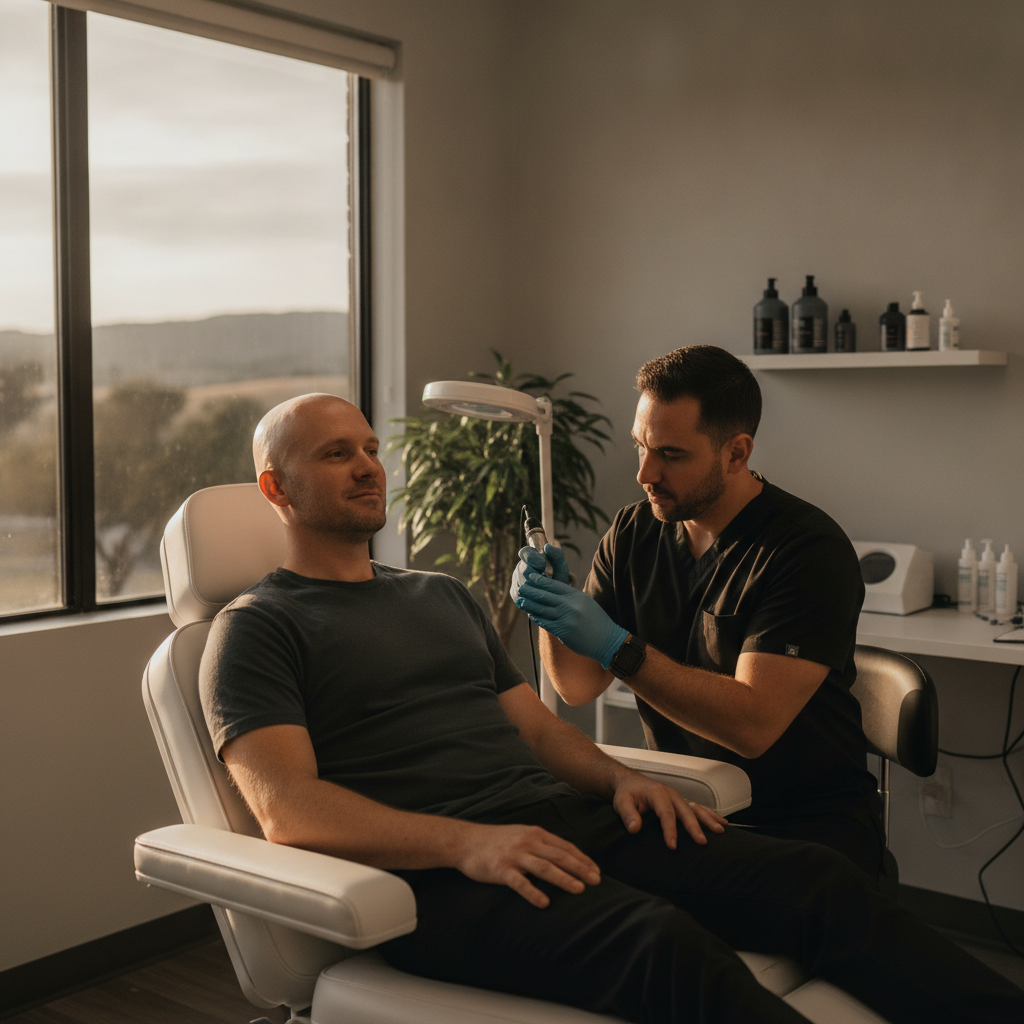

What Should You Know About SMP if You Have Alopecia Totalis or Complete Hair Loss? What Stockton and Sacramento Clients Should Know About Full Coverage
Uncategorized8 min read

What Should You Know About SMP if You Have Alopecia Totalis or Complete Hair Loss? What Stockton and Sacramento Clients Should Know About Full Coverage
Yes — scalp micropigmentation works for alopecia totalis, and for many people in Stockton and the greater Sacramento area, it has been life-changing. When you’ve lost all of your hair and you’re staring at a completely bare scalp every morning, you deserve more than a wig recommendation or a waiting game with unpredictable treatments. SMP gives you something you can actually control: a natural-looking, permanent hairline and the appearance of a close-cropped head of hair — right now, not someday.
Alopecia totalis is one of the more severe presentations of alopecia, defined by total loss of hair on the entire scalp. It sits between alopecia areata (patchy loss) and alopecia universalis (total body hair loss), and it can develop quickly or gradually over time. If you’ve been living with it for years, you already know that regrowth is never guaranteed — and the emotional weight of watching and waiting can be exhausting. SMP doesn’t treat the condition, but it restores something equally important: your reflection.
Why Alopecia Totalis Presents Unique Challenges — And Why SMP Is Well-Suited to Address Them
When pattern baldness is the cause of hair loss, an artist works with the existing hair to blend and transition the SMP. With alopecia totalis, the canvas is different. There is no existing hair to anchor the design to, which means the entire hairline — its shape, its height, its softness — has to be created thoughtfully from scratch. That’s not a limitation. That’s actually an opportunity to build something that fits your face perfectly, without the constraints of what was left behind by genetics.
The challenge is that it requires a skilled, experienced artist. Someone who understands facial structure, skin tone, and how to design a hairline that looks like it belongs on you — not borrowed from a template. Pigment depth, dot size, distribution density, and hairline curvature all need to work in harmony across a fully bare scalp. Done well, the result is indistinguishable from a naturally shaved head.
At Infusion SMP Scalp Micropigmentation in Stockton, this kind of full-coverage work is exactly what we do. Whether you’re dealing with alopecia totalis that developed in your twenties or a condition that’s progressed over decades, the consultation process starts with your face, your skin, and your goals — not a one-size-fits-all approach.
What the Process Actually Looks Like for Full-Scalp Alopecia Coverage
SMP for alopecia totalis typically involves two to three sessions, spaced roughly seven to fourteen days apart. This spacing matters. Each session allows the pigment to settle and the skin to heal, and what you see after the first session will look lighter and more subtle than the finished result. That’s completely normal and part of how the process is designed to work.
In the first session, the artist lays down a foundational layer across the scalp, beginning to map the hairline and establish tone. By the second session, density is built and refined. By the third, detail work and any subtle adjustments bring the final look into full definition. Most clients from Stockton, Lodi, Elk Grove, and the broader Central Valley are genuinely surprised by how much the result evolves between sessions — in a very good way.
Because there’s no existing hair to interfere, pigment application can be precise and consistent across the entire scalp. The artist controls every element of the final look, which is one reason why full-scalp alopecia clients often see some of the most striking and satisfying SMP outcomes.
Hairline Design When You’re Starting from Zero
One of the most important conversations you’ll have during your consultation is about hairline placement and shape. This is where your age, your facial structure, and your personal preferences all come together. A hairline that’s placed too low looks unnatural. One that’s too sharp or too perfectly geometric reads as artificial up close. What you want — what an experienced artist will work toward — is a hairline that has natural softness at the edges and sits at a height that makes sense for who you are right now.
For men with alopecia totalis, the finished result typically replicates the appearance of a cleanly shaved head with a defined, natural hairline. For women, the approach is often different — the focus may be on restoring the appearance of a scalp with hair present rather than a shaved look, using lighter, more diffuse pigment placement that mimics the density of natural hair viewed at the scalp level. If you’re a woman in Sacramento County or San Joaquin County who has been living with alopecia totalis and wondering whether SMP is designed for you too — it absolutely can be.
What About the Central Valley Climate and Sun Exposure?
Living in the Central Valley means your scalp is exposed to some serious sun for a significant portion of the year. If you have alopecia totalis, your bare scalp has probably already taught you that lesson. During the healing period after each SMP session — typically the first ten days — direct sun exposure should be avoided. UV exposure during healing can cause pigment to fade unevenly before it has fully locked in.
Once your SMP is healed, sun protection becomes a long-term habit. A well-applied sunscreen or a hat outdoors is all it takes. The Central Valley heat is manageable with simple aftercare habits, and the results you’re protecting are absolutely worth it. This is something we walk every Stockton and Modesto client through clearly before they leave the studio.
How Does SMP Compare to Other Options for Alopecia Totalis?
There is no shortage of options marketed to people with alopecia — hairpieces, wigs, topical treatments, injections, light therapy. Some of these may be part of your journey. But for many people, the appeal of SMP is that it doesn’t require ongoing maintenance rituals, doesn’t shift or need adhesive, doesn’t react to sweat or water, and doesn’t look like something placed on top of your head. It looks like skin. It looks like you.
In terms of cost, SMP for a full scalp typically ranges somewhere between $2,000 and $4,000 depending on the complexity and the number of sessions required — a fraction of what a custom hairpiece system costs over several years, and incomparable to the inconvenience and upkeep those systems require. For clients coming from Sacramento, Elk Grove, or even further in the Central Valley, the investment and the drive are both worth it when the result is permanent.
If you’re exploring what scalp micropigmentation looks like for density and coverage, the same principles that apply to thinning hair apply here — only in a more comprehensive way.
Frequently Asked Questions: SMP for Alopecia Totalis Near Stockton and Sacramento
Can SMP be done on a scalp with no hair at all?
Yes. SMP works directly on the skin, not on hair follicles. A completely bare scalp is actually a clean, consistent surface to work with. The absence of existing hair gives the artist full control over the design from start to finish.
Will the results look natural if I have no existing hairline to reference?
When performed by an experienced SMP artist, yes. Hairline design for alopecia totalis clients is a deliberate, collaborative process. Your face shape, skin tone, age, and personal preferences all guide the design. The goal is always a result that looks like it grew there.
Is SMP safe if my alopecia is still active or progressing?
SMP can generally be performed on stable or active alopecia, but your specific situation should be discussed during consultation. The pigment is applied to the scalp skin rather than the follicle, so it isn’t affected by the autoimmune process that drives alopecia. However, any ongoing inflammation or open irritation on the scalp would need to be addressed before beginning treatment.
How long will SMP last if I have alopecia totalis?
SMP typically lasts several years before a touch-up refresh is recommended. Sun exposure, skin type, and aftercare habits all play a role in how long pigment retains its vibrancy. Central Valley clients should be especially consistent with sun protection given the regional climate.
Do you work with women who have alopecia totalis, not just men?
Absolutely. Infusion SMP works with women experiencing alopecia totalis, alopecia areata, diffuse thinning, and other forms of hair loss. The approach is different from a typical male shaved-head SMP — it’s tailored to create the appearance of a fuller, hair-present scalp in a way that’s natural for women. You are not an afterthought here.
Ready to Find Out What’s Possible for You?
Living with alopecia totalis doesn’t mean you have to keep feeling limited by what’s missing. SMP offers something concrete, lasting, and genuinely natural-looking — and the right consultation will show you exactly what’s possible for your face, your scalp, and your life. Whether you’re in Stockton, coming from Lodi, driving down from Sacramento, or making the trip from Modesto, Infusion SMP is ready to have that conversation with you.
Reach out to Infusion SMP Scalp Micropigmentation today to schedule your free consultation. There’s no pressure, no obligation — just an honest look at what SMP can do for you.
Results vary. SMP is a cosmetic tattoo procedure, not a medical treatment, and does not regrow hair. Individual results depend on skin, scalp, hair and aftercare.