
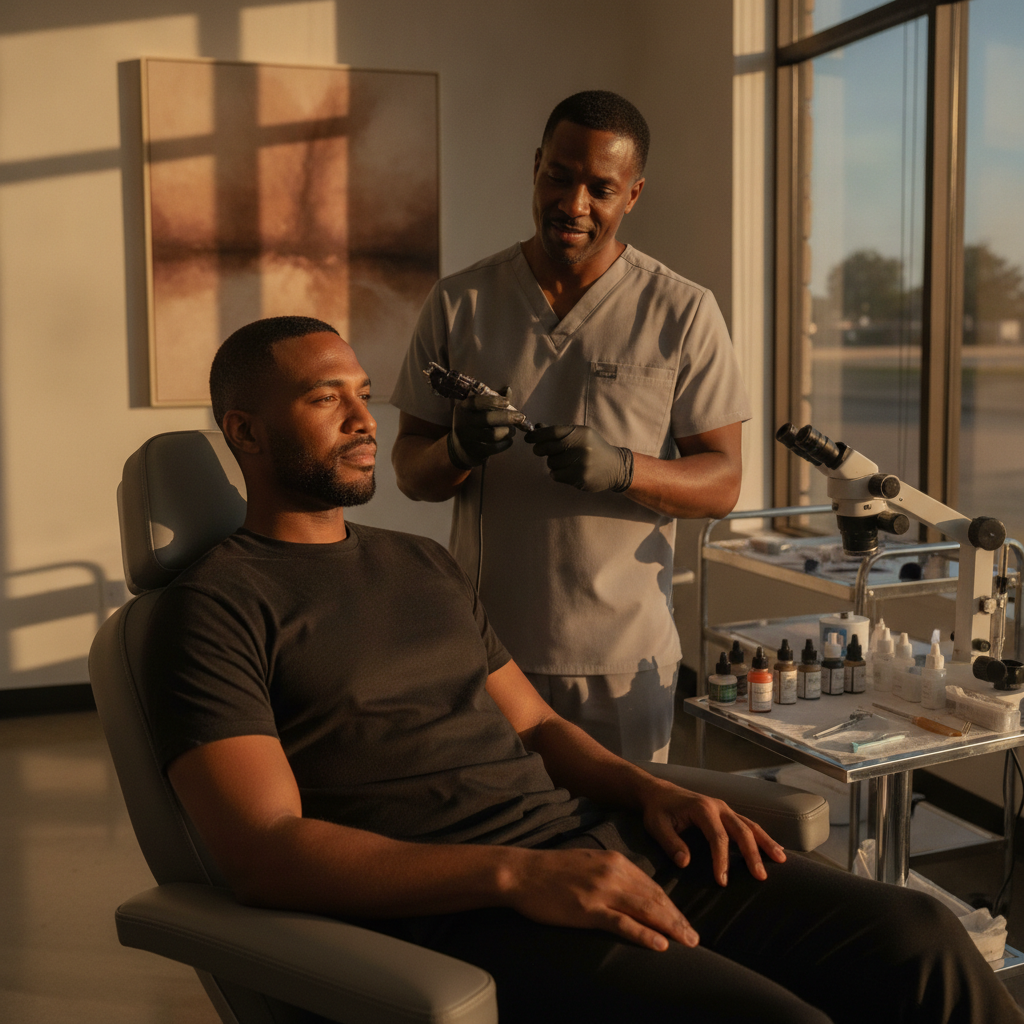

Can You Get SMP If You Have Dark Skin or a Deep Melanin Tone? What Stockton and Modesto Men Should Know About Pigment Matching for Deeper Complexions
Uncategorized9 min read

Can You Get SMP If You Have Dark Skin or a Deep Melanin Tone? What Stockton and Modesto Men Should Know About Pigment Matching for Deeper Complexions
Yes — scalp micropigmentation absolutely works on dark skin, and when it’s done right, it looks completely undetectable. But here’s the honest truth: SMP on deeper complexions requires a level of skill and color theory knowledge that not every provider has. If you’re a man with dark skin in Stockton, Modesto, Manteca, or anywhere along the Central Valley, and you’ve been wondering whether SMP will actually look natural on you, this is the article you’ve been waiting for.
Why Dark Skin Tones Require a More Skilled Approach
Most SMP training programs teach pigment matching against a fairly narrow range of skin tones. The reality in a diverse community like Stockton — where you’ll find men of Black, Hispanic, South Asian, Filipino, Middle Eastern, and mixed heritage — is that a one-size-fits-all approach to pigment selection simply doesn’t work. Melanin-rich skin reflects light differently, reacts to pigment differently, and heals differently than lighter complexions.
The specific challenges that come with deeper skin tones include:
- Pigment can appear lighter or ashier than expected — certain pigment formulas that look great on medium skin will pull gray or blue against a deep, warm complexion, creating an artificial finish
- Contrast calibration is more critical — on lighter skin, the gap between scalp color and stubble simulation is naturally smaller; on dark skin, the artist must be precise about dot density and shade to avoid a heavy, overworked look
- Healing can close dots faster — melanin-rich skin can sometimes fill in the implanted pigment slightly during healing, which is why session spacing and technique adjustments matter
- Keloid and hyperpigmentation risk awareness — experienced artists account for this during needle selection and pressure, especially on clients with a known sensitivity history
None of these are reasons to avoid SMP. They’re reasons to choose your artist carefully — and to ask the right questions before you commit.
What Competitors Often Get Wrong (and Rarely Talk About)
This is a topic that almost none of the Sacramento-area SMP studios address in any meaningful depth on their websites. You might see a gallery photo or two featuring a client with darker skin, but there’s rarely any honest conversation about what actually changes in technique, pigment selection, or session planning for men with deep complexions. That silence isn’t reassuring — it’s a red flag.
When you’re researching scalp micropigmentation and you can’t find any content that speaks directly to your skin tone, you’re left guessing whether the artist even has experience with clients who look like you. That guesswork is unfair, and you deserve better.
At Infusion SMP in Stockton, we work with clients across the full spectrum of skin tones regularly. The Central Valley’s diverse population means this isn’t a specialty case for us — it’s everyday practice.
How Pigment Matching Actually Works on Darker Skin
Matching pigment to dark skin isn’t just about choosing a “darker” shade. It’s about reading the undertone of your complexion — whether your skin pulls warm (golden, red, amber) or cool (ashy, blue-brown) — and then selecting a pigment formula that will complement that undertone after it settles and heals.
Here’s what that process looks like in practice:
- Your artist assesses your scalp color and undertone in natural lighting, not just overhead studio light
- They factor in how your existing hair follicles appear — the shade and size of your natural stubble or follicle visibility
- Pigment formulas are sometimes layered or blended specifically for your complexion, rather than pulling straight from a standard palette
- Dot size and density are calibrated so the result reads as stubble, not a filled-in block of color
This is craftsmanship, not just application. It’s the difference between walking out looking like yourself — but sharper, cleaner, and more confident — versus walking out looking like you have something obvious on your head.
Common Concerns from Dark-Skinned Clients (And Honest Answers)
“Will it look fake or too dark against my scalp?”
Not if your artist calibrates correctly. The goal is always for the pigment to sit just beneath the natural tone of your scalp, mimicking the look of a freshly shaved follicle. On dark skin, this can actually create a beautifully clean, sharp result — especially for men who prefer a tight, faded or shaved aesthetic.
“I have some hyperpigmentation on my scalp — will that affect the result?”
Hyperpigmentation, uneven tone, or sun spots on the scalp are common, especially for men who’ve worked outdoors — something a lot of men in the agriculture and construction sectors across San Joaquin County and Stanislaus County know well. An experienced artist will factor this into the treatment plan, blending pigment across the scalp to create an even, cohesive result rather than simply layering over uneven areas.
“Does SMP work if I’m also dealing with hair loss from traction alopecia?”
Yes — traction alopecia, which disproportionately affects Black men and women due to certain protective styles and tension, can leave areas of significant thinning or full loss along the hairline and temples. SMP can restore those areas beautifully, either filling in density or rebuilding a hairline that has receded from years of tension.
The Shaved-Head Look and Dark Skin: A Natural Combination
For men with dark skin who already wear their hair close to the scalp — whether it’s a tight fade, a Caesar, or a fully shaved head — the full-scalp SMP look is one of the most natural-looking outcomes possible. The sharp, clean aesthetic of a freshly shaved head with a defined hairline is already culturally familiar and widely respected. SMP simply gives you that look permanently, without the daily maintenance of a razor.
If you’re commuting from Tracy or Manteca, working long shifts in healthcare or logistics, or just tired of the constant upkeep of keeping a shaved head looking sharp in the Central Valley heat, SMP removes that burden entirely. Wake up looking fresh. No razors, no products, no hassle.
For men interested in adding density to thinning areas rather than going fully shaved, hair density enhancement with SMP works equally well on dark skin — the pigment blends into existing hair to create the appearance of fuller coverage without disrupting your current style.
What to Ask Before You Book with Any SMP Artist
If you’re comparing providers across Stockton, Sacramento, or Lodi, these are the questions you should be asking:
- Can I see healed results on clients with a similar skin tone to mine? Not just fresh-session photos — healed, settled results. That’s what matters.
- What pigment lines do you use, and do you blend custom shades for deeper complexions?
- How do you adjust your technique for melanin-rich skin? A qualified artist should be able to answer this without hesitation.
- Have you worked with clients with hyperpigmentation, traction alopecia, or scarring on dark skin?
If an artist gives you vague answers or deflects, that’s information. You want someone who has clearly thought about this — because your skin and your results deserve that level of attention.
Frequently Asked Questions
Is SMP more expensive for dark skin tones?
No. SMP pricing is based on the scope of treatment — how much of the scalp is being covered, the complexity of the hairline design, and how many sessions are needed — not your skin tone. What matters is choosing an artist skilled enough to deliver the right result, regardless of cost.
How many sessions will I need if I have dark skin?
Most clients, regardless of skin tone, complete their SMP across two to three sessions spaced roughly 7–14 days apart. Some clients with very deep complexions or specific density goals may benefit from a third or fourth light refinement session to ensure the pigment is perfectly dialed in after healing.
Can SMP help if I have patchy hair loss from alopecia on dark skin?
Yes. Whether the patches are small and scattered or larger areas of loss, SMP can blend pigment across the affected areas to create a uniform, cohesive appearance. On dark skin, the contrast between healthy follicles and bald patches can be especially pronounced, and SMP bridges that gap effectively.
Will Central Valley sun exposure affect how my SMP looks on dark skin?
UV exposure causes pigment to fade more quickly over time on all skin tones, but the effect is similar across complexions. Standard aftercare applies: avoid direct sun exposure during the first two weeks of healing, and use SPF regularly afterward to protect your investment. The hot, dry summers in the Central Valley make this especially important.
I’ve seen SMP results on dark skin that looked blue or ashy — how do I avoid that?
That outcome almost always comes down to the wrong pigment formula or an artist without experience on deeper complexions. It’s not a flaw in the procedure itself — it’s a flaw in execution. Choosing an artist who works with clients across a full range of skin tones, and who can show you healed results, is the best protection against that outcome.
You Deserve Results That Look Like You — Only Better
Hair loss affects men of every background, and every man deserves a solution that’s built around his specific complexion, his culture, his lifestyle, and his aesthetic. If you’ve been hesitant about SMP because you weren’t sure it would work on your skin tone, or because you couldn’t find a provider in the Stockton area who spoke directly to your experience — this is your answer.
At Infusion SMP Scalp Micropigmentation, we work with clients across the full range of skin tones throughout the Central Valley, from Stockton and Lodi to Modesto and beyond. We take pigment matching seriously, we’ll show you real healed results on clients who look like you, and we’ll take the time to design a plan that fits your specific scalp, your hair tone, and the look you’re going for.
Ready to see what’s possible? Contact us to schedule your free consultation — no pressure, no obligation, just an honest conversation about what SMP can do for you.
Results vary. SMP is a cosmetic tattoo procedure, not a medical treatment, and does not regrow hair. Individual results depend on skin, scalp, hair and aftercare.