
How Does SMP Work If You Have a Dark or Olive Complexion? What Stockton Clients with Deeper Skin Tones Should Know
Yes — scalp micropigmentation absolutely works on dark and olive skin tones, and when it’s done right, the results can look more seamless than on lighter complexions. But here’s the honest truth: not every SMP artist is equally experienced working across the full range of skin tones. If you’re in Stockton with a darker or olive complexion — whether your heritage is Latino, South Asian, Middle Eastern, Black, Filipino, or anything in between — the artist’s ability to match pigment and adapt technique to your specific skin matters enormously. Get that right, and SMP looks completely undetectable. Get it wrong, and you’ll notice immediately.
This is one of those topics you’ll struggle to find clearly answered on most SMP studio websites. A lot of providers show before-and-after galleries dominated by lighter skin tones, which can leave clients with deeper complexions wondering whether SMP is even for them. It absolutely is. Let’s walk through what you actually need to know.
Why Skin Tone Matters So Much in SMP — And What Changes with Darker Complexions
SMP works by depositing tiny, precise dots of pigment into the upper layer of the scalp to replicate the look of hair follicles. On any skin tone, the goal is the same: create something that blends seamlessly with your natural stubble, shadow, or hair density. But what changes significantly between a fair-skinned client and someone with a darker or olive complexion is how pigment behaves in the skin, how visible contrast is between the dots and the surrounding scalp, and how that contrast shifts as the skin heals and the pigment settles.
With lighter skin, a mid-tone pigment creates the subtle shadow effect that makes SMP look like a natural shaved head. With darker and olive skin, the contrast between pigment and scalp is naturally lower — which can actually work in your favor, because the dots tend to blend more softly into the surrounding skin. However, it also means that an inexperienced artist who uses the wrong pigment shade or goes in too dark from the start can create results that look heavy, muddy, or overtly artificial.
The most common mistake made on darker skin is using a single pigment that’s either too cool-toned (which can turn ashy or grayish) or too uniformly dark without any layering. Skilled SMP artists understand that deeper skin tones often require a careful build-up across sessions — starting lighter and layering to the right depth — so the final result mimics the natural variation in real hair follicles rather than looking like a flat, stamped pattern.
What a Qualified Artist Does Differently for Dark and Olive Skin
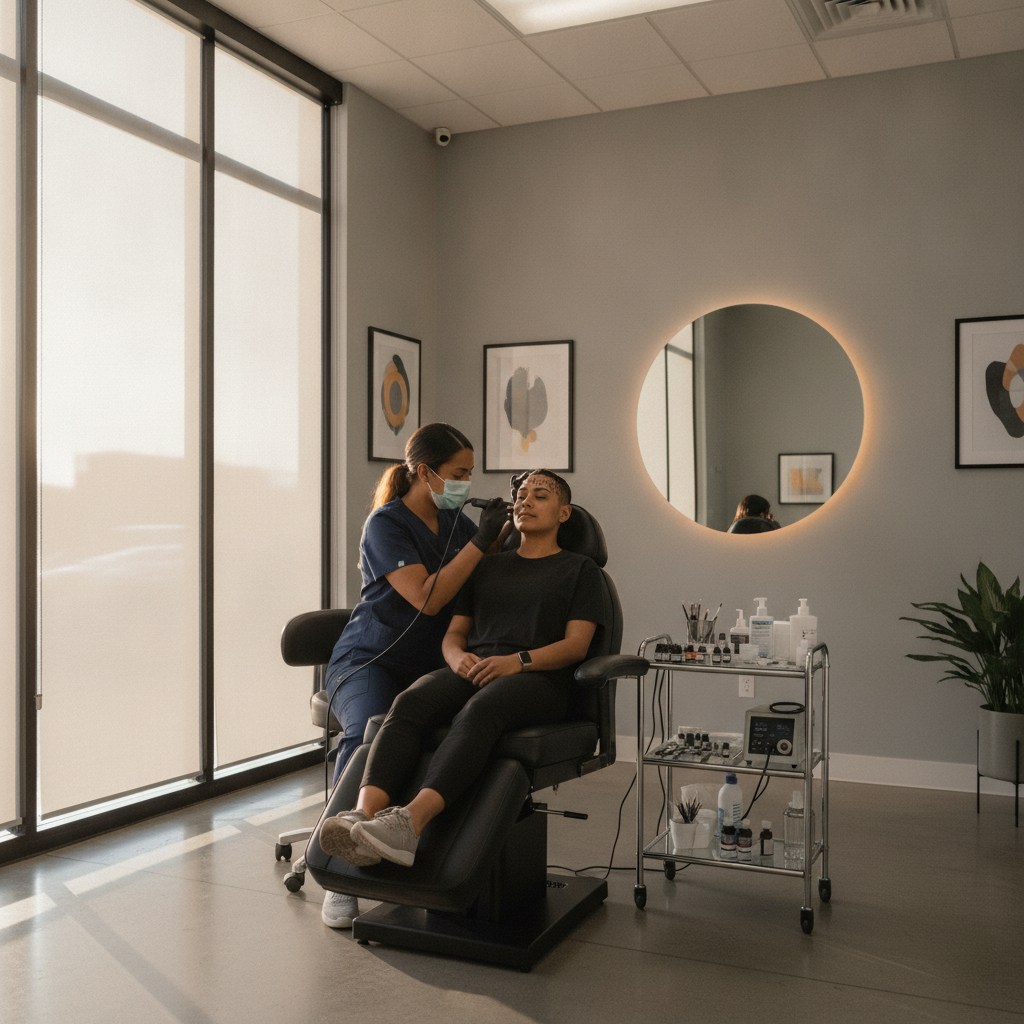
When you sit down for a consultation at a studio with genuine experience across skin tones, you’ll notice the conversation is different. A qualified artist won’t just glance at your head and start talking about needle size. They’ll assess your specific complexion in natural light, discuss your undertones (warm, cool, or neutral), and talk through how your skin type tends to retain pigment versus push it out during healing.
Here are a few specific things that should happen differently for clients with darker or olive skin:
- Custom pigment blending: Rather than pulling a pre-mixed shade off the shelf, an experienced artist will often blend pigments specifically for your complexion — matching not just the darkness level but the undertone (warm brown vs. cool charcoal vs. neutral black) so the dots read as hair, not ink.
- Session-by-session layering: SMP is almost always done in two to three sessions with healing time in between. For darker skin, this staged approach is especially important. Starting too aggressive in session one can result in oversaturation that looks unnatural once healed. Building up gradually gives the artist control and gives your skin time to show how it’s accepting the pigment.
- Hairline design that complements your features: A well-designed hairline is universal — but the specific arc, density, and placement should be calibrated to your face shape and the natural hairline patterns common to your heritage. A hairline that looks right on a light-skinned client may not be the most natural frame for your face.
- Awareness of keloid and hyperpigmentation risk: Some clients with darker skin tones have a higher tendency toward keloid scarring or post-inflammatory hyperpigmentation. A responsible artist will ask about your skin history and adjust their technique and needle depth accordingly. This isn’t a reason to avoid SMP — it’s just a reason to choose an artist who asks the right questions.
Stockton and the broader San Joaquin County area are home to one of the most ethnically diverse populations in California. The Central Valley’s mix of Latino, Southeast Asian, South Asian, and Black communities means local SMP artists here genuinely need this breadth of experience — and the best ones have it.
Will SMP Look Natural on Darker Skin, or Will People Notice?
This is the question that keeps a lot of clients from booking — and it deserves a real answer. When SMP is done properly on dark or olive skin, it doesn’t look like tattoo dots. It looks like a shaved head, a denser hairline, or whatever the specific treatment goal was. People who see you every day won’t be able to tell. Even under close inspection, the result should read as shadow and texture, not as pigment applied to skin.
What creates an unnatural result is almost always artist error, not skin tone. Dots that are too large, pigment that’s too uniform, or a hairline that’s placed unnaturally sharp — those are the red flags to watch for in any gallery. Scalp micropigmentation done with the right technique and the right pigment on deeper skin tones often heals with a richness and depth that looks remarkably authentic.
Clients coming in from Turlock, Tracy, and Modesto with olive or darker complexions have found that the results photograph naturally and hold up well even through the hot Central Valley summers — though sun protection during healing and ongoing SPF use remain important for preserving the pigment long-term regardless of skin tone.
What the Gap in Competitor Content Isn’t Telling You
If you’ve spent time browsing SMP studio websites in the Sacramento area or searching for providers online, you may have noticed something: most of them don’t directly address how their process adapts for different skin tones. Their galleries skew heavily toward lighter-skinned clients, and their written content rarely goes into the specifics of pigment behavior on melanin-rich skin.
That silence matters. It doesn’t necessarily mean those studios can’t do the work — but it does mean you’d be walking in without the information you need to ask the right questions. Before you book anywhere, ask to see before-and-after photos of clients who share your skin tone. Ask how the artist adjusts pigment selection for deeper complexions. Ask about their experience with the specific type of work you need — whether that’s density enhancement for thinning hair, full scalp treatment, or hairline restoration. If they can’t answer those questions specifically, that tells you something important.
Frequently Asked Questions: SMP for Dark and Olive Skin Tones in Stockton
Does SMP pigment fade to a strange color on darker skin?
It can — but only when the wrong pigment is used. Cheap or poorly formulated pigments can shift to blue, green, or ashy tones over time on any skin, but the effect is often more visible on darker complexions where the shift in undertone is easier to spot. Using high-quality, SMP-specific pigments and proper technique significantly reduces this risk.
Will my results look too dark or heavy?
Not with a skilled artist. The layering approach used across multiple sessions is specifically designed to prevent oversaturation. Your artist should be working toward a natural density — not maximum darkness — so the final look reads as shadow and follicles, not a solid fill.
Does SMP work differently for Latino, Black, South Asian, or Filipino clients?
The core technique is the same, but the specific pigment blend, layering depth, and healing considerations vary based on your individual skin tone and undertone — not a racial category. A good artist assesses you as an individual, not a demographic. Stockton’s diverse population means experienced local artists have seen a wide range of complexions and know how to approach them.
How long does SMP last on darker skin?
Pigment longevity is influenced more by sun exposure, skincare habits, and pigment quality than by skin tone itself. Central Valley summers are intense — consistent SPF use after healing is genuinely important for everyone, and it’s one of the most common things clients here in Stockton underestimate. With proper care, SMP typically lasts several years before any touch-up is needed.
Can I see examples of SMP on clients with my skin tone before I commit?
You absolutely should ask for this before booking anywhere. Any reputable SMP studio should be able to show you relevant before-and-after photos. If a studio can only show you results on clients with lighter skin, that’s useful information when making your decision.
You Deserve Results That Actually Look Like You
SMP is a personal decision — and for clients with darker or olive skin, it’s completely reasonable to want to know that the person working on your scalp has real experience matching pigment to complexions like yours. You’re not being overly cautious. You’re being smart.
At Infusion SMP Scalp Micropigmentation in Stockton, we work with clients across the full spectrum of skin tones and hair loss patterns every day. Whether you’re dealing with a receding hairline, thinning hair, alopecia, or a scar you’ve been carrying for years, the goal is always the same: results that look natural to you — not to some hypothetical average client.
If you’ve been holding off because you weren’t sure SMP could look right on your skin, let’s have that conversation. Reach out to us to schedule a free consultation — no pressure, no commitment, just a real conversation about what’s possible for you specifically.