How Does SMP Hold Up Under a Helmet, Hard Hat, or Headgear? What Stockton Tradespeople and Athletes Should Know
If you spend your workdays on a job site wearing a hard hat — or your weekends on a motorcycle, a bicycle, or a sports field with a helmet strapped to your head — you have probably wondered whether scalp micropigmentation can actually survive that kind of daily wear. The honest answer is yes. Once your SMP has fully healed, it holds up remarkably well under helmets, hard hats, and other headgear. But timing matters. The healing window after each session is the period where friction and sweat can genuinely affect your results, and that is what you need to plan around — especially if you work outdoors in the Central Valley’s unforgiving heat.
This is a topic that almost none of the SMP studios serving the greater Stockton and Modesto area address in any real depth. Most competitor content either ignores this question entirely or buries it in a single sentence about “avoiding friction.” That is not good enough if you are a warehouse worker in Lathrop, a construction foreman in Tracy, a healthcare worker who cycles to a Modesto hospital, or a weekend athlete anywhere along the Highway 99 corridor. You deserve a real answer.
What Actually Happens to SMP During the Healing Phase
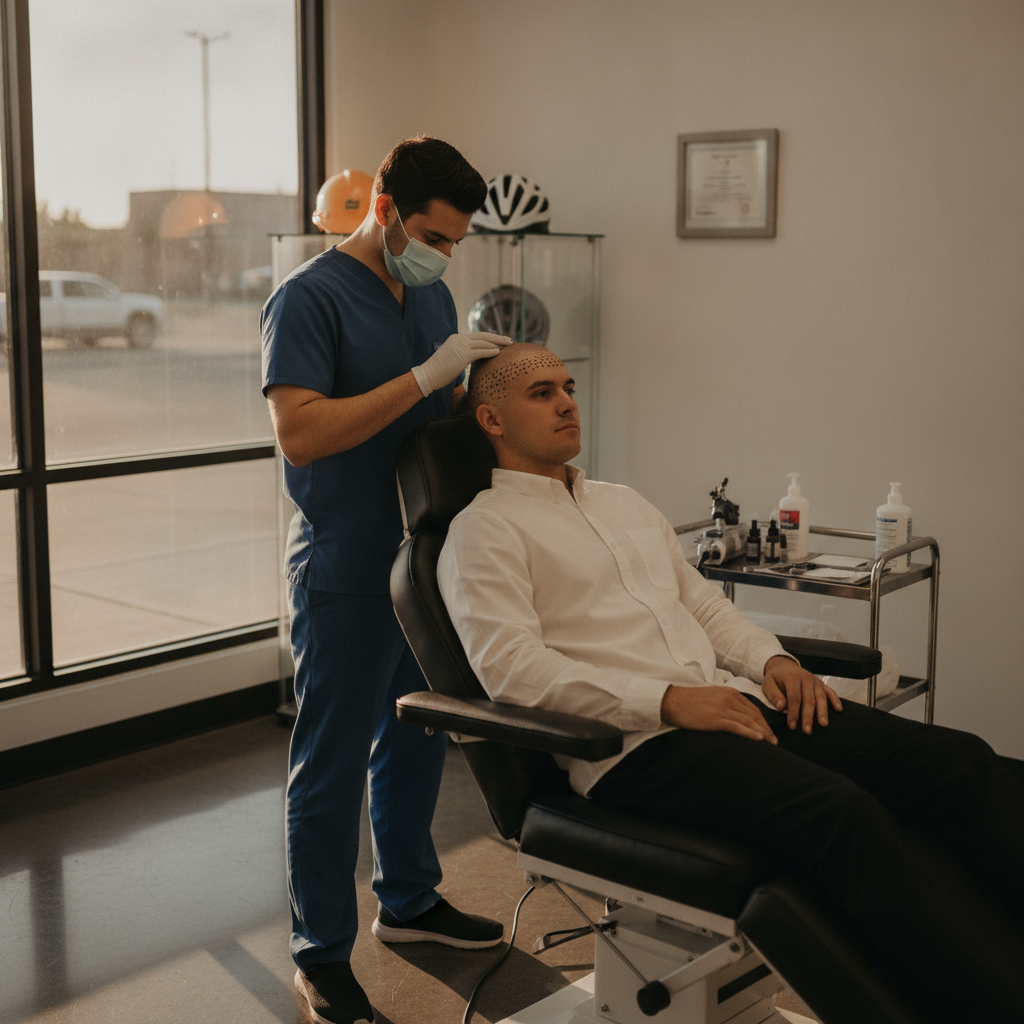
Scalp micropigmentation involves depositing specialized pigment into the upper layers of the dermis using precise, hair-follicle-replicating dots. After each session, your scalp behaves similarly to how it would after any controlled skin procedure — there is a period of sensitivity, minor redness, and surface healing that typically lasts about four to seven days. During that window, the pigment is still settling, the skin is still closing around each dot, and anything that causes sustained friction, pressure, heat buildup, or sweat accumulation can disrupt that process.
That is why the standard guidance is to avoid wearing a helmet or hard hat for at least four to five days after each SMP session. If you absolutely cannot avoid it — for example, if a safety requirement means you legally must wear a hard hat on a job site — this is a conversation to have openly during your consultation. Most artists, including those at Infusion SMP, can help you structure your session schedule around your work commitments rather than against them.
Once Healed, SMP Is Surprisingly Durable Under Headgear
Here is what often surprises people: after the healing period, SMP holds up well under the kinds of conditions that working men and athletes deal with every day. The pigment sits at a depth in the skin where normal surface contact — a hard hat lining, a bicycle helmet foam pad, a motorcycle helmet interior — does not dislodge it. Day-to-day friction and movement at that level of the skin is not deep enough to pull pigment out once it has properly set.
What does affect long-term retention, particularly in the Central Valley, is cumulative UV exposure and the heat that builds up under tight-fitting headgear during a San Joaquin Valley summer. When your scalp is consistently running hot under a hard hat on a 105-degree day in Manteca, the sweat and temperature increase the rate at which your skin naturally exfoliates over months and years. This is a gradual process — not something you will notice week to week — but it is part of why most SMP clients schedule a maintenance touch-up every few years to keep their results looking fresh.
Practical Tips for Workers Who Cannot Take Time Off
One of the most common concerns we hear from guys in the trades — construction workers, agricultural workers, logistics and warehouse staff around the Port of Stockton area, and others whose work is physical and uninterrupted — is that they cannot afford to take a week off between SMP sessions. The good news is that you do not need to take a week off. You just need to be strategic about scheduling.
- Schedule sessions for a Thursday or Friday if possible. This gives you the weekend to heal without wearing your hard hat, and by Monday you are typically past the most sensitive window.
- Talk to your supervisor in advance if you have any flexibility in your PPE schedule. Some workers in light-duty site roles can wear a skull cap or soft cap for the first few days as an alternative — check with your job’s safety requirements first.
- Keep your scalp clean and dry during the healing window. If you are working in a hot environment and sweating heavily, gently pat (never rub) the scalp dry if needed. Do not pick, scratch, or peel anything that forms on the surface.
- Apply a light moisturizer as directed by your artist. The dry Central Valley air — especially in summer — can pull moisture from the scalp faster than in coastal climates, which can affect how smoothly the surface heals.
Your artist will walk you through exactly what to do during the days between sessions. The structure is typically two to three sessions spaced several weeks apart, which gives your scalp time to fully settle before the next layer is added. Each session builds on the last, so by your final appointment, results look progressively more natural and complete.
What About Athletes and Weekend Sports?
If you are an athlete — a cyclist in Lodi, a motorcyclist commuting across the Altamont Pass, a football or baseball player in a Modesto rec league — the same healing-phase rules apply. Avoid your helmet for the first four to five days after each session. After that, you are generally free to return to your normal routine.
High-sweat activities like long rides or contact sports are worth mentioning to your artist upfront. Heavy sweat alone does not damage healed SMP, but it can affect how the scalp feels during the healing window. Some athletes prefer to schedule sessions at the end of a season or during a natural break in their training calendar, which removes any temptation to rush back to full activity too soon.
If you wear a helmet daily for a commute — motorcycle riders in particular — sun protection becomes important at the base of the neck and ears where the helmet does not cover. Sunscreen on exposed scalp areas is one of the simplest ways to protect your pigment retention over the years.
Why This Matters More in the Central Valley Than in Coastal Cities
If you have looked at SMP content from studios based in San Francisco or Los Angeles, their aftercare advice is written for a coastal climate. The Central Valley is a different environment entirely. Stockton summers regularly hit triple digits, job sites are exposed and dry, and the combination of intense UV radiation and physical labor creates conditions that are harder on skin than what most SMP content accounts for.
That is not a reason to avoid SMP — it is a reason to work with someone who understands these conditions. An artist familiar with the local climate will calibrate pigment depth and shade selection with long-term retention in mind, and will give you aftercare guidance that actually applies to your life rather than a generic checklist. Infusion SMP is based right here in Stockton and works with clients from across the Central Valley, including people in physically demanding jobs who needed practical answers, not idealized advice.
Frequently Asked Questions
How long after SMP can I wear my hard hat again?
Most artists recommend waiting at least four to five days after each session before putting on a hard hat or any tight-fitting headgear. If your job has mandatory PPE requirements, mention this during your consultation so your artist can help you plan your session schedule accordingly.
Will sweating under a helmet damage my SMP once it has healed?
Once your SMP has fully settled — typically ten to fourteen days after each session — normal sweat from wearing a helmet or working in heat will not damage the pigment. The concern is specifically during the initial healing window after each session.
Does SMP fade faster for people who work outdoors in the Central Valley?
Cumulative sun exposure and heat over time can gradually accelerate natural fading compared to someone who works indoors. Most outdoor workers in Stockton, Manteca, Tracy, and surrounding areas can expect to schedule a refresh touch-up every three to five years. Using SPF on any exposed scalp area when you are not wearing a hard hat helps slow that process significantly.
Can I schedule my SMP sessions around a physically demanding work schedule?
Absolutely. Most clients do exactly this. A Thursday or Friday session gives you the weekend as your recovery buffer before returning to a hard hat or helmet on Monday. Your artist will work with your schedule — this is one of the advantages of choosing a local studio over a national franchise that runs you through a fixed appointment structure.
Is SMP a good option for men in trades or agriculture who want a low-maintenance hair loss solution?
SMP is one of the best fits for physically active, low-downtime lifestyles. Once healed, there is no daily maintenance, no products, and nothing to adjust before putting on your hard hat. It is a permanent solution that works with your life rather than requiring you to rearrange it every day.
Ready to Find Out If SMP Works for Your Lifestyle?
If you have been putting off looking into SMP because you were not sure how it would fit around your job, your helmet, or your training schedule, you now have enough to know it is worth a real conversation. Infusion SMP Scalp Micropigmentation is based in Stockton and serves clients across San Joaquin County, Stanislaus County, and the broader Central Valley. A free consultation costs you nothing and gives you specific answers based on your actual scalp, your job, and your goals — not a generic FAQ. Reach out today to schedule your free consultation and start with a plan that actually fits your life.