
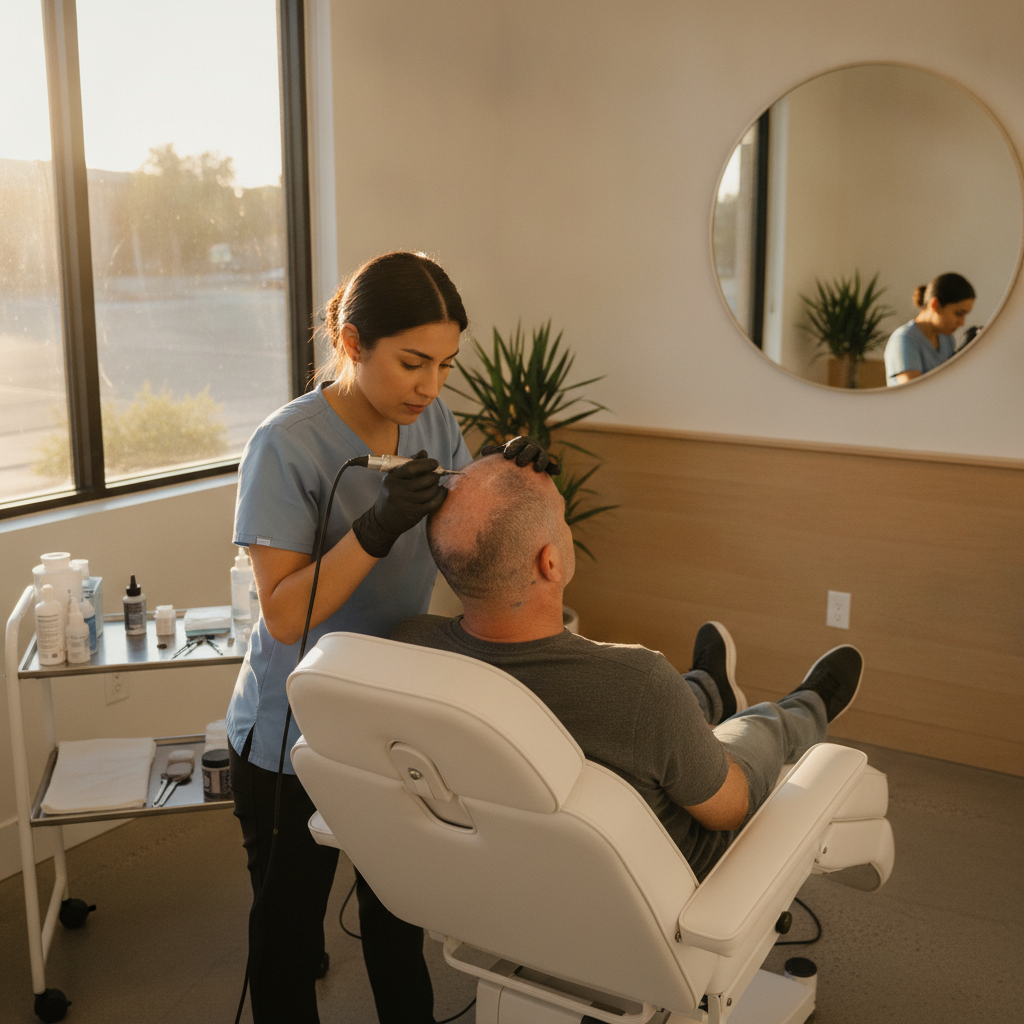
Can SMP Fix a Bad Hairline? What Roseville and Stockton Clients Should Know About Corrective Work
Yes — scalp micropigmentation can correct a bad hairline in most cases, and it’s one of the most requested yet least talked-about uses of SMP. Whether your existing hairline came from a previous SMP session that didn’t age well, a hair transplant that left pluggy or uneven results, or simply a design that never suited your face to begin with, corrective SMP is a real option. For clients in Stockton, Roseville, and across the Central Valley who feel stuck with a hairline they regret, this article breaks down exactly what that correction process looks like — and what you need to know before you book.
Why People End Up Needing Hairline Correction in the First Place
Most clients who come in asking about corrective work fall into one of three groups. The first is people who had SMP done somewhere else — often a cheaper studio, a practitioner still early in their career, or a national franchise clinic where they felt like a number — and the result looks artificial. Maybe the dots are too large, the hairline is too straight and sharp, the pigment has turned blue or green over time, or the placement doesn’t actually match their natural hair pattern. The second group had a hair transplant years ago and the hairline was placed in a position that looked fine at twenty-five but reads as obviously cosmetic now. The third group simply didn’t feel heard during their original consultation — they said they wanted something subtle and got something dramatic instead.
All of these are fixable. But the fix is not always simple, and the approach matters enormously.
What Makes a Hairline Look Unnatural — and How SMP Addresses It
A hairline that reads as fake usually has one or more of these problems: it sits too low on the forehead, it runs in a perfectly straight line with no micro-irregularity, the pigment color is mismatched to the surrounding scalp and stubble, or the dots are too large and uniform. Any one of those can break the illusion.
Corrective SMP works by layering new, correctly sized and shaded pigment dots around and sometimes over the problematic area to soften harsh edges, rebuild a more organic shape, and better match the surrounding scalp tone. In many cases, an experienced artist can work with what’s already there — strategically blending the old work into something that finally looks intentional rather than applied. Learn more about how SMP works at Infusion SMP.
What corrective work cannot always do is fully erase previous pigment. Significant color migration, deep dot saturation, or pigment that has shifted dramatically in tone may require fading treatments — typically laser or saline lightening — before new SMP can be placed cleanly. This is worth discussing upfront in any consultation, because an honest artist will tell you what’s achievable rather than just taking your money and layering more ink over a problem.
The Hairline Design Conversation Most Studios Skip
Here’s where a lot of studios — including several well-known Sacramento-area clinics — fall short: they have a template approach to hairline design. They show you two or three options, pick one that seems close to right, and move on. What they rarely do is spend serious time discussing how your hairline should evolve as you age, how your specific face shape affects where the hairline should sit, and what happens if you continue to lose hair behind the line they’ve drawn.
A good corrective consultation does all of this. It looks at your current facial structure, your age, your natural hair texture and color, and any remaining hair growth to determine where a new hairline makes sense — not just today, but five or ten years from now. For clients in their thirties dealing with an over-lowered hairline from a transplant they had in their twenties, this long-term thinking is especially important.
This is one of the clearest content gaps across competitor sites in this region: very few of them address what a thoughtful hairline design process actually looks like, or what questions a client should be asking before any needle touches their scalp.
What to Expect During Corrective SMP Sessions
Corrective work typically follows the same general session structure as standard SMP — usually two to three appointments spaced a few weeks apart — but the first session tends to be more analytical and conservative. An experienced artist will often start lighter than you might expect, building the correction gradually rather than committing to heavy pigment in one pass. That patience is actually a good sign.
Healing between sessions in the Central Valley summers requires the same care as any SMP work: keep the scalp moisturized, stay out of direct sun, and don’t rush the process. The dry heat across San Joaquin County and the surrounding area can affect how quickly the scalp heals, so your artist should be factoring that into their timeline recommendations. If anyone promises dramatic results in a single session without even asking about your existing work or skin type, that’s a red flag.
How Corrective SMP Differs from a Simple Touch-Up
A touch-up refreshes faded pigment and maintains a result you’re happy with. Corrective SMP starts from a place of dissatisfaction — something about the existing work isn’t right — and the goal is to meaningfully change the outcome, not just darken what’s there. That distinction matters because corrective work is usually more complex, takes more sessions, and requires a higher level of technical skill than maintenance work. It also requires an artist who is comfortable being honest with you about what’s realistic, rather than overpromising to get you in the chair.
For clients coming from Roseville, Tracy, or even Sacramento who have already had work done elsewhere and are frustrated with the result, it’s worth making the drive to a studio where the artist will actually look at your scalp, ask the right questions, and give you a straight answer about what correction will take. Reach out to Infusion SMP for a free consultation — there’s no obligation, and an honest assessment is the first step toward a result you’ll actually feel good about.
Frequently Asked Questions About Corrective SMP Near Stockton
Can SMP fix a hairline that was placed too low?
In most cases, yes — but it depends on how far forward the line sits and how saturated the pigment is. An artist can use strategic placement of new dots to visually raise and soften the line. In more extreme cases, fading the forward edge first will produce a cleaner result.
My old SMP has turned blue or green. Can that be corrected?
Color shift is usually caused by pigment that wasn’t formulated for scalp work or wasn’t applied correctly. Corrective SMP can help blend and neutralize the tone, but significant color migration often benefits from lightening treatments before new pigment is added. A consultation will tell you which route makes sense for your specific situation.
How long does it take to correct bad SMP from another studio?
Most corrective cases involve two to four sessions, spaced three to four weeks apart. If fading or lightening is needed first, the overall timeline may extend to several months. Rushing the process tends to produce worse results, so plan for patience.
Is corrective SMP more expensive than starting fresh?
It can be, depending on the complexity of the correction. The scope, number of sessions needed, and whether any pre-treatment is required all affect cost. That said, it’s almost always less expensive — financially and emotionally — than living with a result you dislike indefinitely.
I had a hair transplant and the hairline looks uneven. Can SMP help blend it?
Yes. SMP is actually one of the most effective tools for improving the appearance of transplant hairlines — filling in sparse areas, softening pluggy rows, and creating the look of consistent density. See how SMP is used for transplant-related corrections here.
You Don’t Have to Keep a Hairline You Regret
If you’re in Stockton, Modesto, Roseville, or anywhere across the Central Valley and you’re living with a hairline that doesn’t look like you — whether it came from a previous SMP session, an aging transplant, or a consultation where no one really listened — corrective work is worth exploring. The right artist won’t pressure you into a decision. They’ll look at what you have, tell you honestly what’s possible, and build a plan that actually makes sense for your face and your life.
At Infusion SMP Scalp Micropigmentation in Stockton, we see corrective cases regularly, and we believe every client deserves a result they feel genuinely confident about — not just one they’ve learned to live with. Book your free consultation today and let’s talk about what’s possible for you.